• Fri frakt över 249 kr
  • •
  • Snabba leveranser
  • •
  • Billiga böcker
Kundservice

Du är på sajten för privatpersoner.

Företag, bibliotek eller offentlig verksamhet?

Du handlar på classic.bokus.com, där alla dina funktioner finns intakta.
Till classic.bokus.com
Bokus logotyp. Gå till startsidan.
  • Erbjudanden
  • Nyheter
  • Student
  • Topplistor
  • Barn & ungdom
  • Bokus Play
  • E-böcker
  • Pocketböcker
  • Spel & pussel

10% rabatt på allt med kod NYSTART10 →

Sidfot

Mina sidor

    Hjälp

    • Kundservice
    • Vanliga frågor och svar
    • Frakt och leverans
    • Retur vid ångerrätt
    • Reklamera vara
    • Betalning
    • Köpvillkor
    • Allmänna villkor
    • Information om webbplatsens tillgänglighet

    Om Bokus

    • Om oss
    • Pressrum
    • För studenter
    • För företag
    • För bibliotek och offentlig verksamhet
    • För leverantörer
    • Hållbarhet

    Populärt

    • Aktuella erbjudanden
    • Presentkort
    • Studentlitteratur
    • Nya böcker
    • Topplistor
    • Signerade böcker
    • Engelska böcker

    Inspiration

    • Boktips
    • BookTok
    • Populära bokserier
    • Barnbokskaraktärer
    • Populära författare
    Logotyp för Bokus
    Följ oss på Facebook (extern länk)Följ oss på Instagram (extern länk)Följ oss på YouTube (extern länk)Följ oss på TikTok (extern länk)
    bokus @ CookiesAnpassa cookiesIntegritetspolicyKöpvillkor
    Till Citymail hemsida (extern länk)Till Budbee hemsida (extern länk)Till Postnord hemsida (extern länk)Till Schenker hemsida (extern länk)Till Early Bird hemsida (extern länk)Till Walleys hemsida (extern länk)
    1. Samhälle och politik
    2. Sociologi och antropologi
    3. Sociologi

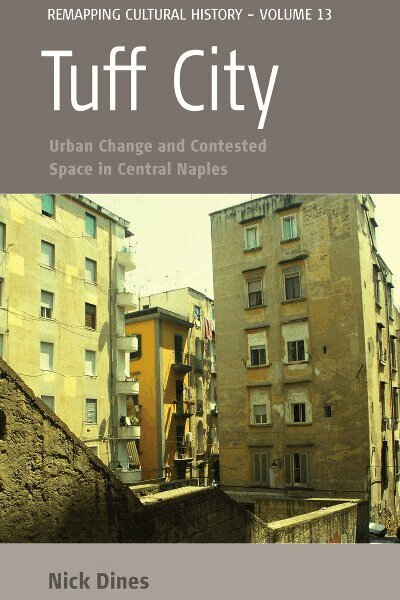
    Tuff City

    Urban Change and Contested Space in Central Naples

    AvNick Dines

    Häftad, Engelska, 2015

    Del i serien Remapping Cultural History

    582 kr

    Beställningsvara. Skickas inom 5-8 vardagar. Fri frakt över 249 kr.

    Fler format och utgåvor

    Inbunden

    2 056 kr

    E-bok

    363 kr

    Beskrivning

    During the 1990s, Naples’ left-wing administration sought to tackle the city’s infamous reputation of being poor, crime-ridden, chaotic and dirty by reclaiming the city’s cultural and architectural heritage. This book examines the conflicts surrounding the reimaging and reordering of the city’s historic centre through detailed case studies of two piazzas and a centro sociale, focusing on a series of issues that include heritage, decorum, security, pedestrianization, tourism, immigration and new forms of urban protest. This monograph is the first in-depth study of the complex transformations of one of Europe’s most fascinating and misunderstood cities. It represents a new critical approach to the questions of public space, citizenship and urban regeneration as well as a broader methodological critique of how we write about contemporary cities.

    Produktinformation

    • Utgivningsdatum:2015-03-01
    • Mått:152 x 229 x 20 mm
    • Vikt:490 g
    • Format:Häftad
    • Språk:Engelska
    • Serie:Remapping Cultural History
    • Antal sidor:364
    • Förlag:Berghahn Books
    • ISBN:9781782389118

    Utforska kategorier

    • Sociologi inom Samhälle och politik
    • Sociala grupper och identitet inom Samhälle och politik

    Mer om författaren

    Nick Dines lived and worked in Naples for seven years. He is research fellow in Sociology at Middlesex University, London.

    Recensioner i media

    “Nick Dines draws on over a decade of intensive interdisciplinary research—history, politics, cultural studies, social geography, and anthropology— …[and] does a fine job of weaving together the competing narratives to offer a penetrating analysis of the contestation over public space embedded in discourses about civility and citizenship. He…also addresses global questions about citizenship, urban renewal, the inequality of zoning, and the securitization of public space. As such, this book could serve as a model for the analysis, critique, and comparison of other urban renewal projects in cities around the global north because Dines methodically and subtlely makes the local speak to global questions.”  ·  American Anthropologist“…this book offers a necessary contribution to the field: a recent take on a Mediterranean city that many people might rashly presume to know by reputation alone. Naples, the shameful, uncontrollable and uncontrolled metropolis is certainly prime fodder for anthropological study. At the same time, and helpfully for urban anthropologists, Dines seeks to dismiss Naples’ exceptionalism, presenting it instead as an ‘ordinary city’.”  ·  OAC Press“Recognising Naples’ uniqueness, Dines supplies theoretical and analytical tools for understanding urban regeneration…, thus fostering the kind of case study-focused ethnographic research that meets the urgent need to think across different urban experiences. Each case study presented in the book invites reflection upon the implications of political discourses about public space, as well as upon the rhetoric of participation and inclusiveness. Collectively, the case studies show the importance of considering different social groups’ divergent ideas and uses of space when studying spatial conflict. Complexity thus becomes an element to be valued and acknowledged in the urban project—in Naples and in contemporary cities elsewhere.”  ·  Society and Space“Naples must be one of the ethnographically most researched cities in the world. In this multi-method study of three areas of urban regeneration, however, Nick Dines breaks new ground by cross-cutting traditional  methodological  divisions to produce an intensely detailed and conceptually original analysis of a recent phase in Neapolitan history… By combining ethnographic observation over many years with both interviews and surveys, Dines breaks with narrow disciplinary habits, and contextualizes, historically as well as culturally, key events and movements that have shaped the city’s present-day configuration.”  ·  Qualitative Research“This is a perceptive book and worthwhile read for the true urbanist. It effectively demonstrates, and even showcases, the value of ethnography as a methodology, and any reader would be appreciative of the pointed detail of the archival research. The lessons it offers from Naples on the politics of public space will be of value to anyone studying the contemporary city.”  ·  The AAG Review of Books“Nick Dines’ painstaking study is a fitting and welcome contribution. Drawing on meticulous and extensive fieldwork conducted during the period of urban renewal dubbed the ‘Neapolitan Renaissance’, the book provides an extremely innovative perspective on Naples compared to the mainstream literature…From the outset, the study acts as a powerful tool of deconstruction of the discourses that have framed the city in the contemporary era. Atavistic backwardness, violent plebeianism, irresolvable passivity, unstoppable passion and an irreparable lack of civicness have been accorded varying levels of significance over the course of time but nonetheless remain a permanent feature of all narratives about Naples.”  ·  Il Manifesto“…a well-written, lively and stimulating study… Current public debates on the so-called Neapolitan Renaissance of the 1990s have often been reduced to the simplistic refrain that ‘it was all a question of image’. Tuff Cityinstead returns to the city’s recent past to critically engage with the myriad changes that took place, including shifts in public discourse.”  ·  Il Matino“This is an important book. In a whole series of ways this study of contemporary Naples will set a bench-mark for urban studies and the way urban history is carried out. It is a book about Naples and thus about the particularities and peculiarities of that specific city. However, this is also a book which goes way beyond Naples itself. It has a lot to tell us about the way the city can and should be studied – about urban studies methodologies – and in this area it is highly original and in some ways sets a new agenda for other researchers, historians, anthropologists, ethnologists, and those using cultural studies approaches.”  ·  John Foot, University College London“This is one of the best books I have read: beautifully written and extremely well researched (a refreshing mix of archival research and participant observation) and superbly theorized, with an impressive knowledge of the range of urban theory, as well as meticulous historical contextualization.”  ·  Jo Labanyi, New York University“…[A]n interesting and readable text. It is scholarly, ambitious in scope and well written.”  ·  Victoria Goddard, Goldsmiths, University of London

    Innehållsförteckning

    • List of IllustrationsList of MapsList of AbbreviationsPrefaceIntroductionPART I: URBAN CHANGE IN AN ORDINARY CITY: NAPLES DURING THE 1990sChapter 1. The Centro Storico: History of a Concept and PlaceChapter 2. Between the General and the Particular: A Neapolitan Version of 'Urban Regeneration'Chapter 3. The Left, the Politics of Citizenship and Shifting Ideas about NaplesChapter 4. Public Space and Urban ChangePART II: THE MAKING OF A REGENERATION SYMBOL: HERITAGE, DECORUM AND THE INCURSIONS OF THE EVERYDAY IN PIAZZA PLEBISCITOChapter 5. Enter the Historic PiazzaChapter 6. From Royal Courtyard to Car ParkChapter 7. The Regeneration of Piazza PlebiscitoChapter 8. Sous les Pavés, la Place! An Ethnography of the New Piazza PlebiscitoChapter 9. Exit Piazza Plebiscito: Rethinking 'Civic' SpacePART III: DEPROVINCIALISING URBAN REGENERATION: PIAZZA GARIBALDI AND IMMIGRATION DURING THE BASSOLINO ERAChapter 10. Enter the Station PiazzaChapter 11. Antechamber to the Southern Italian Capital (1860-1994Chapter 12. Piazza Garibaldi as an Unregenerate Space (1994-2001)Chapter 13. Mapping Immigrant Experiences in and of Piazza GaribaldiChapter 14. Exit Piazza Garibaldi: (Re)connecting Immigration and Urban RenewalPART IV: AN ALTERNATIVE IDEA OF PUBLIC SPACE: THE CENTRO SOCIALE IN MONTESANTOChapter 15. Enter a Neighbourhood ParkChapter 16. The Popular Neighbourhoods in the Twentieth CenturyChapter 17. Diego Armando Maradona Montesanto (DAMM): Collective Action over Public Space in MontesantoChapter 18. Exit DAMM: The Constitutive Role of Collective Action upon Public SpaceConclusion: Rethinking Urban Change in Late Twentieth-Century NaplesGlossary of Italian TermsBibliographyIndex