• Fri frakt över 249 kr
  • •
  • Snabba leveranser
  • •
  • Billiga böcker
Kundservice

Du är på sajten för privatpersoner.

Företag, bibliotek eller offentlig verksamhet?

Du handlar på classic.bokus.com, där alla dina funktioner finns intakta.
Till classic.bokus.com
Bokus logotyp. Gå till startsidan.
  • Erbjudanden
  • Nyheter
  • Student
  • Topplistor
  • Barn & ungdom
  • Bokus Play
  • E-böcker
  • Pocketböcker
  • Spel & pussel

10% rabatt på allt med kod NYSTART10 →

Sidfot

Mina sidor

    Hjälp

    • Kundservice
    • Vanliga frågor och svar
    • Frakt och leverans
    • Retur vid ångerrätt
    • Reklamera vara
    • Betalning
    • Köpvillkor
    • Allmänna villkor
    • Information om webbplatsens tillgänglighet

    Om Bokus

    • Om oss
    • Pressrum
    • För studenter
    • För företag
    • För bibliotek och offentlig verksamhet
    • För leverantörer
    • Hållbarhet

    Populärt

    • Aktuella erbjudanden
    • Presentkort
    • Studentlitteratur
    • Nya böcker
    • Topplistor
    • Signerade böcker
    • Engelska böcker

    Inspiration

    • Boktips
    • BookTok
    • Populära bokserier
    • Barnbokskaraktärer
    • Populära författare
    Logotyp för Bokus
    Följ oss på Facebook (extern länk)Följ oss på Instagram (extern länk)Följ oss på YouTube (extern länk)Följ oss på TikTok (extern länk)
    bokus @ CookiesAnpassa cookiesIntegritetspolicyKöpvillkor
    Till Citymail hemsida (extern länk)Till Budbee hemsida (extern länk)Till Postnord hemsida (extern länk)Till Schenker hemsida (extern länk)Till Early Bird hemsida (extern länk)Till Walleys hemsida (extern länk)
    1. Naturvetenskap och teknik
    2. Teknik och industri
    3. Tillverkningsteknik

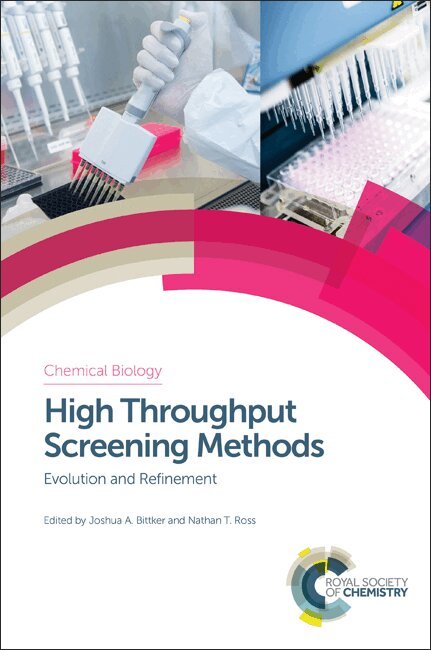
    High Throughput Screening Methods

    Evolution and Refinement

    AvJoshua A Bittker,Nathan T Ross

    Inbunden, Engelska, 2016

    Del i serien Chemical Biology

    2 620 kr

    Skickas . Fri frakt över 249 kr.

    Beskrivning

    High throughput screening remains a key part of early stage drug and tool compound discovery, and methods and technologies have seen many fundamental improvements and innovations over the past 20 years. This comprehensive book provides a historical survey of the field up to the current state-of-the-art. In addition to the specific methods, this book also considers cultural and organizational questions that represent opportunities for future success.Following thought-provoking foreword and introduction from Professor Stuart Schreiber and the editors, chapters from leading experts across academia and industry cover initial considerations for screening, methods appropriate for different goals in small molecule discovery, newer technologies that provide alternative approaches to traditional miniaturization procedures, and practical aspects such as cost and resourcing. Within the context of their historical development, authors explain common pitfalls and their solutions.This book will serve as both a practical reference and a thoughtful guide to the philosophy underlying technological change in such a fast-moving area for postgraduates and researchers in academia and industry, particularly in the areas of chemical biology, pharmacology, structural biology and assay development.

    Produktinformation

    • Utgivningsdatum:2016-12-08
    • Mått:156 x 234 x 26 mm
    • Vikt:775 g
    • Format:Inbunden
    • Språk:Engelska
    • Serie:Chemical Biology
    • Antal sidor:396
    • Förlag:Royal Society of Chemistry
    • ISBN:9781782624714

    Utforska kategorier

    • Tillverkningsteknik inom Naturvetenskap och teknik

    Innehållsförteckning

    • Perspective/overview: State of the art in HTS at the academic-industry interface;Assay design and optimization;Assessment of available compound collections;Novel approaches to discovery and analysis of interesting compound combinations;Modern biophysical methods in target-based screening;Genetic perturbation methods;Understanding luminescence-based screens;Measuring interactions in live cells;Approaches to high-content imaging and multi-feature analysis;Profiling of genetically characterized cell systems;Multidimensional profile-based screening;Using biological systems that better recapitulate physiology;Phenotypic screens with model organisms;Encoded libraries;Modern virtual screening;Research data management;Small molecule bioactivity databases;Chemical biology in a pharma environment;Practical aspects of funding and executing high-throughput screens;