• Fri frakt över 249 kr
  • •
  • Snabba leveranser
  • •
  • Billiga böcker
Kundservice

Du är på sajten för privatpersoner.

Företag, bibliotek eller offentlig verksamhet?

Du handlar på classic.bokus.com, där alla dina funktioner finns intakta.
Till classic.bokus.com
Bokus logotyp. Gå till startsidan.
  • Erbjudanden
  • Nyheter
  • Student
  • Topplistor
  • Barn & ungdom
  • Bokus Play
  • E-böcker
  • Pocketböcker
  • Spel & pussel

10% rabatt på allt med kod: NYSTART10 →

Sidfot

Mina sidor

    Hjälp

    • Kundservice
    • Vanliga frågor och svar
    • Frakt och leverans
    • Retur vid ångerrätt
    • Reklamera vara
    • Betalning
    • Köpvillkor
    • Allmänna villkor
    • Information om webbplatsens tillgänglighet

    Om Bokus

    • Om oss
    • Pressrum
    • För studenter
    • För företag
    • För bibliotek och offentlig verksamhet
    • För leverantörer
    • Hållbarhet

    Populärt

    • Aktuella erbjudanden
    • Presentkort
    • Studentlitteratur
    • Nya böcker
    • Topplistor
    • Signerade böcker
    • Engelska böcker

    Inspiration

    • Boktips
    • BookTok
    • Populära bokserier
    • Barnbokskaraktärer
    • Populära författare
    Logotyp för Bokus
    Följ oss på Facebook (extern länk)Följ oss på Instagram (extern länk)Följ oss på YouTube (extern länk)Följ oss på TikTok (extern länk)
    bokus @ CookiesAnpassa cookiesIntegritetspolicyKöpvillkor
    Till Citymail hemsida (extern länk)Till Budbee hemsida (extern länk)Till Postnord hemsida (extern länk)Till Schenker hemsida (extern länk)Till Early Bird hemsida (extern länk)Till Walleys hemsida (extern länk)
    1. Samhälle och politik
    2. Samhälle och kultur
    3. Kultur och medier
    4. Referensverk och tvärvetenskap

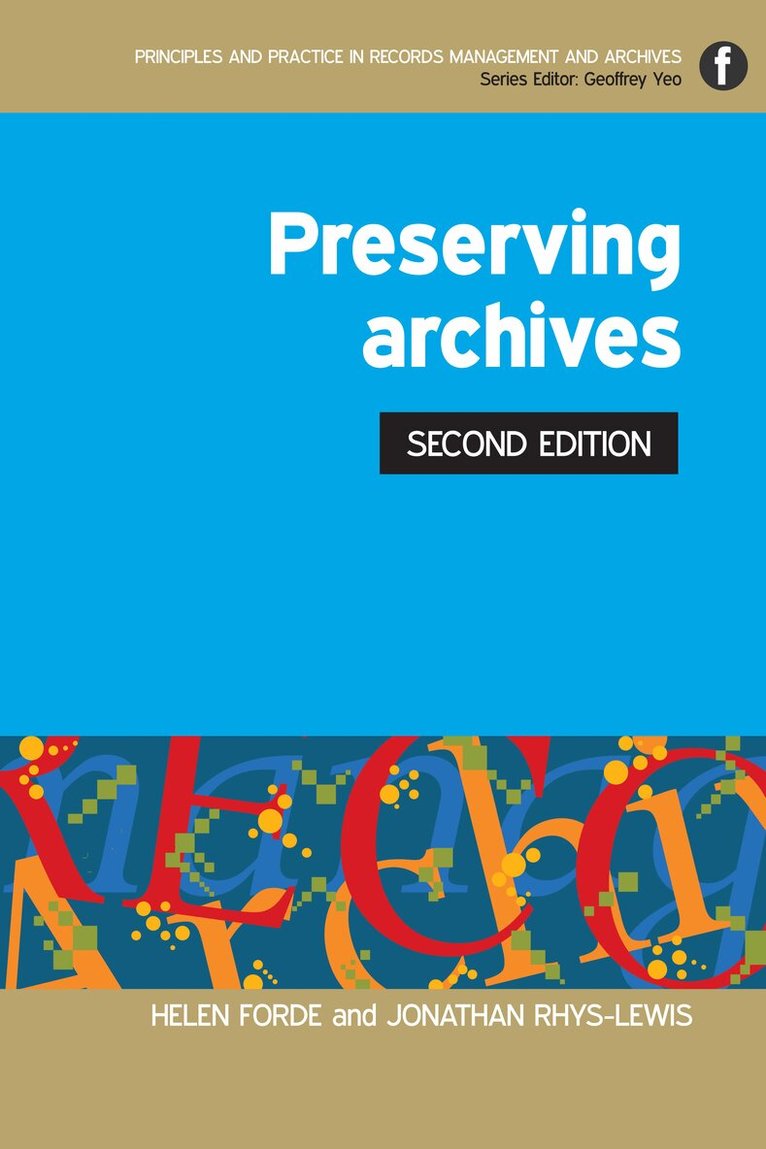
    Preserving Archives

    AvHelen Forde,Jonathan Rhys-Lewis

    Inbunden, Engelska, 2017

    Del i serien Principles and Practice in Records Management and Archives

    2 593 kr

    Beställningsvara. Skickas inom 11-20 vardagar. Fri frakt över 249 kr.

    Fler format och utgåvor

    Häftad

    1 303 kr

    Beskrivning

    A brand new and fully updated edition of this seminal work on archival preservation. Access to archival material – the documentary heritage of people all over the world that gives them their identity and ensures their rights – is dependent on the survival of fragile materials: paper, parchment, photographic materials, audiovisual materials and, most recently, magnetic, optical and increasingly digital formats. The primary importance of such survival is widely acknowledged but sometimes overlooked in a rush to provide ever better means of access. But without the basic material, no services can be offered. Preservation is at the heart of archival activity. Archivists in all types of organizations face questions on how to plan a preservation strategy in less than perfect circumstances, or deal with a sudden emergency. This book considers the causes of threats to the basic material, outlines the preservation options available and offers flexible solutions applicable in a variety of situations. It offers a wide range of case studies and examples from international specialists. This revised edition includes additional material on digital preservation and green building as well as a new chapter on the management and training of volunteers, reflecting a key concern for many archival institutions. Key topics are: • Understanding archival materials and their characteristics • Managing digital preservation • Archive buildings and their characteristics • Safeguarding the building and its contents • Managing archival storage • Managing risks and avoiding disaster • Creating and using surrogates • Exhibiting archives • Handling the records • Managing a pest control programme • Training and the use of volunteers • Putting preservation into practice. Readership: Archivists, librarians, curators and enthusiasts, trained and untrained, in museums, local studies centres and voluntary societies in need of good clear advice.

    Produktinformation

    • Utgivningsdatum:2017-09-29
    • Mått:164 x 237 x 21 mm
    • Vikt:256 g
    • Format:Inbunden
    • Språk:Engelska
    • Serie:Principles and Practice in Records Management and Archives
    • Antal sidor:288
    • Upplaga:2
    • Förlag:Facet Publishing
    • ISBN:9781783303199

    Utforska kategorier

    • Referensverk och tvärvetenskap inom Samhälle och politik

    Mer om författaren

    Helen Forde is a professional archivist who has worked in local authority, private and national archives. Until 2001 she was Head of Preservation Services at the UK national Archives, where she had previously been in charge of both the library and the Museum. She has taught preservation management and worked as an independent consultant on archives. Jonathan Rhys-Lewis is preservation and collections management consultant with over 25 years experience within local government and as an independent consultant. He trains, lectures and publishes on preservation and preservation management.

    Recensioner i media

    …a welcome update…The vast practical experience of the two authors clearly enriches the text. Archivists and librarians will find it a great tool to turn to for high level preservation advice, and for students it will provide a good broad overview of the varied issues facing collections.

    Innehållsförteckning

    • Introduction to the series - Geoffrey Yeo1. Introducing archive preservationIntroductionHow has the relationship between conservation and preservation developed?DefinitionsSummaryNotes2. Understanding archival materials and their characteristicsIntroduction Paper Parchment Inks: from carbon ink to laser printing Photographic materials Analogue audiovisual materials: wax cylinders, shellac and vinyl discs and filmOptical materials: CDs and DVDs Magnetic materials: tape, hard disks and floppy disksMinidiscs Portable digital storageSummaryNotes and references 3. Managing digital preservationIntroductionWhy is digital preservation management important? Why is digital preservation difficult? Costs of digital preservation What should be preserved? Who should be involved? What is the starting point? What happens next? Summary Notes and references 4. Archive buildings and their characteristicsIntroduction How has the concept of archive buildings developed? How did archive buildings develop in the UK? What other ideas have developed for archive buildings? What should be considered before building or adapting an existing building to house an archive?What needs to be explained? Location How should the architect be briefed? What are the problems with adapted buildings or historic buildings? Summary Notes and references 5. Safeguarding the building and its contents IntroductionSecurityFire prevention, detection and suppression Water detection Environmental issues Summary Notes and references 6. Managing archival storageIntroduction Why do environmental conditions matter? What needs to be controlled? Mould: why is it such a threat?Measuring and monitoring temperature and humidity Measuring and monitoring pollution levelsSpecial arrangementsHow can comparative costs be assessed?Shelving, racking and plan chest specificationsWhat kind of equipment is needed?Possible future developments SummaryNotes and references 7. Managing risks and avoiding disasterIntroduction Why undertake an ‘operation-hope-not’? DefinitionsWho is responsible for disaster planning? What should be saved first? Development of a disaster control plan: where to start?Prevention Preparation Reaction Recovery Evaluation SummaryNotes and references 8. Creating and using surrogatesIntroduction Copying archive materialWhat copying techniques are available? What problems arise?Developing a preservation copying policy: why do it?How can the copies themselves be preserved?Selecting correct copying methods Preparation of material Copying of material in-house Use of outside agencies Summary Notes and references 9. Moving the records Introduction What are the risks? Planning the project Briefing a suitable removal firm Minimum removal equipment specifications Preparing for the move The move itselfAnd afterwards... SummaryNotes and references10. Exhibiting archivesIntroduction How can the overall risk be minimized? Managing the care of documents in exhibitions Planning and preparing for an exhibition During the exhibition And afterwards...SummaryNotes and references 11. Handling the recordsIntroductionThe problemImproving the quality of care: how can it be achieved?Where and how can good practice be demonstrated to readers?How can staff be best trained?SummaryNotes12. Managing a pest control programmeIntroductionWhat are the common pests? What damage do pests do to archival materials?Where are they likely to be active? What are the signs of an infestation? How can they be prevented from getting into the collections? Why are previous eradication measures no longer used? Why is integrated pest management (IPM) now adopted as a strategy? How can IPM be introduced? Setting traps Dealing with an infestationOngoing management SummaryNotes and references 13. Training and the use of volunteers Introduction What options for preservation training are available?What areas of preservation should be covered? The use of volunteers What are the key challenges of using volunteers?Using volunteers for preservation activities The importance of documentation Volunteers and the interface with conservation Summary Notes and references 14. Putting preservation into practice Introduction Choices and options Who is responsible? What is a preservation policy? What about strategies? Costs, funding and optionsHow is a programme planned and put into action? And the results? Notes and references AppendicesThe National Archives Conditions for Loans policyA conservation workshopCompiling a Preservation Policy; an advisory templateUCL Library Services: Volunteer AgreementBenchmarking entries: MLABibliographyBritish and international standards relating to archive preservation