• Fri frakt över 249 kr
  • •
  • Snabba leveranser
  • •
  • Billiga böcker
Kundservice

Du är på sajten för privatpersoner.

Företag, bibliotek eller offentlig verksamhet?

Du handlar på classic.bokus.com, där alla dina funktioner finns intakta.
Till classic.bokus.com
Bokus logotyp. Gå till startsidan.
  • Erbjudanden
  • Nyheter
  • Student
  • Topplistor
  • Barn & ungdom
  • Bokus Play
  • E-böcker
  • Pocketböcker
  • Spel & pussel

10% rabatt på allt med kod: NYSTART10 →

Sidfot

Mina sidor

    Hjälp

    • Kundservice
    • Vanliga frågor och svar
    • Frakt och leverans
    • Retur vid ångerrätt
    • Reklamera vara
    • Betalning
    • Köpvillkor
    • Allmänna villkor
    • Information om webbplatsens tillgänglighet

    Om Bokus

    • Om oss
    • Pressrum
    • För studenter
    • För företag
    • För bibliotek och offentlig verksamhet
    • För leverantörer
    • Hållbarhet

    Populärt

    • Aktuella erbjudanden
    • Presentkort
    • Studentlitteratur
    • Nya böcker
    • Topplistor
    • Signerade böcker
    • Engelska böcker

    Inspiration

    • Boktips
    • BookTok
    • Populära bokserier
    • Barnbokskaraktärer
    • Populära författare
    Logotyp för Bokus
    Följ oss på Facebook (extern länk)Följ oss på Instagram (extern länk)Följ oss på YouTube (extern länk)Följ oss på TikTok (extern länk)
    bokus @ CookiesAnpassa cookiesIntegritetspolicyKöpvillkor
    Till Citymail hemsida (extern länk)Till Budbee hemsida (extern länk)Till Postnord hemsida (extern länk)Till Schenker hemsida (extern länk)Till Early Bird hemsida (extern länk)Till Walleys hemsida (extern länk)
    1. Ekonomi och Ledarskap
    2. Företagsekonomi
    3. E-handel

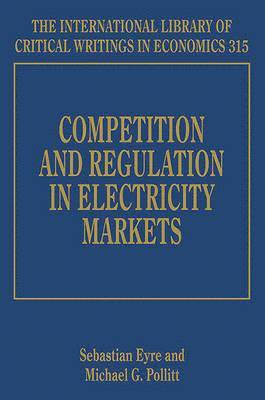
    Competition and Regulation in Electricity Markets

    AvSebastian Eyre,Michael G. Pollitt

    Inbunden, Engelska, 2016

    Del 315 i serien The International Library of Critical Writings in Economics series

    7 163 kr

    Beställningsvara. Skickas inom 5-8 vardagar. Fri frakt över 249 kr.

    Beskrivning

    This timely research review explores the main issues surrounding competition and regulation in electricity markets. The industry is experiencing irresistible forces for change driven by energy policy objectives; a reassessment of market regulation in the face of high energy prices and the response to consumer pressure to agree on what constitutes a fair price for energy. This research review identifies the key articles that underpin the debate across the industries supply chain (generation, supply and networks) and from a regulatory perspective (including market power and incentive regulation) followed by a consideration of the overall impact of liberalisation and future developments.

    Produktinformation

    • Utgivningsdatum:2016-04-29
    • Mått:169 x 244 x undefined mm
    • Format:Inbunden
    • Språk:Engelska
    • Serie:The International Library of Critical Writings in Economics series
    • Förlag:Edward Elgar Publishing Ltd
    • ISBN:9781783479771

    Utforska kategorier

    • E-handel inom Ekonomi och Ledarskap
    • Upphandlingsrätt inom Juridik
    • Energiindustri inom Ekonomi och Ledarskap

    Mer om författaren

    Edited by Sebastian Eyre, Visiting Fellow, Centre for Analysis of Risk and Regulation, London School of Economics and Michael G. Pollitt, Professor of Business Economics, Judge Business School, University of Cambridge, UK

    Innehållsförteckning

    • Contents:Introduction Sebastian Eyre and Michael G. PollittPART I CLASSICS AEconomics1. F.P. Ramsey (1927), ‘A Contribution to the Theory of Taxation’, Economic Journal, 37 (145), March, 47–612. Harold Hotelling (1938), ‘The General Welfare in Relation to Problems of Taxation and of Railway and Utility Rates’, Econometrica, 6 (3), July, 242–69 3. R.H. Montgomery (1939), ‘Government Ownership and Operation of the Electric Industry’, Annals of the American Academy of Political and Social Science, 201, January, 43–94. James C. Bonbright (1941), ‘Major Controversies as to the Criteria of Reasonable Public Utility Rates’, American Economic Review, 30 (5), February, 379–895. Nancy Ruggles (1949–1950), ‘Recent Developments in the Theory of Marginal Costs Pricing’, Review of Economic Studies, 17 (2), 107–266. M. Boiteux (1960), ‘Peak-Load Pricing’, Journal of Business, 33 (2), April, 157–79BRegulation7. Harvey Averch and Leland L. Johnson (1962), ‘Behavior of the Firm Under Regulatory Constraint’, American Economic Review, 52 (5), December, 1052–69 8. George G. Stigler and Claire Friedland (1962), ‘What Can Regulators Regulate? The Case of Electricity’, Journal of Law and Economics, 5, October, 1–169. George J. Stigler (1971), ‘The Theory of Economic Regulation’, Bell Journal of Economics and Management Science, 2 (1), Spring, 3–2110. Sam Peltzman (1976), ‘Toward a More General Theory of Regulation’, Journal of Law and Economics, 19 (2), August, 211–4011. Harold Demsetz (1968), ‘Why Regulate Utilities?’, Journal of Law and Economics, 11 (1), April, 55–6512. Leonard W. Weiss (1975), ‘Antitrust in the Electric Power Industry’, in Almarin Phillips (ed.), Promoting Competition in Regulated Markets, Chapter 5, Washington, DC: Brookings Institution Press, 135–7313. Andrei Shleifer (1985), ‘A Theory of Yardstick Competition’, RAND Journal of Economics, 16 (3), Autumn, 319–2714. Richard A. Posner (1971), ‘Taxation by Regulation’, Bell Journal of Economics and Management Science, 2 (1), Spring, 22–5015. William Stanley Jevons (1885), ‘The Coal Question in England’, Science, 5 (108), February, 175–6PART IIINCENTIVE REGULATION 16. William J. Baumol (1982), ‘Productivity Incentive Clauses and Rate Adjustment for Inflation’, Public Utilities Fortnightly, 110, July, 11–1817. Richard Schmalensee (1989), ‘Good Regulatory Regimes’, RAND Journal of Economics, 20 (3), Autumn, 417–3618. David E.M. Sappington and Dennis L. Weisman (1994), ‘Designing Superior Incentive Regulation: Modifying Plans to Preclude Recontracting and Promote Performance’, Public Utilities Fortnightly, 132 (5), March, 27–3219. Paul L. Joskow (2013), ‘Incentive Regulation in Theory and Practice: Electricity Distribution and Transmission Networks’, in Nancy L. Rose (ed.), Economic Regulation and Its Reform: What Have We Learned?, Chapter 5, Chicago, IL and London, UK: University of Chicago Press, 291–344PART IIICOMPETITION IN GENERATION 20.Paul L. Joskow (1997), ‘Restructuring, Competition and Regulatory Reform in the U.S. Electricity Sector’, Journal of Economic Perspectives, 11 (3), Summer, 119–3821. Peter Cramton and Steven Stoft (2005), ‘A Capacity Market that Makes Sense’, Electricity Journal, 18 (7), August/September, 43–5422. Eric S. Schubert, David Hurlbut, Parviz Adib and Shmuel Oren (2006), ‘The Texas Energy-Only Resource Adequacy Mechanism’, Electricity Journal, 19 (10), December, 39–4923. Richard Green and Nicholas Vasilakos (2010), ‘Market Behaviour with Large Amounts of Intermittent Generation’, Energy Policy, 38 (7), July, 3211–20PART IVMARKET POWER 24. David M. Newbery (1995), ‘Power Markets and Market Power’, Energy Journal, 16 (3), 39–6625. Severin Borenstein, James B. Bushnell and Frank A. Wolak (2002), ‘Measuring Market Inefficiencies in California’s Restructured Wholesale Electricity Market’, American Economic Review, 92 (5), December, 1376–40526. Richard Green (1999), ‘The Electricity Contract Market in England and Wales’, Journal of Industrial Economics, XLVII (1), March, 107–2427. Paul L. Joskow and Edward Kahn (2002), ‘A Quantitative Analysis of Pricing Behavior in California’s Wholesale Electricity Market During Summer 2000’, Energy Journal, 23 (4), 1–3528. Severin Borenstein (2002), ‘The Trouble with Electricity Markets: Understanding California’s Restructuring Disaster’, Journal of Economic Perspectives, 16 (1), Winter, 191–21129. Andrew Sweeting (2007), ‘Market Power in the England and Wales Wholesale Electricity Market 1995–2000’, Economic Journal, 117 (520), April, 654–8530. Richard Gilbert and David Newbery (2010), ‘Electricity Merger Policy in the US and EU Electricity Generation’, in François Lévêque and Howard Shelanski, Antitrust and Regulation in the EU and US: Legal and Economic Perspectives, Chapter 6, Cheltenham, UK and Northampton, MA: Edward Elgar Publishing Ltd, 160–81PART VTRANSMISSION AND SYSTEM OPERATION 31. Roger E. Bohn, Michael C. Caramanis and Fred C. Schweppe (1984), ‘Optimal Pricing in Electrical Networks over Space and Time’, RAND Journal of Economics, 15 (3), Autumn, 360–7632. William W. Hogan (1992), ‘Contract Networks for Electric Power Transmission’, Journal of Regulatory Economics, 4 (3), September, 211–4233. Hung-Po Chao and Stephen Peck (1995), ‘A Market Mechanism for Electric Power Transmission’, Journal of Regulatory Economics, 10 (1), July, 25–5934. Paul Joskow and Jean Tirole (2005), ‘Merchant Transmission Investment’, Journal of Industrial Economics, LIII (2), June, 233–6435. Stephen C. Littlechild and Carlos J. Skerk (2008), ‘Transmission Expansion in Argentina 4: A Review of Performance’, Energy Economics, 30 (4), July, 1462–90PART VIRETAIL COMPETITION 36. Chris M. Wilson and Catherine Waddams Price (2010), ‘Do Consumers Switch to the Best Supplier?’, Oxford Economic Papers, 62 (4), October, 647–6837. Stephen Littlechild (2008), ‘Municipal Aggregation and Retail Competition in the Ohio Energy Sector’, Journal of Regulatory Economics, 34 (2), October, 164–94PART VII LIBERALISATION IMPACTS 38. Paul L. Joskow (2008), ‘Lessons Learned from Electricity Market Liberalization’, Energy Journal, 29 (2), 9–42PART VIII FUTURE DEVELOPMENTS 39. Christopher Hood (2010), ‘Can We? Administrative Limits Revisited’, Public Administration Review, 70 (4), July/August, 527–3440. Michael G. Pollitt (2012), ‘Lessons from the History of Independent System Operators in the Energy Sector’, Energy Policy, 47, August, 32–4841. L. Lynne Kiesling (2009), ‘Organization Form and the Wires’, in Deregulation, Innovation and Market Liberalization: Electricity Regulation in a Continually Evolving Environment, Chapter 5, London, UK and New York, NY: Routledge, 88–103, notes, references42. Ahmad Faruqui and Sanem Sergici (2010), ‘Household Response to Dynamic Pricing of Electricity: A Survey of 15 Experiments’, Journal of Regulatory Economics, 38 (2), October, 193–225Index