• Fri frakt över 249 kr
  • •
  • Snabba leveranser
  • •
  • Billiga böcker
Kundservice

Du är på sajten för privatpersoner.

Företag, bibliotek eller offentlig verksamhet?

Du handlar på classic.bokus.com, där alla dina funktioner finns intakta.
Till classic.bokus.com
Bokus logotyp. Gå till startsidan.
  • Erbjudanden
  • Student
  • Topplistor
  • Barn & ungdom
  • Bokus Play
  • E-böcker
  • Ljudböcker
  • Pocketböcker
  • Spel och pussel

Pocketfynda! Hundratals böcker för 49 kr/st →

Sidfot

Mina sidor

    Hjälp

    • Kundservice
    • Vanliga frågor och svar
    • Frakt och leverans
    • Retur vid ångerrätt
    • Reklamera vara
    • Betalning
    • Köpvillkor
    • Allmänna villkor
    • Information om webbplatsens tillgänglighet

    Om Bokus

    • Om oss
    • Pressrum
    • För studenter
    • För företag
    • För bibliotek och offentlig verksamhet
    • För leverantörer
    • Hållbarhet

    Populärt

    • Aktuella erbjudanden
    • Presentkort
    • Studentlitteratur
    • Nya böcker
    • Topplistor
    • Signerade böcker
    • Engelska böcker

    Inspiration

    • Boktips
    • BookTok
    • Barnbokskaraktärer
    • Populära författare
    Logotyp för Bokus
    Följ oss på Facebook (extern länk)Följ oss på Instagram (extern länk)Följ oss på YouTube (extern länk)Följ oss på TikTok (extern länk)
    bokus @ CookiesAnpassa cookiesIntegritetspolicyKöpvillkor
    Till Citymail hemsida (extern länk)Till Budbee hemsida (extern länk)Till Postnord hemsida (extern länk)Till Schenker hemsida (extern länk)Till Early Bird hemsida (extern länk)Till Walleys hemsida (extern länk)
    1. Ekonomi och Ledarskap
    2. Företagsekonomi
    3. Entreprenörskap

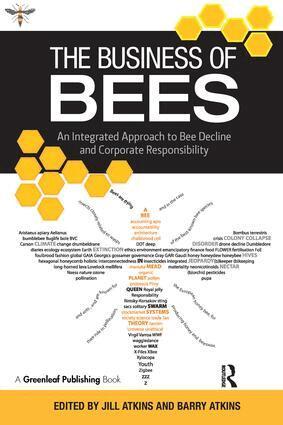
    Business of Bees

    An Integrated Approach to Bee Decline and Corporate Responsibility

    AvJill Atkins,Barry Atkins

    Häftad, Engelska, 2016

    733 kr

    Beställningsvara. Skickas inom 10-15 vardagar. Fri frakt över 249 kr.

    Beskrivning

    Our bee populations are under threat. Over the past 60 years, they have lost much of their natural habitat and are under assault from pesticides and intensive farming. We rely on bees and other insects to pollinate our fruit and vegetables and, without them, our environment and economy will be in crisis.The Business of Bees provides the first integrated account of diminishing bee populations, as well as other pollinators, from an interdisciplinary perspective. It explores the role of corporate responsibility and governance as they relate to this critical issue and examines what the impact will be on consumers, companies, stock markets and ultimately on global society if bee populations continue to decline at a dangerous rate.The book considers the issue of global bee population decline from a variety of disciplines, combining the perspectives of academics in accounting, science and humanities with those of practitioners in the finance industry. The chapters explore the impact of the rapid decline in pollinator populations on the natural world, on corporations, on the stock market and on accounting. The Business of Bees will be essential reading for those in academia, business and finance sectors and anyone invested in the future of our planet.

    Produktinformation

    • Utgivningsdatum:2016-06-10
    • Mått:156 x 234 x 26 mm
    • Vikt:640 g
    • Format:Häftad
    • Språk:Engelska
    • Antal sidor:366
    • Förlag:Taylor & Francis Ltd
    • ISBN:9781783534357

    Utforska kategorier

    • Entreprenörskap inom Ekonomi och Ledarskap
    • Fjärilar, insekter, spindlar inom Djur och Natur
    • Miljövetenskap och miljöpolitik inom Naturvetenskap och teknik

    Mer om författaren

    JILL ATKINS holds a Chair in Financial Management at Sheffield University Management School and is a visiting professor at the University of the Witwatersrand, South Africa. BARRY ATKINS has a background in script-writing and editing for BBC Radio and TV.

    Recensioner i media

    What [this book] does do is look at a much bigger picture of the industry of bees, and the roles that corporations and governments play in the issues of honey bee decline, and examines what the impact will be on consumers, companies, stock markets and global society in general. It addresses inputs from academics in accounting, science and humanities and practitioners in the finance industry. This is not a light-read how-to beekeeping book by any stretch of the imagination. However, if you are part of a corporation that has a vested interest in some level of pollination, have input at some level of government that benefits from this, or contribute to an academic level of research, the information in this book is a remarkable jumping off place.  - Bee Culture Magazine - Kim Flottum, Editor

    Innehållsförteckning

    • PrefaceAcknowledgementsPart I: The historical, scientific, cultural, philosophical and deep ecology context of bee decline1. Bee decline: An integrated approach Jill Atkins, University of Sheffield, UK Barry Atkins, University of South Wales, UK2. The historical, cultural and philosophical context of bee decline Jill Atkins, University of Sheffield, UK Barry Atkins, University of South Wales, UK3. Bee bio-basics and conservation benefits: Essential pieces in the pollinator puzzle Scott Longing and Samuel Discua, Texas Tech University, USA4. From corporate social responsibility to accountability in the bumblebee trade: A Japanese perspective Carol Reade, San José State University, USA Koichi Goka, National Institute for Environmental Studies, Japan Robbin Thorp, University of California, Davis, USA Masahiro Mitsuhata, Arysta LifeScience Corporation, Japan Marius Wasbauer, University of California, Davis, USA5. Bombus terrestris: A personal deep ecology account Jack Christian, Manchester Metropolitan University Business School, UKPart II: Investors, bees and the stock market6. The bee and the stock market: An overview of pollinator decline and its economic and corporate significance Rick Stathers, Schroders, UK7. Pollinators as a portfolio risk: Making the case for investor action Abigail Herron, Aviva Investors, UK8. Bees and pesticides: The Ontario controversy Margaret Clappison and Aris Solomon, Athabasca University, Faculty of Business, Canada9. Bee colony and food supply collapse: Could investors be the cavalry? Raj Thamotheram and Olivia Stewart, Preventable Surprises, UKPart III: Accounting for bees and bee decline10. How to account for bees and pollinators?  Joël Houdet, African Centre for Technology Studies (ACTS), Kenya Ruan Veldtman, South African National Biodiversity Institute (SANBI)11. Bee accounting and accountability in the UK Jill Atkins, University of Sheffield, UK Elisabetta Barone, Brunel University, UK Warren Maroun, University of the Witwatersrand, South Africa Barry Atkins, University of South Wales, UK12. Accounting for bees: Evidence from disclosures by US listed companies  Andrea M. Romi and Scott D. Longing, Texas Tech University, USA13. No bees in their bonnets: On the absence of bee-reporting by South African listed companies  Warren Maroun, University of the Witwatersrand, South Africa14. Corporate bee accountability among Swedish companies Kristina Jonäll, Gothenburg University, Sweden Gunnar Rimmel, Jönköping University, Sweden15. Bees and accountability in Germany: A multi-stakeholder perspective Christoph F. Biehl, Henley Centre for Governance, Accountability and Responsible Investment, UK Martina N. Macpherson, Sustainable Investment Partners Ltd, UK16. An integrated approach to bee decline: Making a bee line for the future? Jill Atkins, University of Sheffield, UK Barry Atkins, University of South Wales, UKAbout the authors