• Fri frakt över 249 kr
  • •
  • Snabba leveranser
  • •
  • Billiga böcker
Kundservice

Du är på sajten för privatpersoner.

Företag, bibliotek eller offentlig verksamhet?

Du handlar på classic.bokus.com, där alla dina funktioner finns intakta.
Till classic.bokus.com
Bokus logotyp. Gå till startsidan.
  • Erbjudanden
  • Nyheter
  • Student
  • Topplistor
  • Barn & ungdom
  • Bokus Play
  • E-böcker
  • Pocketböcker
  • Spel & pussel

10% rabatt på allt med kod: NYSTART10 →

Sidfot

Mina sidor

    Hjälp

    • Kundservice
    • Vanliga frågor och svar
    • Frakt och leverans
    • Retur vid ångerrätt
    • Reklamera vara
    • Betalning
    • Köpvillkor
    • Allmänna villkor
    • Information om webbplatsens tillgänglighet

    Om Bokus

    • Om oss
    • Pressrum
    • För studenter
    • För företag
    • För bibliotek och offentlig verksamhet
    • För leverantörer
    • Hållbarhet

    Populärt

    • Aktuella erbjudanden
    • Presentkort
    • Studentlitteratur
    • Nya böcker
    • Topplistor
    • Signerade böcker
    • Engelska böcker

    Inspiration

    • Boktips
    • BookTok
    • Populära bokserier
    • Barnbokskaraktärer
    • Populära författare
    Logotyp för Bokus
    Följ oss på Facebook (extern länk)Följ oss på Instagram (extern länk)Följ oss på YouTube (extern länk)Följ oss på TikTok (extern länk)
    bokus @ CookiesAnpassa cookiesIntegritetspolicyKöpvillkor
    Till Citymail hemsida (extern länk)Till Budbee hemsida (extern länk)Till Postnord hemsida (extern länk)Till Schenker hemsida (extern länk)Till Early Bird hemsida (extern länk)Till Walleys hemsida (extern länk)
    1. Djur och Natur
    2. Djurböcker
    3. Vilda djur
    4. Fågelböcker

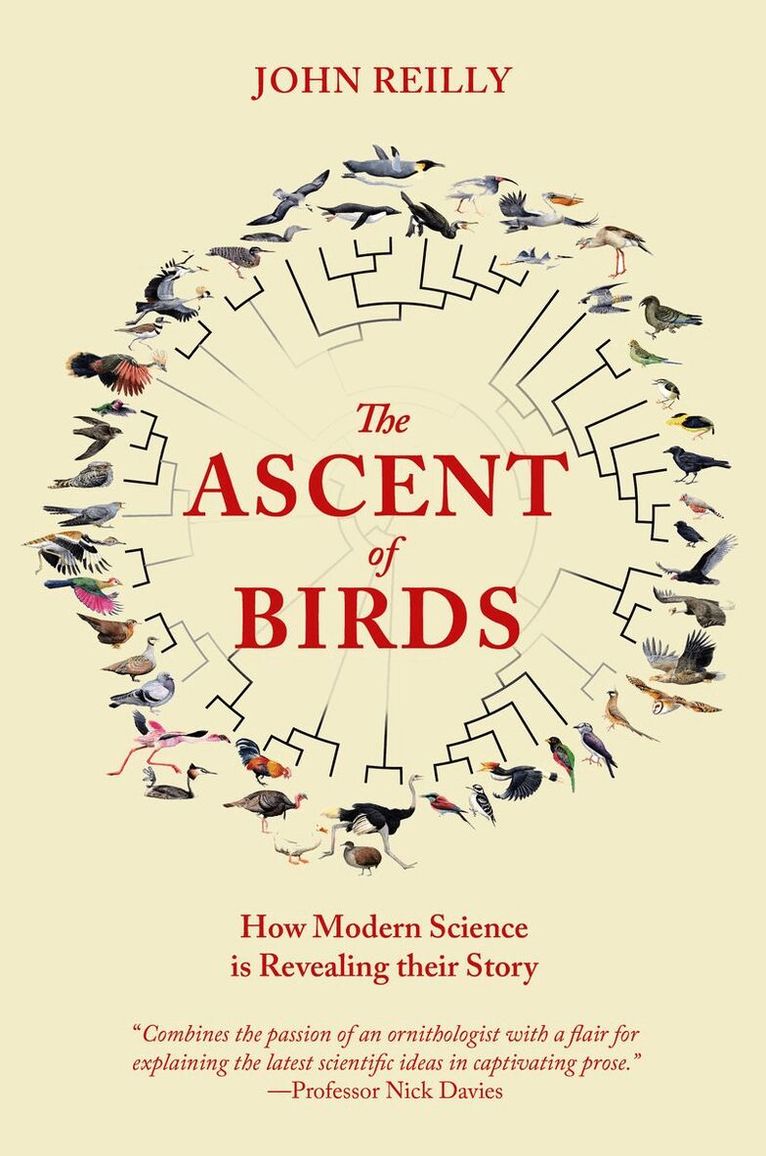
    Ascent of Birds

    How Modern Science is Revealing their Story

    AvJohn Reilly

    Häftad, Engelska, 2019

    Del i serien Pelagic Monographs

    376 kr

    Skickas . Fri frakt över 249 kr.

    Fler format och utgåvor

    E-bok

    369 kr

    E-bok

    554 kr

    Beskrivning

    When and where did the ancestors of modern birds evolve? What enabled them to survive the meteoric impact that wiped out the dinosaurs? How did these early birds spread across the globe and give rise to the 10,600-plus species we recognise today ― from the largest ratites to the smallest hummingbirds? Based on the latest scientific discoveries and enriched by personal observations, The Ascent of Birds sets out to answer these fundamental questions.The Ascent of Birds is divided into self-contained chapters, or stories, that collectively encompass the evolution of modern birds from their origins in Gondwana, over 100 million years ago, to the present day. The stories are arranged in chronological order, from tinamous to tanagers, and describe the many dispersal and speciation events that underpin the world's 10,600-plus species. Although each chapter is spearheaded by a named bird and focuses on a specific evolutionary mechanism, the narrative will often explore the relevance of such events and processes to evolution in general.The book starts with The Tinamou’s Story, which explains the presence of flightless birds in South America, Africa, and Australasia, and dispels the cherished role of continental drift as an explanation for their biogeography. It also introduces the concept of neoteny, an evolutionary trick that enabled dinosaurs to become birds and humans to conquer the planet.The Vegavis's Story explores the evidence for a Cretaceous origin of modern birds and why they were able to survive the asteroid collision that saw the demise not only of dinosaurs but of up to three-quarters of all species.The Duck's Story switches to sex: why have so few species retained the ancestral copulatory organ? Or, put another way, why do most birds exhibit the paradoxical phenomenon of penis loss, despite all species requiring internal fertilisation?The Hoatzin's Story reveals unexpected oceanic rafting from Africa to South America: a stranger-than-fiction means of dispersal that is now thought to account for the presence of other South American vertebrates, including geckos and monkeys.The latest theories underpinning speciation are also explored. The Manakin’s Story, for example, reveals how South America’s extraordinarily rich avifauna has been shaped by past geological, oceanographic and climatic changes, while The Storm-Petrel’s Story examines how species can evolve from an ancestral population despite inhabiting the same geographical area. The thorny issue of what constitutes a species is discussed in The Albatross's Story, while The Penguin’s Story explores the effects of environment on phenotype ― in the case of the Emperor penguin, the harshest on the planet.Recent genomic advances have given scientists novel approaches to explore the distant past and have revealed many unexpected journeys, including the unique overland dispersal of an early suboscine from Asia to South America (The Sapayoa’s Story) and the blackbird's ancestral sweepstake dispersals across the Atlantic (The Thrush’s Story).Additional vignettes update more familiar concepts that encourage speciation: sexual selection (The Bird-of-Paradise's Story); extended phenotypes (The Bowerbird's Story); hybridisation (The Sparrow's Story); and 'great speciators' (The White-eye's Story). Finally, the book explores the raft of recent publications that help explain the evolution of cognitive skills (The Crow's Story); plumage colouration (The Starling's Story); and birdsong (The Finch's Story)

    Produktinformation

    • Utgivningsdatum:2019-04-01
    • Mått:157 x 235 x 25 mm
    • Vikt:600 g
    • Format:Häftad
    • Språk:Engelska
    • Serie:Pelagic Monographs
    • Antal sidor:340
    • Förlag:Pelagic Publishing
    • ISBN:9781784272036

    Utforska kategorier

    • Fågelböcker inom Djur och Natur
    • Biovetenskap inom Naturvetenskap och teknik
    • Geografi inom Naturvetenskap och teknik

    Mer om författaren

    Professor John Reilly has been a keen birder all his life, visiting over fifty countries and observing nearly half the world's bird species. In the late 1970s, he led several pioneering bird and wildlife tours to the Arctic island of Spitsbergen. Since developing an interest in avian evolution, he has concentrated on tracking down and photographing species that have important evolutionary stories to tell, birds that provide the key characters for each of the book's chapters.After graduating in biochemistry and then medicine, John worked as a consultant haematologist in Sheffield for 25 years. In addition to teaching, lecturing and clinical work, he led an active research programme into the causes and treatment of various blood cancers, authoring over 200 scientific articles in peer-reviewed journals.John's medical and scientific career, and time spent as a bird guide, enable him to present complex scientific concepts to the non-specialist - whether in the field of leukaemia or the evolution of birds.In 2014, he retired from the NHS to concentrate on travelling and writing. This career change was encouraged by the success of his first book, Greetings from Spitsbergen: Tourists at the Eternal Ice (2009) published by Tapir Academic Press. In 2013 he established Svalbard Press, with the aim of publishing the histories of different countries as revealed by their early postcards. The first volume in the series, Spitsbergen's Early Postcards: an annotated catalogue, was published in 2014. Further volumes on Papua New Guinea and Greenland are in preparation.

    Recensioner i media

    This is perhaps the most exciting book on bird evolution I have ever read. Far from a chronological follow-up of the main fossils of dinosaurs to date, the author has chosen to present 27 species or groups of species, chosen for their spectacular or very particular adaptations, and to show where they come from, how they have evolved and spread, diversified, or sometimes contracted, and therefore how complex specializations or astonishing distributions can be explained today. Some may use recent or unusual evolutions (sympatric speciation of two Azorean petrels) or may not be the result of as long a history as was thought (Hoatzin's claw), but all show to what point evolution takes various paths to achieve the extraordinary biodiversity of today. There are practically no illustrations (except for a central notebook of photos of the protagonists) and references are relegated to the end, but the style is so captivating that we do not notice it. For such a low price, it is an opportunity to learn to what extent the evolution of our birds over the ages is not simply a succession of morphological changes, but that ecology, biogeography, plate tectonics or sometimes chance may have played an important role.

    Innehållsförteckning

    • Acknowledgements List of Illustrations Timeline - Geological Ages - Prologue: Evolution of an IdeaPART ONE: NON-PASSERINES 1. The Tinamou's Story: Death of a Paradigm2. The Vegavis's Story: The Cradle of Modern Birds3. The Waterfowl's Story: Refugia, High Living, and Sex4. The Hoatzin's Story: An Improbable Voyage5. The Penguin's Story: Phenotype and Environment6. The Storm Petrel's Story: Sympatry versus Allopatry7. The Albatross's Story: The Species Problem8. The Godwit's Story:Quantum Compasses9. The Buzzard's Story: Accidental Speciation10. The Owl's Story: Nightlife11. The Oilbird's Story: Evolutionary Distinctiveness12. The Hummingbird's Story: A Route of Evanescence13. The Parrot's Story: Vicariance and DispersalPART TWO: PASSERINES 14. The New Zealand Wren's Story: A Novel Foot15. The Manakin's Story: Why so many Suboscines?16. The Sapayoa's Story: Odd One Out17. The Scrubbird's Story: Where Song Began18. The Bowerbird's Story: Extended Phenotypes19. The Crows' Story: Cognitive Skills20. The Bird of Paradise's Story: Sexual Selection21. The Starling's Story: Structural Colours22. The Thrush's Story: Sweepstake Dispersals23. The Sparrow's Story: Hybridisation and Speciation24. The Zebra Finch's Story: Evolution of Birdsong25. The Crossbill's Story: Adaptive Radiation and Coevolution26. The White-eye's Story: Supertramps and Great Speciators27. The Tanager's Story: A Final FlourishPostscript: The Sixth Extinction Appendix 1: Glossary Dramatis Personae Bibliography Index