• Fri frakt över 249 kr
  • •
  • Snabba leveranser
  • •
  • Billiga böcker
Kundservice

Du är på sajten för privatpersoner.

Företag, bibliotek eller offentlig verksamhet?

Du handlar på classic.bokus.com, där alla dina funktioner finns intakta.
Till classic.bokus.com
Bokus logotyp. Gå till startsidan.
  • Erbjudanden
  • Nyheter
  • Student
  • Topplistor
  • Barn & ungdom
  • Bokus Play
  • E-böcker
  • Pocketböcker
  • Spel & pussel

10% rabatt på allt med kod NYSTART10 →

Sidfot

Mina sidor

    Hjälp

    • Kundservice
    • Vanliga frågor och svar
    • Frakt och leverans
    • Retur vid ångerrätt
    • Reklamera vara
    • Betalning
    • Köpvillkor
    • Allmänna villkor
    • Information om webbplatsens tillgänglighet

    Om Bokus

    • Om oss
    • Pressrum
    • För studenter
    • För företag
    • För bibliotek och offentlig verksamhet
    • För leverantörer
    • Hållbarhet

    Populärt

    • Aktuella erbjudanden
    • Presentkort
    • Studentlitteratur
    • Nya böcker
    • Topplistor
    • Signerade böcker
    • Engelska böcker

    Inspiration

    • Boktips
    • BookTok
    • Populära bokserier
    • Barnbokskaraktärer
    • Populära författare
    Logotyp för Bokus
    Följ oss på Facebook (extern länk)Följ oss på Instagram (extern länk)Följ oss på YouTube (extern länk)Följ oss på TikTok (extern länk)
    bokus @ CookiesAnpassa cookiesIntegritetspolicyKöpvillkor
    Till Citymail hemsida (extern länk)Till Budbee hemsida (extern länk)Till Postnord hemsida (extern länk)Till Schenker hemsida (extern länk)Till Early Bird hemsida (extern länk)Till Walleys hemsida (extern länk)
    1. Naturvetenskap och teknik
    2. Teknik och industri
    3. Elektronik och kommunikationer

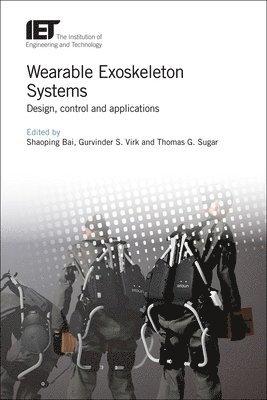
    Wearable Exoskeleton Systems

    Design, control and applications

    AvShaoping Bai,Gurvinder Singh Virk

    Inbunden, Engelska, 2018

    Del i serien Control, Robotics and Sensors

    1 778 kr

    Beställningsvara. Skickas inom 3-6 vardagar. Fri frakt över 249 kr.

    Beskrivning

    Wearable exoskeletons are electro-mechanical systems designed to assist, augment, or enhance motion and mobility in a variety of human motion applications and scenarios. The applications, ranging from providing power supplementation to assist the wearers to situations where human motion is resisted for exercising applications, cover a wide range of domains such as medical devices for patient rehabilitation training recovering from trauma, movement aids for disabled persons, personal care robots for providing daily living assistance, and reduction of physical burden in industrial and military applications. The development of effective and affordable wearable exoskeletons poses several design, control and modelling challenges to researchers and manufacturers. Novel technologies are therefore being developed in adaptive motion controllers, human-robot interaction control, biological sensors and actuators, materials and structures, etc.In this book, the editors and authors report recent advances and technology breakthroughs in exoskeleton developments. It will be of interest to engineers and researchers in academia and industry as well as manufacturing companies interested in developing new markets in wearable exoskeleton robotics.

    Produktinformation

    • Utgivningsdatum:2018-05-11
    • Mått:156 x 234 x 28 mm
    • Vikt:780 g
    • Format:Inbunden
    • Språk:Engelska
    • Serie:Control, Robotics and Sensors
    • Antal sidor:408
    • Förlag:Institution of Engineering and Technology
    • ISBN:9781785613029

    Utforska kategorier

    • Elektronik och kommunikationer inom Naturvetenskap och teknik

    Mer om författaren

    Shaoping Bai is an Associate Professor at the Department of Mechanical and Manufacturing Engineering, Aalborg University, Denmark. His research interests include dynamics and design, assistive exoskeletons, parallel manipulators, and walking robots. He holds a Ph.D. degree in Robotics from Nanyang Technological University, Singapore.Gurvinder Singh Virk is Technical Director at InnotecUK involved in designing and commercialising specialised robotic systems for hazardous environments and service robots for healthcare. His current interests are in wearable exoskeletons; climbing and walking robots, and robot safety standardisation. He has been awarded the Freedom of the City of London for his work and holds a PhD in Control theory from Imperial College, University of London, UK. He has held Professorship positions at several universities in UK, New Zealand, Germany, China, India and Sweden.Thomas Sugar is Professor in the Department of Engineering, The Polytechnic School, Ira A. Fulton Schools of Engineering, Arizona State University, USA. He works in the areas of wearable robotics for rehabilitation, gait assistance and enhanced mobility. He holds a PhD in Mechanical Engineering and Applied Mechanics from the University of Pennsylvania, USA.

    Innehållsförteckning

    • Section 1: Review and overall requirementsChapter 1: Lower-limb wearable roboticsChapter 2: Review of exoskeletons for medical and service applications: ongoing research in Europe on wearable robots, with focus on lower extremity exoskeletonsChapter 3: Soft wearable robotsChapter 4: Exploring user requirements for a lower body soft exoskeleton to assist mobility Section 2: Design and control of exoskeletonsChapter 5: Design and control of spherical shoulder exoskeletons for assistive applicationsChapter 6: Calibration platform for wearable 3D motion sensorsChapter 7: Control and performance of upper- and lower extremity SEA-based exoskeletonsChapter 8: Gait-event-based synchronization and control of a compact portable knee-ankle-foot exoskeleton robot for gait rehabilitation Section 3: DevicesChapter 9: Real-time gait planning for a lower limb exoskeleton robotChapter 10: Soft wearable assistive robotics: exosuits and supernumerary limbsChapter 11: Walking assistive apparatus for gait training patients and promotion exercise of the elderly Section 4: Commercialization issuesChapter 12: Regulatory issues for exoskeletonsChapter 13: Test methods for exoskeletons - lessons learned from industrial and response roboticsChapter 14: Ekso Bionics