• Fri frakt över 249 kr
  • •
  • Snabba leveranser
  • •
  • Billiga böcker
Kundservice

Du är på sajten för privatpersoner.

Företag, bibliotek eller offentlig verksamhet?

Du handlar på classic.bokus.com, där alla dina funktioner finns intakta.
Till classic.bokus.com
Bokus logotyp. Gå till startsidan.
  • Erbjudanden
  • Nyheter
  • Student
  • Topplistor
  • Barn & ungdom
  • Bokus Play
  • E-böcker
  • Pocketböcker
  • Spel & pussel

10% rabatt på allt med kod NYSTART10 →

Sidfot

Mina sidor

    Hjälp

    • Kundservice
    • Vanliga frågor och svar
    • Frakt och leverans
    • Retur vid ångerrätt
    • Reklamera vara
    • Betalning
    • Köpvillkor
    • Allmänna villkor
    • Information om webbplatsens tillgänglighet

    Om Bokus

    • Om oss
    • Pressrum
    • För studenter
    • För företag
    • För bibliotek och offentlig verksamhet
    • För leverantörer
    • Hållbarhet

    Populärt

    • Aktuella erbjudanden
    • Presentkort
    • Studentlitteratur
    • Nya böcker
    • Topplistor
    • Signerade böcker
    • Engelska böcker

    Inspiration

    • Boktips
    • BookTok
    • Populära bokserier
    • Barnbokskaraktärer
    • Populära författare
    Logotyp för Bokus
    Följ oss på Facebook (extern länk)Följ oss på Instagram (extern länk)Följ oss på YouTube (extern länk)Följ oss på TikTok (extern länk)
    bokus @ CookiesAnpassa cookiesIntegritetspolicyKöpvillkor
    Till Citymail hemsida (extern länk)Till Budbee hemsida (extern länk)Till Postnord hemsida (extern länk)Till Schenker hemsida (extern länk)Till Early Bird hemsida (extern länk)Till Walleys hemsida (extern länk)
    1. Naturvetenskap och teknik
    2. Teknik och industri
    3. Maskinteknik och material

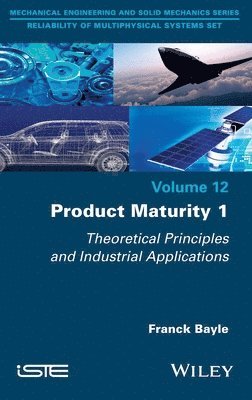
    Product Maturity 1

    Theoretical Principles and Industrial Applications

    AvFranck Bayle

    Inbunden, Engelska, 2022

    1 800 kr

    Beställningsvara. Skickas inom 5-8 vardagar. Fri frakt över 249 kr.

    Fler format och utgåvor

    E-bok

    2 177 kr

    E-bok

    2 177 kr

    Beskrivning

    Every parent is concerned when a child is slow to become a mature adult. This is also true for any product designer, regardless of their industry sector. For a product to be mature, it must have an expected level of reliability from the moment it is put into service, and must maintain this level throughout its industrial use.While there have been theoretical and practical advances in reliability from the 1960s to the end of the 1990s, to take into account the effect of maintenance, the maturity of a product is often only partially addressed.Product Maturity 1 fills this gap as much as possible; a difficult exercise given that maturity is a transverse activity in the engineering sciences; it must be present throughout the lifecycle of a product.

    Produktinformation

    • Utgivningsdatum:2022-04-08
    • Mått:156 x 234 x 14 mm
    • Vikt:483 g
    • Format:Inbunden
    • Språk:Engelska
    • Antal sidor:224
    • Förlag:ISTE Ltd and John Wiley & Sons Inc
    • ISBN:9781786307392

    Utforska kategorier

    • Maskinteknik och material inom Naturvetenskap och teknik
    • Tillverkningsteknik inom Naturvetenskap och teknik

    Mer om författaren

    Franck Bayle is an electronic engineer by training. He has practiced for almost 15 years, working at Crouzet and then at Thales in Valence, France. He has also worked in reliability and maturity.

    Innehållsförteckning

    • Foreword by Laurent Denis ixForeword by Serge Zaninotti xiiiAcknowledgements xvIntroduction xviiChapter 1. Reliability Review 11.1. Failure rate 11.2. Temperature effect 61.3. Effect of maintenance 61.4. MTBF 71.5. Nature of the reliability objective 9Chapter 2. Maturity 11Serge ZANINOTTI2.1. Context 112.2. Normative context and its implications 132.2.1. Quality standards 132.2.2. Quality management system and product quality 132.2.3. Product quality and dependability 162.2.4. Product dependability and maturity 182.2.5. Standards in various domains 232.2.6. Perspectives 242.3. Building of maturity 282.4. Confirmation of maturity 30Chapter 3. Derating Analysis 333.1. Derating 333.2. Rules provided by the manufacturers of components 343.2.1. CMS resistors 343.2.2. Capacitors 383.2.3. Magnetic circuits 413.2.4. Fuses 413.2.5. Resonators 423.2.6. Oscillators 423.2.7. Photocouplers 423.2.8. Diodes 433.2.9. Zener diodes 433.2.10. Tranzorb diodes 433.2.11. Low power bipolar transistors 453.2.12. Power bipolar transistors 453.2.13. Low power MOSFET transistors 463.2.14. High power MOSFET transistors 463.2.15. Integrated circuits 473.3. Reference-based approach 473.4. Creation of derating rules 493.4.1. Rules for constant temperature 533.4.2. Rule for voltage 583.5. Summary 59Chapter 4. Components with Limited Service Life 614.1. RDF 2000 guide 634.1.1. Power transistor 634.1.2. Photocouplers 644.1.3. Switch or push button 644.1.4. Connectors 654.2. FIDES 2009 guide 654.2.1. Fans 664.2.2. Batteries 664.3. Manufacturer’s data 684.3.1. Wet electrolytic capacitor 684.3.2. Connectors 714.3.3. Relays 724.3.4. Optocouplers 734.3.5. Batteries 764.3.6. Fans 774.3.7. Flash memories 784.3.8. Potentiometers 794.3.9. Quartz oscillators 814.3.10. Voltage references 814.4. Summary of components with limited service life 82Chapter 5. Analysis of Product Performances 855.1. Analyses during the design stage 855.1.1. Worst-case analysis 855.1.2. Quadratic analysis 885.1.3. Monte-Carlo analysis 895.1.4. Numerical simulations 915.2. Analyses during the manufacturing stage 92Chapter 6. Aggravated Tests 956.1. Definition 956.2. Objectives of aggravated tests 956.3. Principles of aggravated tests 976.3.1. Choice of physical constraints 1016.3.2. Principle of HALT 1016.3.3. Specific or additional constraints 1066.3.4. Number of required samples 1066.3.5. Operational test, diagnosis and identification of weaknesses 1076.3.6. Monitoring specification 1076.3.7. Instrumentation 1086.3.8. Root cause analysis, corrective actions and breakdown management 1086.4. Robustness 1116.4.1. Estimation of robustness margins 1116.4.2. Sufficient margins 112Chapter 7. Burn-In Test 1177.1. Link between HALT and HASS tests 1197.2. POS1 test 1197.2.1. Miner’s approach 1197.2.2. Approach according to the physical laws of failure 1217.2.3. Zero-failure reliability proof approach 1247.3. POS2 test 1257.3.1. Influence of parameter Q 1287.3.2. Influence of parameter p 1297.3.3. Summary of the POS2 test 1337.4. HASS cycle 1337.4.1. Precipitation stage 1337.4.2. Detection stage 1347.5. Should burn-in tests be systematically conducted? 1367.5.1. Constraints extrinsic to the equipment manufacturer 1377.5.2. Constraints intrinsic to the equipment manufacturer 1377.5.3. Decision criteria 1377.6. Test coverage 1427.7. Economic aspect of burn-in 1447.7.1. No burn-in test is conducted 1457.7.2. Burn-in test is conducted 146Chapter 8. Run-In 1538.1. Run-in principle 1538.2. Stabilization 1568.2.1. Proposed principle 1568.2.2. Drift acceleration law 1598.2.3. Choice of the drift model 1618.2.4. Equivalent level of physical contribution 1628.3. Expression of the corresponding degradation 1648.4. Optimization of the stabilization time 1658.5. Estimation of a prediction interval of the degradation 1678.5.1. Principle of the stabilization method 167List of Notations 171List of Definitions 173List of Acronyms 179References 183Index 187