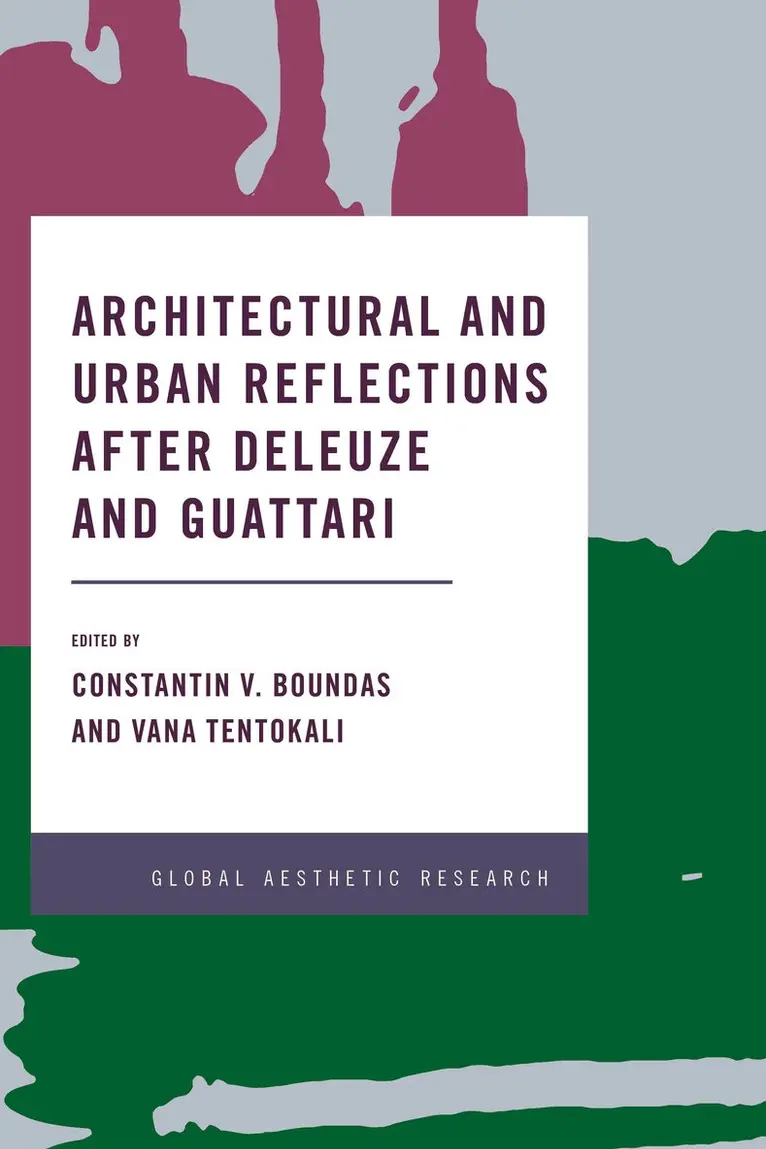
Architectural and Urban Reflections after Deleuze and Guattari
Constantin V. Boundas, Vana Tentokali
671 kr
Du är på sajten för privatpersoner.
619 kr
Beställningsvara. Skickas inom 10-15 vardagar. Fri frakt över 249 kr.
Vana Tentokali is a Dr Architect and Professor Emeritus in the Department of Architecture at the Aristotle University of Thessaloniki. Vana has held a number of positions, including being a member of the teaching faculty in the Department of Architecture at Roger Williams College (Bristol Rhode Island U.S.A., 1986); a Research Fellow at the Behavioral Science Research Group in Architecture (Department of Architecture) and the Program for Gender Studies (Department of Humanities) at MIT Cambridge Massachusetts, U.S.A. (1982-1985); aVisiting Scholar for the Program of History, Theory and Criticism (Department of Architecture MIT, spring semester 1992), and a Visiting Research Fellow for the Program in Hellenic Studies, (Princeton University, U.S.A., fall term 2008). Constantin V. Boundas (Trent University, Ontario) holds M.A. Ph.D. from Purdue, and he is Professor Emeritus of Philosophy and a member of the Centre for the Study of Theory, History and Culture at Trent University. He is the editor of The Deleuze Reader (New York: Columbia University Press, 1993); with Dorothea Olkowski, of The Theater of Philosophy: Critical Essays on Gilles Deleuze (New York: Routledge, 1994); and of Deleuze and Philosophy (Edinburgh: Edinburgh University Press, 2006); the General Editor of The Companion to the Twentieth Century Philosophies, jointly published by Edinburgh and Columbia University Presses in 2007; and of Deleuze: The Intensive Reduction (London and New York: Continuum, 2009).
This book dares to pose the question of what kind of architecture can realize the virtual plane of Ideas of Deleuze and Guattari’s philosophy. This because in spite of many years of theorizing about Deleuze and Guattari’s possible view of the role of architecture in their philosophy, there still has been no satisfactory answer to this question. The difficulty of this question and the complexity and diversity of the answers in this volume are due to the possibility or impossibility in the contemporary era of a nomadic architecture constituted as an immanent plane of trajectories, a swarm of intensities, the unlivable site of the body without organs, the differentiating principle of the fold, the unleashing of sensation, the perceptible realization of imperceptible forces, a map that deterritorializes, or an instrument of the propagation of light. This accomplished assemblage of architects, urban planners, and philosophers urge us to consider how the ideas of Deleuze and Guattari both organize and derange their architectural visions as they ceaselessly experiment with the very idea of the worlds architecture might be capable of creating.
Constantin V. Boundas, Vana Tentokali
671 kr
Constantin V. Boundas, Vana Tentokali
Inbunden, 2017
1 955 kr
Constantin V. Boundas, Dorothea Olkowski
Häftad, 2019
552 kr
Du är på sajten för privatpersoner.
619 kr
Beställningsvara. Skickas inom 10-15 vardagar. Fri frakt över 249 kr.
Vana Tentokali is a Dr Architect and Professor Emeritus in the Department of Architecture at the Aristotle University of Thessaloniki. Vana has held a number of positions, including being a member of the teaching faculty in the Department of Architecture at Roger Williams College (Bristol Rhode Island U.S.A., 1986); a Research Fellow at the Behavioral Science Research Group in Architecture (Department of Architecture) and the Program for Gender Studies (Department of Humanities) at MIT Cambridge Massachusetts, U.S.A. (1982-1985); aVisiting Scholar for the Program of History, Theory and Criticism (Department of Architecture MIT, spring semester 1992), and a Visiting Research Fellow for the Program in Hellenic Studies, (Princeton University, U.S.A., fall term 2008). Constantin V. Boundas (Trent University, Ontario) holds M.A. Ph.D. from Purdue, and he is Professor Emeritus of Philosophy and a member of the Centre for the Study of Theory, History and Culture at Trent University. He is the editor of The Deleuze Reader (New York: Columbia University Press, 1993); with Dorothea Olkowski, of The Theater of Philosophy: Critical Essays on Gilles Deleuze (New York: Routledge, 1994); and of Deleuze and Philosophy (Edinburgh: Edinburgh University Press, 2006); the General Editor of The Companion to the Twentieth Century Philosophies, jointly published by Edinburgh and Columbia University Presses in 2007; and of Deleuze: The Intensive Reduction (London and New York: Continuum, 2009).
This book dares to pose the question of what kind of architecture can realize the virtual plane of Ideas of Deleuze and Guattari’s philosophy. This because in spite of many years of theorizing about Deleuze and Guattari’s possible view of the role of architecture in their philosophy, there still has been no satisfactory answer to this question. The difficulty of this question and the complexity and diversity of the answers in this volume are due to the possibility or impossibility in the contemporary era of a nomadic architecture constituted as an immanent plane of trajectories, a swarm of intensities, the unlivable site of the body without organs, the differentiating principle of the fold, the unleashing of sensation, the perceptible realization of imperceptible forces, a map that deterritorializes, or an instrument of the propagation of light. This accomplished assemblage of architects, urban planners, and philosophers urge us to consider how the ideas of Deleuze and Guattari both organize and derange their architectural visions as they ceaselessly experiment with the very idea of the worlds architecture might be capable of creating.
Constantin V. Boundas, Vana Tentokali
671 kr
Constantin V. Boundas, Vana Tentokali
Inbunden, 2017
1 955 kr
Constantin V. Boundas, Dorothea Olkowski
Häftad, 2019
552 kr