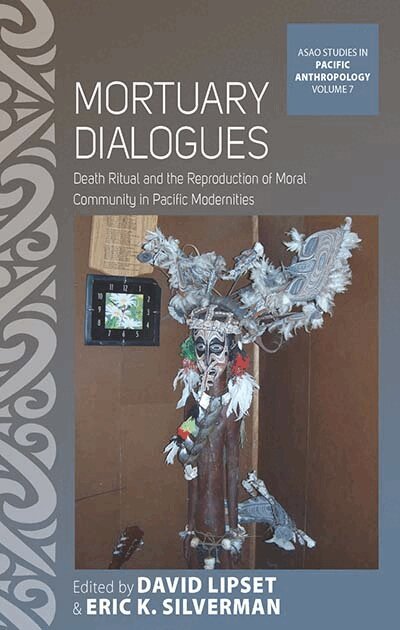
Mortuary Dialogues
Death Ritual and the Reproduction of Moral Community in Pacific Modernities
AvDavid Lipset,Eric K. Silverman
Del i serien ASAO Studies in Pacific Anthropology
566 kr
Beställningsvara. Skickas inom 3-6 vardagar. Fri frakt över 249 kr.
Beskrivning
Produktinformation
- Utgivningsdatum:2019-07-12
- Mått:152 x 229 x 13 mm
- Vikt:396 g
- Format:Häftad
- Språk:Engelska
- Serie:ASAO Studies in Pacific Anthropology
- Antal sidor:262
- Förlag:Berghahn Books
- ISBN:9781789205060
Utforska kategorier
Mer om författaren
David Lipset is Professor of Anthropology at the University of Minnesota.
Recensioner i media
“The book contributes to our understanding of what it is like to live in the contemporary Pacific. Doing this through the lens of mortuary rituals is both original and relevant.” • HAL“Methodologically, Mortuary Dialogues demonstrates the value of anthropologists revisiting their fieldwork sites. The authors share a longstanding engagement with the communities they describe. By juxtaposing personal experiences from repeated intervals of field- work with readings of historical sources, they achieve solid depth to their analyses of continuity and change in ritual responses to death.” • Journal of the Humanities and Social Sciences of Southeast Asia“The narratives used in the studies skillfully alternate between memories of a past living, a way of life not affected by socio-political histories of the ‘West’, and the experiences grounded in new and present realities of the 21st century by focusing on the ‘double’… nature of these rituals…Overall the book is detailed, easy to understand, historically informed and critical.” • Social Anthropology“The editors begin with the familiar idea that mortuary rites reproduce the moral community in the face of death’s disruption, but they add that these rites are privileged sites for negotiating the tension between reproduction and historical transformation…Taken as a whole this collection balances a serious attempt to understand cultural change with enough ethnographic variety to satisfy anybody.” • Pacific Affairs“Mortuary Dialogues shows the mortuary practices in the Pacific are a window through which the impact of the different facets of modernity on people's lives, practices and beliefs can be observed...The book contributes to our understanding of what it is like to live in the contemporary Pacific. Doing this through the lens of mortuary rituals is both original and relevant.” • Anthropological Forum“Applying Mikhail Bakhtin’s concept of discourse, the editors and many of the contributors focus on both the official and the unofficial voices in the ongoing mortuary debates about Christianity, capitalism, and the state—the three forces that have made a major impact on the lives of the Pacific peoples in the postcolonial era… this book is theoretically innovative, ethnographically rich, and very thought provoking.” • American Ethnologist “One of the more noteworthy of the book’s features is the great diversity in the content of the dialogues separately reported and the range of theoretical perspectives adopted to account for them within the dialogue rubric…Each of these studies is to be praised for the heartfelt poignancy of the stories they tell, which are part and parcel of life in the Pacific today. The diversity of theoretical orientations informing those stories, which is impossible to cover adequately in a review of this nature, will also give readers much of great value to ponder.” • Anthropos“Mortuary Dialogues is an initiated contribution to the ethnography of Oceania, with relevance far beyond the Pacific… Mortuary Dialogues is also a thought-provoking attempt to revitalize anthropological theory on meanings of mortuary ritual…Mortuary Dialogues demonstrates the value of anthropologists revisiting their fieldwork sites. The authors share a longstanding engagement with the communities they describe. By juxtaposing personal experiences from repeated intervals of fieldwork with readings of historical sources, they achieve solid depth to their analyses of continuity and change in ritual responses to death.” • Bijdragen tot de Taal-, Land- en Volkenkunde“This book is notable for its wealth of ethnographic data on mortuary practices in very different parts of a changing Pacific, as well as for the critique running through it that reminds us that Hertz’s model is an idealization—both emic and etic—from which the actual practice departs into varying degrees of ambivalence.” • Roger Lohmann, Trent University“The chapters here offer some very important additions to the discipline and are stimulating and good reads whether or not one agrees with the authors’ points.” • Frederick Damon, University of Virginia
Innehållsförteckning
- List of Figures and TablesForewordShirley LindenbaumAcknowledgementsMapIntroduction: Mortuary Ritual, Modern Social Theory and the Historical Moment in Pacific ModernityEric K. Silverman and David LipsetPART I: TENACIOUS VOICESChapter 1. Fearing the Dead: The Mortuary Rites of Marshall Islanders’ amid the Tragedy of Pacific ModernityLaurence M. CarucciChapter 2. Into the World of Sorrow: Women and the Work of Death in Maori Mortuary RitesChe Wilson and Karen SinclairChapter 3. Death and Experience in Rawa Mortuary Rites, Papua New GuineaDoug DaltonChapter 4. The Knotted Person: Death, the Bad Breast and Melanesian Modernity among the Murik, Papua New GuineaDavid LipsetChapter 5. Mortuary Ritual and Mining Riches in Island MelanesiaNicholas A. Bainton and Martha MacintyrePART II: EQUIVOCAL VOICESChapter 6. Finishing Kapui's Name: Birth, Death and the Reproduction of Manam Society, Papua New GuineaNancy C. LutkehausChapter 7. Transformations of Male Initiation and Mortuary Rites among the Kayan of Papua New GuineaAlexis T. von PoserChapter 8. Mortuary Failures: Traditional Uncertainties and Modern Families in the Sepik River, Papua New GuineaEric K. SilvermanChapter 9. Everything Will Come Up Like TV, Everything Will Be Revealed: Death in an Age of Uncertainty in the Purari Delta, Papua New GuineaJoshua BellAfterword: Mortuary Dialogues in Pacific Modernities and AnthropologyDavid Lipset, Eric K. Silverman and Eric VenbruxIndex