• Fri frakt över 249 kr
  • •
  • Snabba leveranser
  • •
  • Billiga böcker
Kundservice

Du är på sajten för privatpersoner.

Företag, bibliotek eller offentlig verksamhet?

Du handlar på classic.bokus.com, där alla dina funktioner finns intakta.
Till classic.bokus.com
Bokus logotyp. Gå till startsidan.
  • Erbjudanden
  • Nyheter
  • Student
  • Topplistor
  • Barn & ungdom
  • Bokus Play
  • E-böcker
  • Pocketböcker
  • Spel & pussel

10% rabatt på allt med kod: NYSTART10 →

Sidfot

Mina sidor

    Hjälp

    • Kundservice
    • Vanliga frågor och svar
    • Frakt och leverans
    • Retur vid ångerrätt
    • Reklamera vara
    • Betalning
    • Köpvillkor
    • Allmänna villkor
    • Information om webbplatsens tillgänglighet

    Om Bokus

    • Om oss
    • Pressrum
    • För studenter
    • För företag
    • För bibliotek och offentlig verksamhet
    • För leverantörer
    • Hållbarhet

    Populärt

    • Aktuella erbjudanden
    • Presentkort
    • Studentlitteratur
    • Nya böcker
    • Topplistor
    • Signerade böcker
    • Engelska böcker

    Inspiration

    • Boktips
    • BookTok
    • Populära bokserier
    • Barnbokskaraktärer
    • Populära författare
    Logotyp för Bokus
    Följ oss på Facebook (extern länk)Följ oss på Instagram (extern länk)Följ oss på YouTube (extern länk)Följ oss på TikTok (extern länk)
    bokus @ CookiesAnpassa cookiesIntegritetspolicyKöpvillkor
    Till Citymail hemsida (extern länk)Till Budbee hemsida (extern länk)Till Postnord hemsida (extern länk)Till Schenker hemsida (extern länk)Till Early Bird hemsida (extern länk)Till Walleys hemsida (extern länk)
    1. Historia och arkeologi
    2. Historia
    3. Europas historia

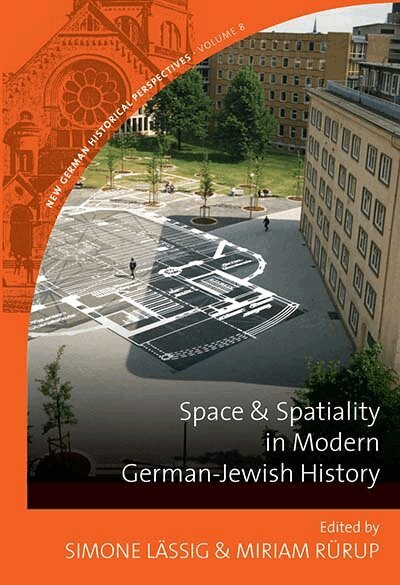
    Space and Spatiality in Modern German-Jewish History

    AvSimone Lässig,Miriam Rürup

    Häftad, Engelska, 2019

    Del i serien New German Historical Perspectives

    526 kr

    Beställningsvara. Skickas inom 5-8 vardagar. Fri frakt över 249 kr.

    Beskrivning

    What makes a space Jewish? This wide-ranging volume revisits literal as well as metaphorical spaces in modern German history to examine the ways in which Jewishness has been attributed to them both within and outside of Jewish communities, and what the implications have been across different eras and social contexts. Working from an expansive concept of “the spatial,” these contributions look not only at physical sites but at professional, political, institutional, and imaginative realms, as well as historical Jewish experiences of spacelessness. Together, they encompass spaces as varied as early modern print shops and Weimar cinema, always pointing to the complex intertwining of German and Jewish identity.

    Produktinformation

    • Utgivningsdatum:2019-08-20
    • Mått:152 x 229 x 19 mm
    • Vikt:494 g
    • Format:Häftad
    • Språk:Engelska
    • Serie:New German Historical Perspectives
    • Antal sidor:340
    • Förlag:Berghahn Books
    • ISBN:9781789205121

    Utforska kategorier

    • Europas historia inom Historia och arkeologi
    • Sociala grupper och identitet inom Samhälle och politik
    • Historia inom Historia och arkeologi

    Mer om författaren

    Simone Lässig is Director of the German Historical Institute, Washington, DC, and Professor of Modern History at Braunschweig University. She edits Publications of the German Historical Institute Series (Cambridge University Press), Studies in German History Series (Berghahn) and co-edits the journal Geschichte und Gesellschaft.

    Recensioner i media

    “The present volume bears the fruits of more than two decades of scholarship on Jewish space, and the long gestation period of this anthology is well worth the wait… Overall, this is a welcome addition to a flourishing field, indeed, the “spatial turn” in Jewish studies diagnosed in the late 1990s, is set to continue to enhance the work of historians, particularly those of us working in borderlands and who engage with the study of boundaries between population groups…thorough editorial work and a superbly crafted introduction.” • Modern Jewish Studies“In their various ways, the contributions of the volume… offer rich food for thought… the volume advances the discussion of space and spatiality in German-Jewish history considerably, and in the best instances individual contributions successfully break down the barriers between German and non-German historiography, just as the editors hoped they would.” • German History “The range of approaches and the sheer breadth of spaces and texts treated here—synagogues and cemeteries, German landscapes, Freud and his reception, philanthropy, urban ghettos, photography, and museums—provide a compelling and rich window into Jewish spaces in their historical context.” • Barbara Mann, Jewish Theological Seminary of America“This collection makes a convincing case for the application of ‘space’ as an analytic category for the study of minorities in European society, affording new insights into the complexities and fluidities of intertwined and ‘entangled’ histories.” • Jonathan Skolnik, University of Massachusetts, Amherst

    Innehållsförteckning

    • List of FiguresPrefaceIntroduction: What Made a Space “Jewish”? Reconsidering a Category of Modern German HistorySimone Lässig and Miriam RürupPART I: IMAGINATIONS: REMEBERANCE AND REPRESENTATION OF SPACES AND BOUNDARIESChapter 1. 
Of Sounds and Stones: The Jewish-Christian Contact Zone of a Swiss Village in the Nineteenth-CenturyAlexandra BinnenkadeChapter 2. 
Imaginations of the Ghetto: Jewish Debates on Ghettos and Jewish Society in Late Nineteenth-Century GaliciaJürgen HeydeChapter 3. 
Modernization and Memory in German-Jewish HistoryNils RoemerChapter 4. 
From Place to Race and Back Again: The Jewishness of Psychoanalysis RevisitedAnthony D. KaudersChapter 5. Jewish Displacement and Simulation in the German Films of E. A. DupontOfer Ashkenazi
Chapter 6. Layered Pasts: The Judengasse in Frankfurt and Narrating German-Jewish History after the HolocaustMichael Meng
PART II: TRANSFORMATIONS: EMERGENCES, SHIFTS AND DISSOLUTIONS IN SPACES AND BOUNDARIESChapter 7. 
The Representation and Creation of Spaces through Print Media: 
Some Insights from the History of the Jewish Press…Kerstin von der KroneChapter 8. 
Out of the Ghetto, Into the Middle Class: 
Changing Perspectives on Jewish Spaces in Nineteenth-Century Germany – 
The Case of Synagogues and Jewish Burial GroundsAndreas GotzmannChapter 9. Spatial Variations and Locations: Synagogues at the Intersection of Architecture, Town, and ImaginationSylvia Necker
Chapter 10. Jewish Philanthropy and the Formation of Modernity: Baron de Hirsch and His Vision of Jewish Spaces in European Societies    Björn SiegelChapter 11. Reconstruction Jewishness, Deconstructing the Past: 
Reading Berlin’s Scheunenviertel over the Course of the Twentieth CenturyAnne-Christin Saß
PART III: PRACTICES: NEGOTIATING, EXPERIENCING, AND APPROPRIATING SPACES AND BOUNDARIESChapter 12. 
A Hybrid Space of Communication: Hebrew Printing in Jessnitz, 1718–1745Dirk SadowskiChapter 13. 
Faith in Residence: Jewish Spatial Practice in the Urban ContextJoachim SchlörChapter 14. Photography as Jewish SpaceMichael Berkowitz
Chapter 15. 
Jews, Foreigners, and the Space of the Postwar Economy: 
The Case of Munich's MöhlstrasseAnna HolianChapter 16. 
Creating a Bavarian Space for Rapprochement: The Jewish Museum MunichRobin OstowChapter 17. 
Real Imaginary Spaces and Places: Virtual, Actual, and OtherwiseRuth Ellen GruberBibliographyIndex