• Fri frakt över 249 kr
  • •
  • Snabba leveranser
  • •
  • Billiga böcker
Kundservice

Du är på sajten för privatpersoner.

Företag, bibliotek eller offentlig verksamhet?

Du handlar på classic.bokus.com, där alla dina funktioner finns intakta.
Till classic.bokus.com
Bokus logotyp. Gå till startsidan.
  • Erbjudanden
  • Nyheter
  • Student
  • Topplistor
  • Barn & ungdom
  • Bokus Play
  • E-böcker
  • Pocketböcker
  • Spel & pussel

10% rabatt på allt med kod: NYSTART10 →

Sidfot

Mina sidor

    Hjälp

    • Kundservice
    • Vanliga frågor och svar
    • Frakt och leverans
    • Retur vid ångerrätt
    • Reklamera vara
    • Betalning
    • Köpvillkor
    • Allmänna villkor
    • Information om webbplatsens tillgänglighet

    Om Bokus

    • Om oss
    • Pressrum
    • För studenter
    • För företag
    • För bibliotek och offentlig verksamhet
    • För leverantörer
    • Hållbarhet

    Populärt

    • Aktuella erbjudanden
    • Presentkort
    • Studentlitteratur
    • Nya böcker
    • Topplistor
    • Signerade böcker
    • Engelska böcker

    Inspiration

    • Boktips
    • BookTok
    • Populära bokserier
    • Barnbokskaraktärer
    • Populära författare
    Logotyp för Bokus
    Följ oss på Facebook (extern länk)Följ oss på Instagram (extern länk)Följ oss på YouTube (extern länk)Följ oss på TikTok (extern länk)
    bokus @ CookiesAnpassa cookiesIntegritetspolicyKöpvillkor
    Till Citymail hemsida (extern länk)Till Budbee hemsida (extern länk)Till Postnord hemsida (extern länk)Till Schenker hemsida (extern länk)Till Early Bird hemsida (extern länk)Till Walleys hemsida (extern länk)
    1. Djur och Natur
    2. Naturböcker
    3. Växtböcker

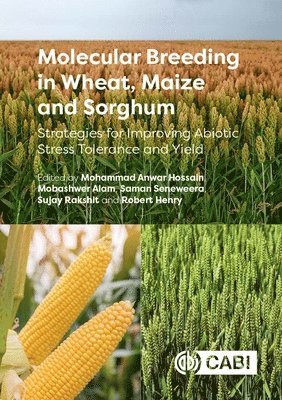
    Molecular Breeding in Wheat, Maize and Sorghum

    Strategies for Improving Abiotic Stress Tolerance and Yield

    AvMohammad Anwar Hossain,Mobashwer Alam

    Inbunden, Engelska, 2021

    2 834 kr

    Beställningsvara. Skickas inom 5-8 vardagar. Fri frakt över 249 kr.

    Beskrivning

    The global population is projected to reach almost 10 billion by 2050, and food and feed production will need to increase by 70%. Wheat, maize and sorghum are three key cereals which provide nutrition for the majority of the world's population. Their production is affected by various abiotic stresses which cause significant yield losses. The effects of climate change also increase the frequency and severity of such abiotic stresses. Molecular breeding technologies offer real hope for improving crop yields. Although significant progress has been made over the last few years, there is still a need to bridge the large gap between yields in the most favorable and most stressful conditions. This book: - Provides a valuable resource for wheat, maize and sorghum scientists working on breeding and molecular biology, physiology and biotechnology. - Presents the latest in-depth research in the area of abiotic stress tolerance and yield improvements. - Contains the necessary information to allow plant breeders to apply this research to effectively breed new varieties of these crops. It provides a consolidated reference for plant breeders and crop scientists working on the challenges of enhanced crop productivity and climate change adaptability.

    Produktinformation

    • Utgivningsdatum:2021-07-02
    • Mått:172 x 244 x 32 mm
    • Vikt:1 483 g
    • Format:Inbunden
    • Språk:Engelska
    • Antal sidor:552
    • Förlag:CABI Publishing
    • ISBN:9781789245431

    Utforska kategorier

    • Växtböcker inom Djur och Natur
    • Botanik inom Naturvetenskap och teknik
    • Miljövetenskap och miljöpolitik inom Naturvetenskap och teknik

    Mer om författaren

    Mobashwer Alam is a Senior Research Fellow and a theme leader of Predictive Agriculture for Improved Productivity and Value at the Queensland Alliance for Agriculture and Food Innovation, UQ. He is the team leader of the QAAFI's National Passionfruit Breeding and Evaluation Program (PF22000). He has more than twenty-two years of experience in multi-disciplinary research, including plant breeding, quantitative genetics, genomics, plant physiology, and crop modelling. He is interested in developing rapid breeding tools and utilizing plant genomics in horticultural crop improvement. Dr Shabir Hussain Wani is Assistant Professor, Genetics and Plant Breeding at Sher-e-Kashmir University of Agricultural Sciences and Technology, Kashmir, India. He has published more than 300 papers/chapters in journals and books of international and national repute. He is involved as Principal breeder for wheat variety Shalimar wheat 3 released in the year 2023 and associated as Co breeder for more than 10 crop varieties. He is Principal Investigator for JKDST funded research project on wheat molecular breeding for stripe rust resistance. He is also Co-PI for several research projects funded by DBT, DST and other funding agencies. Has been actively involved in teaching of important UG & PG courses on Genetics and Biotechnology since the year 2013. Currently, he is working as Scientist in the All India Coordinated Research Project on Seed (Crops) at SKUAST K, Shalimar.

    Innehållsförteckning

    • Chapter 1: Recent Understanding on Molecular Mechanisms of Plant Abiotic Stress Response and Tolerance Chapter 2: Breeding Strategies to Enhance Abiotic Stress Tolerance and Yield Improvement in Wheat, Maize and Sorghum Chapter 3: Recent Advancement of Molecular Breeding for Improving Salinity Tolerance in Wheat Chapter 4: Genomics and Molecular Physiology for Improvement of Drought Tolerance in Wheat Chapter 5: Molecular Breeding for Improving Heat Stress Tolerance in Wheat Chapter 6: Molecular Breeding for Improving Waterlogging Tolerance in Wheat Chapter 7: Molecular Breeding for Improving Aluminium Resistance in Wheat Chapter 8: Molecular Breeding for Enhancing Iron and Zinc Content in Wheat Grains Chapter 9: Recent Advancements of Molecular Breeding and Functional Genomics for Improving Nitrogen-, Phosphorus- and Potassium-Use Efficiencies in Wheat Chapter 10: Molecular Breeding for Improving Yield in Wheat: Recent Advances and Future Perspectives Chapter 11: Tools for Transforming Wheat Breeding: Genomic Selection, Rapid Generation Advance and Database-Based Decision Support Chapter 12: CRISPR-Mediated Gene Editing in Wheat for Abiotic Stress Tolerance Chapter 13: Application of Pangenomics for Wheat Molecular Breeding Chapter 14: Recent Advancement of Molecular Understanding for Combating Salinity Stress in Maize Chapter 15: Isolation of Genes/Quantitative Trait Loci for Drought Stress Tolerance in Maize Chapter 16: The Genetic Architecture and Breeding Towards Cold Tolerance in Maize: Review Chapter 17: Physiological and Molecular Mechanisms Underlying Excess Moisture Stress Tolerance in Maize: Molecular Breeding Opportunities to Increase Yield Potential Chapter 18: Recent Molecular Breeding Advances for Improving Aluminium Tolerance in Maize and Sorghum Chapter 19: Physiological and Molecular Interventions for Improving Nitrogen-Use Efficiency in Maize Chapter 20: Recent Advancement in Molecular Breeding for Improving Nutrient-Use Efficiency in Maize Chapter 21: Molecular Breeding for Increasing Nutrition Quality in Maize: Recent Progress Chapter 22: Molecular Breeding for Improving Yield in Maize: Recent Advances and Future Perspectives Chapter 23: CRISPR-Mediated Genome Editing in Maize for Improved Abiotic Stress Tolerance Chapter 24: Molecular Breeding for Combating Salinity Stress in Sorghum: Progress and Prospects Chapter 25: Quantitative Trait Locus mapping and Genetic Improvement to Strengthen Drought Tolerance in Sorghum Chapter 26: Improving Abiotic Stress Tolerance to Adapt Sorghum to Temperate Climatic Regions Chapter 27: Isolation of Quantitative Trait Loci/Gene(s) Conferring Cadmium Tolerance in Sorghum Chapter 28: Molecular Breeding for Increasing Micronutrient Content in Sorghum Chapter 29: Ideotype Breeding for Improving Yield in Sorghum: Recent Advances and Future Perspectives