• Fri frakt över 249 kr
  • •
  • Snabba leveranser
  • •
  • Billiga böcker
Kundservice

Du är på sajten för privatpersoner.

Företag, bibliotek eller offentlig verksamhet?

Du handlar på classic.bokus.com, där alla dina funktioner finns intakta.
Till classic.bokus.com
Bokus logotyp. Gå till startsidan.
  • Erbjudanden
  • Nyheter
  • Student
  • Topplistor
  • Barn & ungdom
  • Bokus Play
  • E-böcker
  • Pocketböcker
  • Spel & pussel

10% rabatt på allt med kod: NYSTART10 →

Sidfot

Mina sidor

    Hjälp

    • Kundservice
    • Vanliga frågor och svar
    • Frakt och leverans
    • Retur vid ångerrätt
    • Reklamera vara
    • Betalning
    • Köpvillkor
    • Allmänna villkor
    • Information om webbplatsens tillgänglighet

    Om Bokus

    • Om oss
    • Pressrum
    • För studenter
    • För företag
    • För bibliotek och offentlig verksamhet
    • För leverantörer
    • Hållbarhet

    Populärt

    • Aktuella erbjudanden
    • Presentkort
    • Studentlitteratur
    • Nya böcker
    • Topplistor
    • Signerade böcker
    • Engelska böcker

    Inspiration

    • Boktips
    • BookTok
    • Populära bokserier
    • Barnbokskaraktärer
    • Populära författare
    Logotyp för Bokus
    Följ oss på Facebook (extern länk)Följ oss på Instagram (extern länk)Följ oss på YouTube (extern länk)Följ oss på TikTok (extern länk)
    bokus @ CookiesAnpassa cookiesIntegritetspolicyKöpvillkor
    Till Citymail hemsida (extern länk)Till Budbee hemsida (extern länk)Till Postnord hemsida (extern länk)Till Schenker hemsida (extern länk)Till Early Bird hemsida (extern länk)Till Walleys hemsida (extern länk)
    1. Medicin
    2. Medicin: allmänt
    3. Medicinhistoria

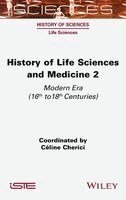
    History of Life Sciences and Medicine, Volume 2

    Modern Era (16th to 18th Centuries)

    AvCeline Cherici,Celine Cherici

    Inbunden, Engelska, 2026

    Del i serien ISTE Invoiced

    1 776 kr

    Beställningsvara. Skickas inom 5-8 vardagar. Fri frakt över 249 kr.

    Beskrivning

    Studying and understanding the history of life sciences and medicine in the modern era requires an in-depth reflection on knowledge that is often seen as contradictory.History of Life Sciences and Medicine 2 presents key concepts from the 16th to the 18th century in an accessible way. It analyses the history of anatomic pathology, clinical practice, experimentation, different life systems, transformism, and the role of images and classifications.This conceptual study of the history of life sciences thus redefines the links between medicine and biology in a period when the exploration and understanding of the body oscillated between different models, ranging from mechanism to vitalism.The analyses presented invite reflection on the singularity of ancient concepts such as 'life,' 'anatomy' and 'experience,' whose definitions are renewed according to techniques and experiments.

    Produktinformation

    • Utgivningsdatum:2026-03-24
    • Mått:163 x 240 x 21 mm
    • Vikt:570 g
    • Format:Inbunden
    • Språk:Engelska
    • Serie:ISTE Invoiced
    • Antal sidor:304
    • Förlag:ISTE Ltd
    • ISBN:9781789452099

    Utforska kategorier

    • Medicinhistoria inom Medicin
    • Biologi inom Naturvetenskap och teknik

    Mer om författaren

    Céline Cherici is Senior Lecturer in the History and Philosophy of Medicine at the University of Picardie Jules Verne, Amiens, France. Her research interests focus on the history of neuroscience.

    Innehållsförteckning

    • Presentation of Field "History of Science" xiJean-Claude DUPONTIntroduction xiiiCéline CHERICIChapter 1. From Dissection to the Origin of Diseases: 16th–18th Centuries 1Céline CHERICI1.1. Introduction 11.2. New explorations of the human body 21.3. From moving bodies to organs in pieces 141.4. Advent of the anatomopathological and clinical methods 221.5. Schools of thought modeling medical practice 301.6. Developments in clinical anatamopathology 321.7. Conclusion 341.8. References 35Chapter 2. The Clinic or the Art of Diagnosis 41Jean François THURLOY2.1. Introduction 412.2. The birth of a concept 422.3. Classification thinking 472.4. Searching for an effective treatment 512.5. The anatomo-clinical method 532.6. Institutionalization of the clinic: the hospital 542.7. Conclusion 572.8. References 58Chapter 3. Experimentation on Living Beings in the Modern Era 61Jean-Claude DUPONT3.1. Introduction 613.2. The emblematic case of blood circulation 623.3. The origins of the experimental exploration of living beings 683.4. The exploration of animal functions and experimental controversies 733.5. Chemical exploration of respiration 833.6. Conclusion 883.7. References 89Chapter 4. The Visible and the Invisible: Images of the Body, From Descartes to the Encyclopedists 97Paolo QUINTILI4.1. The legacy of humanism and the Renaissance 974.2. Separation of the microcosm and macrocosm: the Baroque period 1034.3. The Cartesian body machine: between Harvey and Descartes 1084.4. The successors of Descartes and the Flemish anatomists 1134.5. Images of the body during the Age of Enlightenment: from Lancisi to the Encyclopedia 1254.6. References 135Chapter 5. The Observation and Classification of Living Beings: The Animal, 16th–18th Centuries 143Jean-Luc GUICHET5.1. Introduction 1435.2. Ancient and medieval legacy 1445.3. The scholarly 16th century: a century of inventory and transition 1465.4. The 17th century: disruption at work 1505.5. The 18th century: classification, observation, the question of the human species 1555.6. Conclusion 1615.7. References 162Chapter 6. Observation and Classification of Living Beings: Plants 165Olivier PERRU6.1. Introduction 1656.2. Botany in the 16th century: description and conceptual framework 1666.3. Botany in the 17th century 1766.4. The epistemic revolution of the 18th century 1846.5. Conclusion 1886.6. References 189Chapter 7. Models, Systems, and Metaphors for Living Beings, from Descartes to Barthez 193Paolo QUINTILI7.1. Metaphor for life in the 17th century: the mechanism 1937.2. Criticisms of the Cartesian mechanism: pre-existence of germs, iatrochemistry and animism 1997.3. Spinoza and the "Spinozism" of the Enlightenment: the new life sciences 2057.4. Diderot, the Encyclopédie and the vitalism of the Montpellier School 2097.5. References 220Chapter 8. The Emergence of Transformism in the 18th and 19th Centuries 229Stéphane TIRARD8.1. Introduction 2298.2. Buffon and listing of species over time 2308.3. Thinking about life beyond dogma: a plethora of approaches 2378.4. Lamarck, story of a conversion: from fixism to "transformism" 2418.5. Cuvier and the compositional plans 2478.6. Geoffroy Saint-Hilaire and the principle of recapitulation 2488.7. Conclusion 2498.8. References 250List of Authors 253Index of Terms 255Index of Names 259Summary of Volume 1 265Summary of Volume 3 271