• Fri frakt över 249 kr
  • •
  • Snabba leveranser
  • •
  • Billiga böcker
Kundservice

Du är på sajten för privatpersoner.

Företag, bibliotek eller offentlig verksamhet?

Du handlar på classic.bokus.com, där alla dina funktioner finns intakta.
Till classic.bokus.com
Bokus logotyp. Gå till startsidan.
  • Erbjudanden
  • Nyheter
  • Student
  • Topplistor
  • Barn & ungdom
  • Bokus Play
  • E-böcker
  • Pocketböcker
  • Spel & pussel

10% rabatt på allt med kod: NYSTART10 →

Sidfot

Mina sidor

    Hjälp

    • Kundservice
    • Vanliga frågor och svar
    • Frakt och leverans
    • Retur vid ångerrätt
    • Reklamera vara
    • Betalning
    • Köpvillkor
    • Allmänna villkor
    • Information om webbplatsens tillgänglighet

    Om Bokus

    • Om oss
    • Pressrum
    • För studenter
    • För företag
    • För bibliotek och offentlig verksamhet
    • För leverantörer
    • Hållbarhet

    Populärt

    • Aktuella erbjudanden
    • Presentkort
    • Studentlitteratur
    • Nya böcker
    • Topplistor
    • Signerade böcker
    • Engelska böcker

    Inspiration

    • Boktips
    • BookTok
    • Populära bokserier
    • Barnbokskaraktärer
    • Populära författare
    Logotyp för Bokus
    Följ oss på Facebook (extern länk)Följ oss på Instagram (extern länk)Följ oss på YouTube (extern länk)Följ oss på TikTok (extern länk)
    bokus @ CookiesAnpassa cookiesIntegritetspolicyKöpvillkor
    Till Citymail hemsida (extern länk)Till Budbee hemsida (extern länk)Till Postnord hemsida (extern länk)Till Schenker hemsida (extern länk)Till Early Bird hemsida (extern länk)Till Walleys hemsida (extern länk)
    1. Psykologi och pedagogik
    2. Pedagogik
    3. Utbildningsstrategier och utbildningspolitik

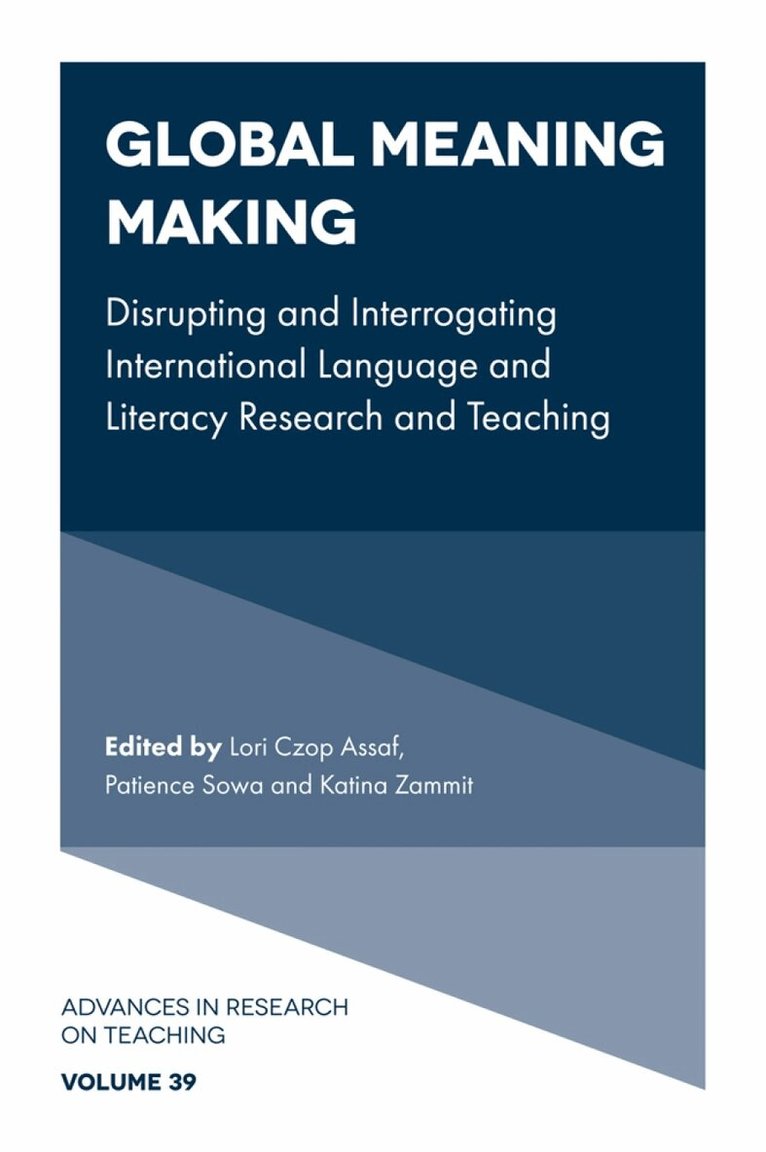
    Global Meaning Making

    Disrupting and Interrogating International Language and Literacy Research and Teaching

    AvLori Czop Assaf,Patience Sowa

    Inbunden, Engelska, 2022

    Del 39 i serien Advances in Research on Teaching

    1 270 kr

    Beställningsvara. Skickas inom 5-8 vardagar. Fri frakt över 249 kr.

    Beskrivning

    We live in an increasingly interdependent and interconnected world. The COVID-19 crisis has provided a stark reminder of the enormous educational inequities within and across countries around the globe. Featuring international language and literacy researchers who apply various tenets of global meaning making to disrupt and interrogate contradictions and tensions in global scholarship, Global Meaning Making focuses on a model of interrogating international literacy research and pedagogical pursuits with the ultimate goal of transforming how we engage in global endeavours. Organized around three major themes: Literacy Programs, Policies and Curriculum; Language of Instruction Policies and Practices and Engaging in Global Literacies, chapter authors reimagine global approaches that respect the histories, ways of knowing, needs, hopes and values of voices beyond the western, including those from the Global South: Asia, Africa, Oceania, and South and Central Americas. Each chapter outlines research the chapter authors are conducting or have conducted and describes implications for how their work utilizes tenets of global meaning making.

    Produktinformation

    • Utgivningsdatum:2022-08-23
    • Mått:152 x 229 x 23 mm
    • Vikt:585 g
    • Format:Inbunden
    • Språk:Engelska
    • Serie:Advances in Research on Teaching
    • Antal sidor:336
    • Förlag:Emerald Publishing Limited
    • ISBN:9781801179331

    Utforska kategorier

    • Utbildningsstrategier och utbildningspolitik inom Psykologi och pedagogik
    • Pedagogisk metodik inom Psykologi och pedagogik

    Mer om författaren

    Lori Czop Assaf works at Texas State University in the Department of Curriculum and Instruction. She teaches undergraduate and graduate literacy courses and coordinates the Early Childhood- 6th ESL Undergraduate Program. Assaf directs a study abroad program in rural Eastern Cape of South Africa and conducts research in Chile. As a Fulbright Scholar, Lori worked in Indonesia with university faculty, local classroom teachers, and primary grade students teaching language and literacy instruction. Her research includes teacher education, writing instruction and multicultural teaching and learning with a special focus on emergent bilinguals and English language learners.Patience Sowa is a Senior Literacy and Language Advisor in the International Education Division of RTI International’s International Development Group. She provides technical support to RTI country projects in literacy and language, and teacher professional development. Sowa has worked in multicultural and multilingual contexts in Africa, the Middle East and North America, as a teacher and teacher educator. Her research interests include preservice teacher preparation and teaching in bi/multilingual contexts. An international editorial board member of Teaching and Teacher Education, one of her recent publications is, “Higher grounds: Practical guidelines for forging learning pathways in upper primary education”.Katina Zammit works at Western Sydney University in the School of Education. She teaches literacy courses at undergraduate and postgraduate levels. As Associate Dean, Learning and Teaching, and Deputy Dean, Katina guides the development and accreditation of teacher education programs and post-initial teacher education programs. Zammit works closely with colleagues in school and fellow academics in Australia and other countries to improve student engagement in learning and literacy outcomes for students from culturally and linguistically diverse backgrounds and/or living in poverty. Her research interests include multiliteracies, writing and creating texts in multiple modes, transformative pedagogies and pedagogical leadership.

    Innehållsförteckning

    • Preface; Robert Tierney Section 1. Literacy Programs, Policies and Curriculum Chapter 1. Introduction: Stitching a Global Meaning Making Patchwork Quilt; Patience Sowa, Katina Zammit, and Lori Czop Assaf Chapter 2. International Literacy Development in the Peruvian Amazon: Three Problematic Assumptions; Desirée Pallais-Downing Chapter 3. Becoming Global Meaning Makers: The Making and Remaking of Literacy Education Expertise and Practice in Belize; Odelia Caliz, Ray Lawrence, Rashid Murillo, Denise Neal, Jennifer Sanders, Yvonne Tyndall-Howell, and Deborah Williams Chapter 4. Tapasā: An Invitation to Decolonize Literacy Teacher Education in Aotearoa New Zealand; Jessica Cira Rubin and David Taufui Mikato Fa’avae Chapter 5. Academic literacies from the South to the South: Tensions and Advances in Three Initiatives Located in Ibero-America; María Constanza Errázuriz, Lucía Natale, and Juan Antonio Núñez Cortés Section 2. Language of Instruction Policies and Practices Chapter 6. Challenges and Practical Considerations of the Choice of Languages of Instruction in Low and Middle Income Countries; Patience SowaChapter 7. Challenging Existing Spaces: Deconstructing Indigenous Power Imbalances within Aotearoa New Zealand; Rachel Martin and Amanda Denston Chapter 8. Between Many Worlds: Which Language to use in Primary Schools - Mother Tongue, Vernacular, or English?; Carol Abiri and Katina Zammit Chapter 9. Community Mapping in One Rural Community in South Africa: Teacher Candidates Grapple with Colonizing Influences on Language and Literacy; Lori Czop Assaf, Kristie O’Donnell Lussier, and Meagan Hoff Section 3. Engaging in Global Literacies Chapter 10. Interrupting Existing Frames and Being Mindful: An Examination of Culturally Responsive Teachers of High Performing Immigrant and Refugee Youth in a German Secondary School; K. Dara Hill Chapter 11. Cosmopolitanism to Frame Teaching Global Literacies; Shea N. Kerkhoff and Ming Yi Chapter 12. “My Way is a Little Bit Wrong:” How Refugee-Background Students Negotiate the Boundaries of American Academic Literacies; Meagan Hoff Chapter 13. School Interrupted: Issues and Perspectives from COVID-19 Remote Teaching; Chinwe H. Ikpeze and Susan Schultz Chapter 14. Voices of Chinese Students: What Motivates them to Read?; Jiening Ruan and Susan Schultz Chapter 15. Conclusion; Katina Zammit, Lori Czop Assaf, and Patience Sowa