• Fri frakt över 249 kr
  • •
  • Snabba leveranser
  • •
  • Billiga böcker
Kundservice

Du är på sajten för privatpersoner.

Företag, bibliotek eller offentlig verksamhet?

Du handlar på classic.bokus.com, där alla dina funktioner finns intakta.
Till classic.bokus.com
Bokus logotyp. Gå till startsidan.
  • Erbjudanden
  • Nyheter
  • Student
  • Topplistor
  • Barn & ungdom
  • Bokus Play
  • E-böcker
  • Pocketböcker
  • Spel & pussel

10% rabatt på allt med kod: NYSTART10 →

Sidfot

Mina sidor

    Hjälp

    • Kundservice
    • Vanliga frågor och svar
    • Frakt och leverans
    • Retur vid ångerrätt
    • Reklamera vara
    • Betalning
    • Köpvillkor
    • Allmänna villkor
    • Information om webbplatsens tillgänglighet

    Om Bokus

    • Om oss
    • Pressrum
    • För studenter
    • För företag
    • För bibliotek och offentlig verksamhet
    • För leverantörer
    • Hållbarhet

    Populärt

    • Aktuella erbjudanden
    • Presentkort
    • Studentlitteratur
    • Nya böcker
    • Topplistor
    • Signerade böcker
    • Engelska böcker

    Inspiration

    • Boktips
    • BookTok
    • Populära bokserier
    • Barnbokskaraktärer
    • Populära författare
    Logotyp för Bokus
    Följ oss på Facebook (extern länk)Följ oss på Instagram (extern länk)Följ oss på YouTube (extern länk)Följ oss på TikTok (extern länk)
    bokus @ CookiesAnpassa cookiesIntegritetspolicyKöpvillkor
    Till Citymail hemsida (extern länk)Till Budbee hemsida (extern länk)Till Postnord hemsida (extern länk)Till Schenker hemsida (extern länk)Till Early Bird hemsida (extern länk)Till Walleys hemsida (extern länk)
    1. Ekonomi och Ledarskap
    2. Nationalekonomi

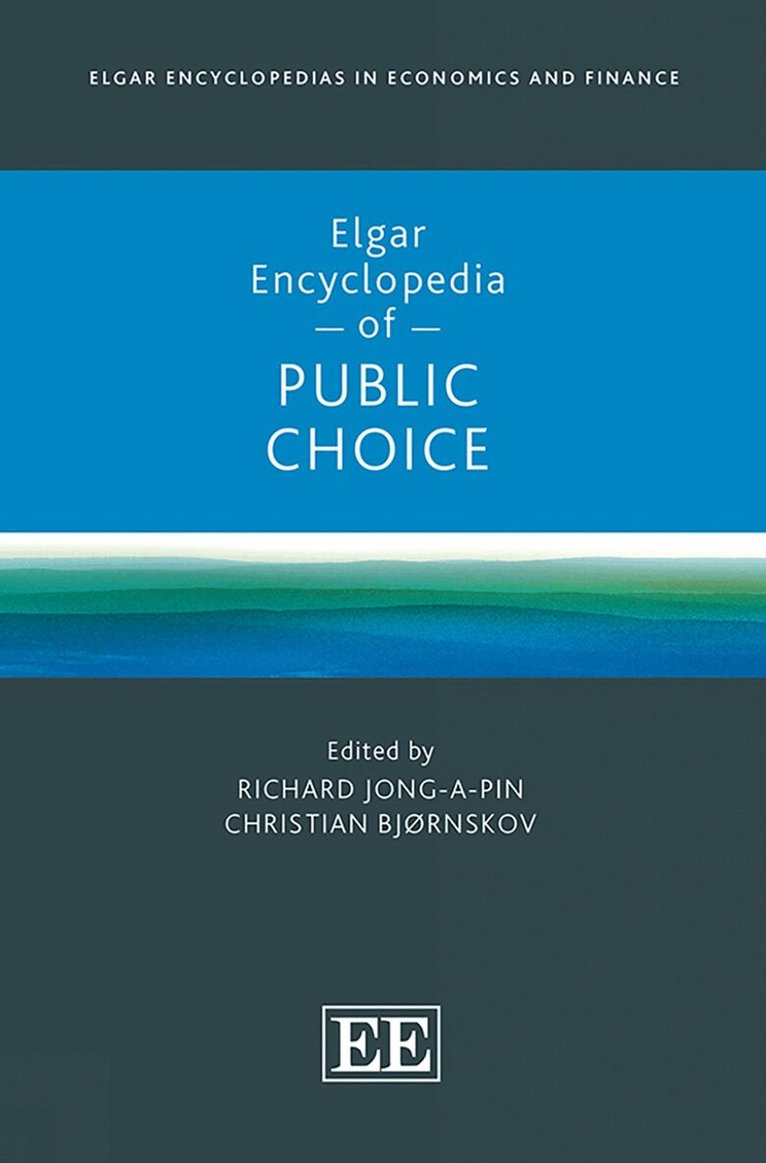
    Elgar Encyclopedia of Public Choice

    AvRichard Jong-A-Pin,Christian Bjørnskov

    Inbunden, Engelska, 2025

    Del i serien Elgar Encyclopedias in Economics and Finance series

    5 900 kr

    Beställningsvara. Skickas inom 5-8 vardagar. Fri frakt över 249 kr.

    Beskrivning

    The Elgar Encyclopedia of Public Choice offers a comprehensive and authoritative guide to the interdisciplinary field that bridges economics, political science, and philosophy. With contributions from leading scholars around the globe, this volume explores how incentives, institutions, and individual behavior shape collective decision-making in democratic and non-democratic contexts alike.Covering foundational concepts such as constitutionalism, rational ignorance, rent-seeking, the median voter, and Arrow’s impossibility theorem, the Encyclopedia also delves into contemporary debates on algorithmic fairness, authoritarian populism, expressive choice, and the role of emotion in politics. It brings public choice theory to bear on issues ranging from corruption, fiscal federalism, and globalization, to political dynasties, constitutional design, and the decline of democracy, and documents the unique insights of the approach.From classical models of strategic voting and collective action to emergent perspectives on behavioral asymmetries and belief consumption, this Encyclopedia illuminates the enduring relevance of public choice in understanding the mechanics of governance, power, policy, and political change.Essential reading for researchers, students, and practitioners, this is the definitive reference for anyone seeking to understand the logic—and limits—of political decision-making.Key Features:A diverse range of international expertsExamines how economics and politics influence each other in real-world settingsProvides forward-thinking insights into political behavior, corruption, election cycles and policy-making

    Produktinformation

    • Utgivningsdatum:2025-11-28
    • Mått:169 x 244 x undefined mm
    • Format:Inbunden
    • Språk:Engelska
    • Serie:Elgar Encyclopedias in Economics and Finance series
    • Förlag:Edward Elgar Publishing Ltd
    • ISBN:9781802207743

    Utforska kategorier

    • Nationalekonomi inom Ekonomi och Ledarskap
    • Referensverk och tvärvetenskap inom Samhälle och politik
    • Ekonomisk politik inom Ekonomi och Ledarskap

    Mer om författaren

    Edited by Richard Jong-A-Pin, Associate Professor of Economics, University College Groningen, University of Groningen, the Netherlands and Christian Bjørnskov, Professor of Economics, Department of Economics and Business, Aarhus University, Denmark and Affiliated Researcher, the Research Institute of Industrial Economics (IFN)

    Recensioner i media

    ‘Public choice brings the tools of economics to bear on politics, and this Encyclopedia shows just how far that approach can take us. A rigorous and wide-ranging resource, it reflects the depth and diversity of a field still reshaping how we understand collective decision-making.’

    Innehållsförteckning

    • ContentsPreface xiv1 Abstention 1François Facchini and Louis Jaeck2 Affect in public choice 9Frans van Winden3 Algorithmic fairness 17John Patty and Elizabeth Maggie Penn4 Anarchy and public choice 27Peter T. Leeson5 Apartheid 33Art Carden and Christopher Lingle6 Are voters informed and rational? 37Donald Wittman7 Arrow’s theorem and voting rules 45Nicholas R. Miller8 Attitudes toward globalization 51Philipp Harms and Nils D. Steiner9 Baumol’s cost disease and Leviathan 62Otto Brøns-Petersen10 Beauty in politics 70Niclas Berggren, Henrik Jordahl, and Panu Poutvaara11 Behavioral symmetry 81Cameron Tilley, Geoffrey Brennan, and Michael Munger12 Belief consumption 86Christian Schubert and Jan Schnellenbach13 By-product firms 93Paul Pecorino14 Candidates’ positions in deterministic multidimensional models 99Maria Gallego15 Candidates’ positions in probabilistic multidimensional policy models 107Maria Gallego16 Candidates’ positions in multidimensional valence models 115Maria Gallego17 Capitalism 123Art Carden and Ilia Murtazashvili18 Central bank independence 128Jakob de Haan19 Checks and balances in socialist countries 134Yang Zhou20 Coase theorem 139Randall G. Holcombe21 Coercion 144Art Carden, John Meadowcroft, and Ilia Murtazashvili22 Competition (antitrust) policy 152William F. Shughart II23 Consequences of globalization 159Niklas Potrafke and Jan-Egbert Sturm24 Constitutional political economy 167Georg Vanberg25 Corruption as a problem in public choice 175Susan Rose-Ackerman26 Covering and the uncovered set 181Nicholas R. Miller27 Decline of democracy? Part 1 187Ronald Wintrobe28 Decline of democracy? Part 2 194Ronald Wintrobe29 Democracy and the quality of institutions 199Pierre-Guillaume Méon30 Democratic quality and population health 206Alberto Batinti and Joan Costa-Font31 Democratization and the threat of revolution 212Toke S. Aidt and Raphaël Franck32 Development policy 220Andreas Freytag and Moritz Wolf33 Direct democracy 228John G. Matsusaka34 A dividend of democracy 235Thomas Markussen and Jean-Robert Tyran35 Duverger’s law and the seat product model 244Nicholas R. Miller36 Economic freedom: Impact on growth and inequality 252Jakob de Haan and Jan-Egbert Sturm37 The economic model of man 259Martin Paldam38 Elections and norms of behaviour 264Marco Giani and Pierre-Guillaume Méon39 Electoral engineering 271Uğurcan Evci and Marek M. Kaminski40 Elinor Ostrom 279Gert Tinggaard Svendsen41 Expressive choice 284Colin Jennings42 Females as policymakers 292Monika Köppl-Turyna43 Finance and income inequality 299Jakob de Haan, Regina Pleninger, and Jan-Egbert Sturm44 Fiscal equalization 309Monika Köppl-Turyna45 Fiscal federalism 314Christoph A. Schaltegger and Marco Portmann46 Foreign influence 325Toke S. Aidt, Facundo Albornoz, and Esther Hauk47 Government failure as failure of the market for politics 333Reiner Eichenberger and David Stadelmann48 Government propaganda 340Christopher J. Coyne and Yahya Alshamy49 Grease-the-wheels hypothesis 346Pierre-Guillaume Méon50 Group size paradox 355Paul Pecorino51 Informal or shadow economy 362Friedrich Schneider52 Information in rent-seeking contests 369Lambert Schoonbeek53 Institutions and economic growth 374Francisco José �Veiga54 International currency 384Carsten Hefeker55 International humanitarian aid 390Andreas Fuchs and Samuel Siewers56 Iterated Prisoner’s Dilemma: Basics 399Piotr Swistak57 Iterated Prisoner’s Dilemma: Results 403Piotr Swistak58 Measures of corruption 407Nadia Fiorino and Emma Galli59 Measuring electoral competitiveness: Part 1: Unpredictability 411Stanley L. Winer60 Measuring electoral competitiveness: Part 2: Contestability 420Stanley L. Winer61 Measuring democracy 425Tommy Krieger62 The median voter model 433Roger D. Congleton63 Methodological individualism 441Cameron Tilley and Michael Munger64 Military-industrial complex 447Christopher J. Coyne and Nathan P. Goodman65 Mixed electoral systems 454Jarosław Flis, Marek M. Kaminski, and Jeremiasz Salamon66 Nonviolent action 462Joshua Ammons and Christopher J. Coyne67 Outcomes of partisan politics 468Klaus Gründler, Niklas Potrafke, and Cameron A. Shelton68 Partisan gerrymandering 476Bernard Grofman and Jonathan Cervas69 Paying “cash-for-votes” 483Anand Murugesan and Jean-Robert Tyran70 Political budget cycles: Part 1: From political business to political budget cycles 493Frank Bohn, Lamar Crombach, and Jan-Egbert Sturm71 Political budget cycles: Part 2: Conditional national political budget cycles 501Jakob de Haan and Bram Gootjes72 Political budget cycles: Part 3: Subnational political budget cycles 513Francisco José �Veiga and Linda Gonçalves Veiga73 Political budget cycles: Part 4: Rationality in political budget cycle model 523Lamar Crombach, Frank Bohn, and Jan-Egbert Sturm74 Peer effects and social contagion 529Thomas Apolte and Kim Leonie Kellermann75 Pocketbook voting 538Panu Poutvaara and Robert Schwager76 Political dynasties 548Maqsood Aslam and Etienne Farvaque77 Political economy of emerging donors 553Angelika Budjan and Axel Dreher78 Political economy of entrepreneurship policy 563Daniel L. Bennett79 Political economy of international sanctions 571Jerg Gutmann, Matthias Neuenkirch, and Florian Neumeier 80 Political fragmentation: Impact on fiscal policy 579Jakob de Haan and Jan-Egbert Sturm81 Political legislation cycles 591Fabio Padovano82 Political economy of attention 599Patrick Balles, Ulrich Matter, and Alois Stutzer83 Political ideology 607Maite Laméris and Richard Jong-A-Pin84 Politico-economic models 613Friedrich Schneider85 Politics as exchange 619Randall G. Holcombe86 Primacy effects 623Marek M. Kaminski and Steven Linder87 Prisoner’s Dilemma 629Piotr Swistak88 Procyclical fiscal policy 633Toshihiro Ihori and Keigo Kameda89 Property rights and public choice 641Peter T. Leeson and Ennio E. Piano90 Public choice analysis of European integration 646Roland Vaubel91 Public choice and good governance 650Roger D. Congleton92 Public choice in the democracy of Ancient Athens 658George Tridimas93 Public debt 666François Facchini94 Public spending 674François Facchini95 Public choice and stadium subsidies 681John Charles Bradbury, Dennis Coates, and Brad R. Humphreys96 Public health and public choice 690Peter T. Leeson and Henry A. Thompson97 Public sector efficiency 696Monika Köppl-Turyna98 Ratchet effect 703Christopher J. Coyne, Abigail R. Hall, and Matthew A. Owens99 Relatively absolute absolutes 709Cameron Tilley and Michael Munger100 Rent seeking 715Kai A. Konrad101 Rise of authoritarian populism: A revolt against reason? 722Ronald Wintrobe102 Secession as a public choice 729Martin Rode103 Shortsightedness effect 738Joseph Connors and James Gwartney104 Slavery 742Art Carden, Phillip W. Magness, John Meadowcroft, and Ilia Murtazashvili105 Socialism 751Art Carden, Ilia Murtazashvili, and Anna Claire Flowers106 Status quo 759Cameron Tilley and Michael Munger107 Strategic corporate environmentalism 766Pim Heijnen 108 Strategic voting 769Aaron Hamlin, Whitney Hua, and Raquel Centeno109 Suicide terrorism and martyrdom 776Mario Ferrero110 Theocracy 780Mario Ferrero111 Threshold public good games 786Pim Heijnen112 The transitional gains trap 791Art Carden and Sarah Moore113 Trust in financial institutions and central banks 796Carin van der Cruijsen and Anna Samarina114 Uncertainty and economic reforms 805Carsten Hefeker and Michael Neugart115 US Constitutional Convention 811Keith Dougherty and Ted Rossier116 US Electoral College 817Nicholas R. Miller117 Voting motives 824Panu Poutvaara and Robert SchwagerIndex 834