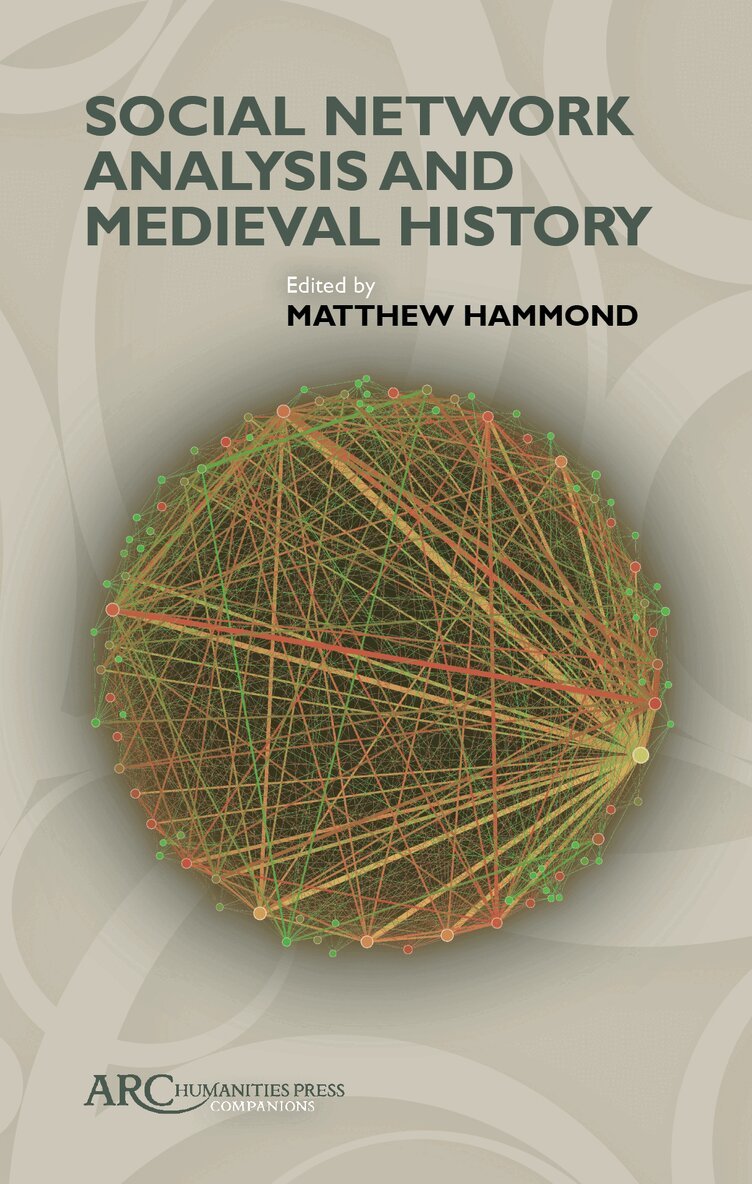
Social Network Analysis and Medieval History
2 933 kr
Beställningsvara. Skickas inom 5-8 vardagar. Fri frakt över 249 kr.
Du är på sajten för privatpersoner.
2 933 kr
Beställningsvara. Skickas inom 5-8 vardagar. Fri frakt över 249 kr.
Matthew Hammond, FRHistS, is a researcher at the University of Hull, and has previously worked at the University of Glasgow, King's College London, and the University of Edinburgh. As a creator of the People of Medieval Scotland database, he has been interested in social network analysis since 2013.
Social network analysis (SNA) has been gathering momentum in medieval studies for several decades, but edited volumes that systematically survey its application across such a wide range of sources, periods, and methodological questions remain rare. This collection, assembled by Matthew Hammond, fills that gap with ambition and considerable success. Fifteen chapters, organized into five thematic parts, carry the reader from foundational methodology to specific case studies in Scotland, Flanders, Iceland, and Germany, with a preface by Johannes Preiser-Kapeller that frames the broader stakes of the enterprise. The result is a serious and valuable reference point for historians wishing to understand what formal network methods can do with medieval evidence.[...]The volume’s strengths are considerable. The range of sources covered--narrative hagiography, saga literature, charter witness lists, inquisition depositions, benefice registers, urban debt records--demonstrates convincingly that SNA can be adapted to almost any relational evidence that survives from the medieval period. The willingness of contributors to reflect carefully on the limitations of their own methods, to distinguish network patterns that correspond to historical realities from those that may be artefacts of source survival or authorial shaping, is one of the volume’s most reassuring qualities. The five parts are coherently organized, and the progression from methodological introduction through source-specific applications to explicit testing of the approach gives the volume a satisfying intellectual arc.[…]Social Network Analysis and Medieval History is a serious and stimulating collection that will serve anyone working at the intersection of digital humanities and medieval studies. It is also an accessible and challenging introduction for historians considering formal network methods for the first time.
Stephanie L. Batkie, Matthew W. Irvin, Lynn Shutters
Inbunden, 2021
3 118 kr
Du är på sajten för privatpersoner.
2 933 kr
Beställningsvara. Skickas inom 5-8 vardagar. Fri frakt över 249 kr.
Matthew Hammond, FRHistS, is a researcher at the University of Hull, and has previously worked at the University of Glasgow, King's College London, and the University of Edinburgh. As a creator of the People of Medieval Scotland database, he has been interested in social network analysis since 2013.
Social network analysis (SNA) has been gathering momentum in medieval studies for several decades, but edited volumes that systematically survey its application across such a wide range of sources, periods, and methodological questions remain rare. This collection, assembled by Matthew Hammond, fills that gap with ambition and considerable success. Fifteen chapters, organized into five thematic parts, carry the reader from foundational methodology to specific case studies in Scotland, Flanders, Iceland, and Germany, with a preface by Johannes Preiser-Kapeller that frames the broader stakes of the enterprise. The result is a serious and valuable reference point for historians wishing to understand what formal network methods can do with medieval evidence.[...]The volume’s strengths are considerable. The range of sources covered--narrative hagiography, saga literature, charter witness lists, inquisition depositions, benefice registers, urban debt records--demonstrates convincingly that SNA can be adapted to almost any relational evidence that survives from the medieval period. The willingness of contributors to reflect carefully on the limitations of their own methods, to distinguish network patterns that correspond to historical realities from those that may be artefacts of source survival or authorial shaping, is one of the volume’s most reassuring qualities. The five parts are coherently organized, and the progression from methodological introduction through source-specific applications to explicit testing of the approach gives the volume a satisfying intellectual arc.[…]Social Network Analysis and Medieval History is a serious and stimulating collection that will serve anyone working at the intersection of digital humanities and medieval studies. It is also an accessible and challenging introduction for historians considering formal network methods for the first time.
Stephanie L. Batkie, Matthew W. Irvin, Lynn Shutters
Inbunden, 2021
3 118 kr
Du är på sajten för privatpersoner.
2 933 kr
Beställningsvara. Skickas inom 5-8 vardagar. Fri frakt över 249 kr.
Matthew Hammond, FRHistS, is a researcher at the University of Hull, and has previously worked at the University of Glasgow, King's College London, and the University of Edinburgh. As a creator of the People of Medieval Scotland database, he has been interested in social network analysis since 2013.
Social network analysis (SNA) has been gathering momentum in medieval studies for several decades, but edited volumes that systematically survey its application across such a wide range of sources, periods, and methodological questions remain rare. This collection, assembled by Matthew Hammond, fills that gap with ambition and considerable success. Fifteen chapters, organized into five thematic parts, carry the reader from foundational methodology to specific case studies in Scotland, Flanders, Iceland, and Germany, with a preface by Johannes Preiser-Kapeller that frames the broader stakes of the enterprise. The result is a serious and valuable reference point for historians wishing to understand what formal network methods can do with medieval evidence.[...]The volume’s strengths are considerable. The range of sources covered--narrative hagiography, saga literature, charter witness lists, inquisition depositions, benefice registers, urban debt records--demonstrates convincingly that SNA can be adapted to almost any relational evidence that survives from the medieval period. The willingness of contributors to reflect carefully on the limitations of their own methods, to distinguish network patterns that correspond to historical realities from those that may be artefacts of source survival or authorial shaping, is one of the volume’s most reassuring qualities. The five parts are coherently organized, and the progression from methodological introduction through source-specific applications to explicit testing of the approach gives the volume a satisfying intellectual arc.[…]Social Network Analysis and Medieval History is a serious and stimulating collection that will serve anyone working at the intersection of digital humanities and medieval studies. It is also an accessible and challenging introduction for historians considering formal network methods for the first time.
Stephanie L. Batkie, Matthew W. Irvin, Lynn Shutters
Inbunden, 2021
3 118 kr