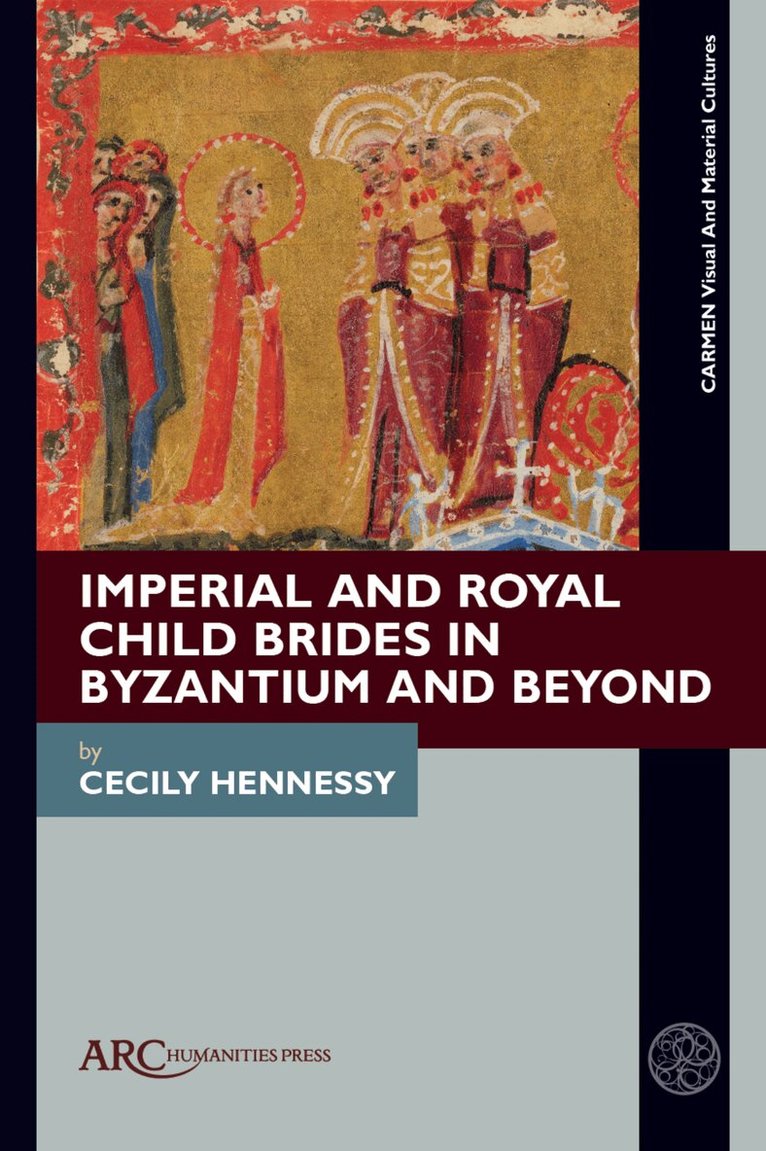
Inbunden, Engelska, 2025
Imperial and Royal Child Brides in Byzantium and Beyond
Del i serien CARMEN Visual and Material Cultures
2375 kr
Beställningsvara. Skickas inom 7-10 vardagar. Fri frakt över 249 kr.
Beskrivning
Produktinformation
- Utgivningsdatum: 2025-12-31
- Mått: 152 x 229 x undefined mm
- Format: Inbunden
- Språk: Engelska
- Serie: CARMEN Visual and Material Cultures
- Antal sidor: 244
- Förlag: Arc Humanities Press
- ISBN: 9781802702712
Utforska kategorier
Mer om författaren
Cecily Hennessy is a Byzantine art historian and former Academic Director of Christie’s Education. Her research includes images of the young and the family in Byzantine art; the art and architecture of Constantinople, Jerusalem, and Ravenna; and connections between Byzantine and Western art.
Recensioner i media
[C]hild marriage endures as a contemporary phenomenon, making Cecily Hennessy’s book surveying the lives of thirty-one Byzantine child brides from the tenth through the mid-fifteenth century highly relevant. Still, as the author notes, it is important to keep in mind that “concepts of youth, responsibility, maturity...are culturally dependent” (3-4), and therefore medieval child marriage must be viewed in its historical context, without making facile or misleading comparisons to practices today. It is important to keep in mind that Byzantium, like other pre-modern societies that had markedly low life expectancies, was a society of young people; it has been estimated that about half of the population was under the age of 20 at any given time.[...]Hennessy’s study explores the socio-political and cultural import of imperial and royal child marriage in Byzantium and across various medieval societies. Roughly half of the brides examined were Byzantine girls married off to foreign rulers, while one-third were foreign maidens wedded to Byzantine emperors or imperial heirs. The book opens with an informative chart (xvi-xix) that lists the brides, grooms, their ages at the time of betrothal and/or marriage, and the number of children produced from the union, along with the mother’s age at the time of the birth of the first and last child.[...]This book is a welcome addition to the study of Byzantine children and adolescents,[...] The book’s accessible style and ample illustrations render it approachable to readers new to the topic, while its scholarly apparatus that includes footnotes, a substantial (although not comprehensive) bibliography, and an index, furnishes useful resources for medievalists. Given the complex familial relationships of the protagonists, it would have been handy to include family trees that help the reader navigate the tangled kinship networks. Similarly, maps marking the birth places and marital homes of the child brides would provide valuable geographic context. Overall, this book successfully highlights the vital role young girls played in medieval diplomacy and statecraft, even if historians can only hypothesize about their lived experiences and emotional responses.
Betyg & recensioner
0 recensioner
Inga recensioner tillgängliga.