• Fri frakt över 249 kr
  • •
  • Snabba leveranser
  • •
  • Billiga böcker
Kundservice

Du är på sajten för privatpersoner.

Företag, bibliotek eller offentlig verksamhet?

Du handlar på classic.bokus.com, där alla dina funktioner finns intakta.
Till classic.bokus.com
Bokus logotyp. Gå till startsidan.
  • Erbjudanden
  • Nyheter
  • Student
  • Topplistor
  • Barn & ungdom
  • Bokus Play
  • E-böcker
  • Pocketböcker
  • Spel & pussel

10% rabatt på allt med kod: NYSTART10 →

Sidfot

Mina sidor

    Hjälp

    • Kundservice
    • Vanliga frågor och svar
    • Frakt och leverans
    • Retur vid ångerrätt
    • Reklamera vara
    • Betalning
    • Köpvillkor
    • Allmänna villkor
    • Information om webbplatsens tillgänglighet

    Om Bokus

    • Om oss
    • Pressrum
    • För studenter
    • För företag
    • För bibliotek och offentlig verksamhet
    • För leverantörer
    • Hållbarhet

    Populärt

    • Aktuella erbjudanden
    • Presentkort
    • Studentlitteratur
    • Nya böcker
    • Topplistor
    • Signerade böcker
    • Engelska böcker

    Inspiration

    • Boktips
    • BookTok
    • Populära bokserier
    • Barnbokskaraktärer
    • Populära författare
    Logotyp för Bokus
    Följ oss på Facebook (extern länk)Följ oss på Instagram (extern länk)Följ oss på YouTube (extern länk)Följ oss på TikTok (extern länk)
    bokus @ CookiesAnpassa cookiesIntegritetspolicyKöpvillkor
    Till Citymail hemsida (extern länk)Till Budbee hemsida (extern länk)Till Postnord hemsida (extern länk)Till Schenker hemsida (extern länk)Till Early Bird hemsida (extern länk)Till Walleys hemsida (extern länk)
    1. Kultur
    2. Arkitektur

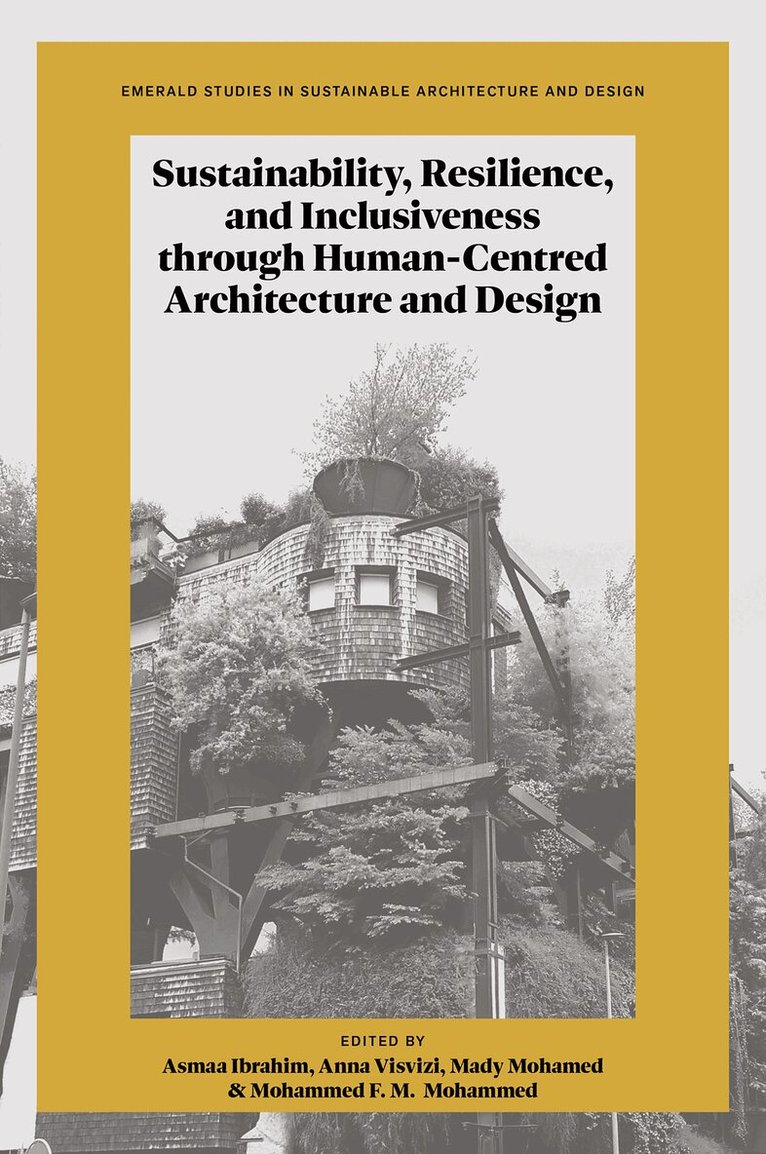
    Sustainability, Resilience, and Inclusiveness through Human-Centred Architecture and Design

    AvAsmaa Ibrahim,Anna Visvizi

    Inbunden, Engelska, 2026

    Del i serien Emerald Studies in Sustainable Architecture and Design

    1 134 kr

    Beställningsvara. Skickas inom 5-8 vardagar. Fri frakt över 249 kr.

    Beskrivning

    The way we design and build our cities, buildings, and public spaces takes on critical importance in the face of critical issues such as climate change, social inequality, and rapid urbanization. Architecture and design not only shape the environments in which we live but also influence energy use, natural resource management, and social inclusion. These disciplines have the potential to play a pivotal role in advancing sustainable development, yet their contributions are often overlooked.Sustainability, Resilience, and Inclusiveness through Human-Centred Architecture and Design examines the profound ways in which architecture and design can contribute to global imperatives framed by the United Nations Sustainable Development Goals (SDGs), particularly those focused on sustainable cities and communities (SDG 11), affordable and clean energy (SDG 7), and reduced inequalities (SDG 10).This volume offers a three-part exploration. Part 1 delves into energy efficiency, discussing innovations like biomimicry for zero-energy buildings and IoT-integrated systems in educational spaces. Part 2 bridges sustainability and heritage preservation, showcasing AI-assisted designs and adaptive placemaking strategies. Finally, Part 3 presents real-world case studies, from Saudi Arabia’s sustainable design frameworks to the impact of the pandemic on residential spaces in Egypt. With fresh insights and empirical evidence, this collected edition sets a new agenda for integrating human-centered approaches into sustainable design and architecture. Providing a vital resource for academics, policymakers, architects, and urban planners, Human-Centered Architecture and Design underscores the urgent need for collaboration across disciplines to create a built environment that supports thriving, resilient, and inclusive communities.

    Produktinformation

    • Utgivningsdatum:2026-03-09
    • Mått:152 x 229 x 16 mm
    • Vikt:393 g
    • Format:Inbunden
    • Språk:Engelska
    • Serie:Emerald Studies in Sustainable Architecture and Design
    • Antal sidor:256
    • Förlag:Emerald Publishing Limited
    • ISBN:9781805928829

    Utforska kategorier

    • Arkitektur inom Kultur

    Mer om författaren

    Asmaa Ibrahim, Ph.D., is a Professor of urban development at the Arch. Dep. Faculty of Engineering, Cairo University and the Dean of the College of Architecture & Design at Effat University. She has fourteen years of experience in strategic regional and urban planning projects in UN HABITAT, GOPP, and GIZ with a focus on community development, gender programming and regeneration policies in historic districts, and new urban expansions and more than 20 international publications in the field of sustainable urbanism.Anna Visvizi, Ph.D. (dr hab.), economist and political scientist, Professor at the SGH Warsaw School of Economics, and Visiting Professor at Effat University. Seasoned editor, researcher, recognized author, and accomplished project manager, Professor Visvizi has extensive experience in academia, think-tank and government sectors in Europe and the US, including the OECD.Mady Mohamed, Ph.D., Professor of Architecture, joined Effat University in Fall-2014. He received his PhD degree at Dundee School of Architecture, UK in July/2009. He has more than 20 years of academic and practice experience. Through his private firm, Mady participated in the design and construction for several projects, and he was the sole architect and the main architectural/LEED consultant for different residential, office, medical and educational buildings.Mohammed F. M. Mohammed, Ph.D., is a Professor of architecture and design. He received his Masters and Ph.D. in Architecture from Cairo University, Egypt in 1999, 2004 respectively. Dr. Mohammed has taught Architecture and Design in Egypt at Cairo University between 1995 and 2009. Also, he has taught Architecture and Design in KSA at Umm Al-Qura University between 2009 and 2013. He is currently teaching courses in capstone project and Design Studios at Effat University, Saudi Arabia.

    Innehållsförteckning

    • Chapter 1. Architecture and Design in Context of Climate Change: An Introduction; Asmaa Ibrahim, Mady Mohamed, Mohammed F. M. Mohammed, and Anna Visvizi PART I. ARCHITECTURE AND DESIGN FOR ENERGY EFFICIENCY Chapter 2. Promoting Renewable Energy Through Interior Architecture and Design: Focus on Carbon Emissions’ Reduction; Habibah Mohammed Abdulaziz Almulhim and Hanan Suliman Eissa Chapter 3. Sustainable Retrofitting: The Significance of Adapting the already Existing Buildings; Dina Ahmed Ahmed Elmeligy and Mohammad Refaat Mohammad Abdelaal Chapter 4. Energy Efficiency in Educational Buildings; Abobakr Al-Sakkaf, Basma Mostafa, Tarek S. Ghoniemy, and Sherif Ahmed Chapter 5. Integrating Bioengineering Principles in Interior Eco-Design for Promoting artificial intelligence (AI) and Sustainable Usability Responsible Functionality; Mai Ahmed Fakhrey Farahat Mousa Chapter 6. Simulation Analysis of a Hybrid Ventilation system to improve Internal Air Quality and Energy Performance of Buildings: A Case Study of a Residential Unit in Riyadh City, Saudi Arabia; Najat M.D. Al Ruwaily and Ahmed O.M.S. Mostafa Chapter 7. Differential Pressure Effect on Air Flow Through the “Takhtabush”; Mady Mohamed PART II. ARCHITECTURE AND DESIGN IN THE CONTEXT OF HERITAGE PROTECTION Chapter 8. Using Computer Applications to measure the Efficiency of Environmental Design in Heritage Buildings; Reem Elhaddad Chapter 9. Enhancing Building Climatic Performance Using AI-Assisted Facade Design: Evidence From Literature; Tarek Saad Ragab, Marah Aljassem, and Jury Aboanoor Chapter 10. Investment of the Historic “Mount Uhud” to Establish Mountain Resorts, Overlooking the Prophet's Mosque in Al-Madinah; Nusaibah Mohammed Abdualhammed Al-shabi and Marwa Hussein Tawfik Hussein PART III. CASE STUDIES: AN INSIGHT INTO THE DAY-TO-DAY PRACTICE OF ARCHITECTURE IN THE ARAB WORLDChapter 11. Developing a Sustainable Mountain Resorts Design Framework for Aseer, Saudi Arabia; Haifa Al-Harbi and Mostafa Sabbagh Chapter 12. Rethinking Home: The Influence of Pandemic on Residential Spaces in Egypt; Yasmin Hesham, Hussam Salama, and Ibrahim SalehChapter 13. Indoor Air Quality, Mitigating Co2 Concentration in Classrooms Using Adjacent Corridors And Atriums; Feras Balkhi, Mostafa Sabbagh, and Mohannad Bayoumi Chapter 14. Adapting Placemaking to Climate Change: Redefining the Placemaking Diagram; Tarek Saad Ragab, Ghadeer Alawi, and Mady Mohamed