• Fri frakt över 249 kr
  • •
  • Snabba leveranser
  • •
  • Billiga böcker
Kundservice

Du är på sajten för privatpersoner.

Företag, bibliotek eller offentlig verksamhet?

Du handlar på classic.bokus.com, där alla dina funktioner finns intakta.
Till classic.bokus.com
Bokus logotyp. Gå till startsidan.
  • Erbjudanden
  • Nyheter
  • Student
  • Topplistor
  • Barn & ungdom
  • Bokus Play
  • E-böcker
  • Pocketböcker
  • Spel & pussel

10% rabatt på allt med kod NYSTART10 →

Sidfot

Mina sidor

    Hjälp

    • Kundservice
    • Vanliga frågor och svar
    • Frakt och leverans
    • Retur vid ångerrätt
    • Reklamera vara
    • Betalning
    • Köpvillkor
    • Allmänna villkor
    • Information om webbplatsens tillgänglighet

    Om Bokus

    • Om oss
    • Pressrum
    • För studenter
    • För företag
    • För bibliotek och offentlig verksamhet
    • För leverantörer
    • Hållbarhet

    Populärt

    • Aktuella erbjudanden
    • Presentkort
    • Studentlitteratur
    • Nya böcker
    • Topplistor
    • Signerade böcker
    • Engelska böcker

    Inspiration

    • Boktips
    • BookTok
    • Populära bokserier
    • Barnbokskaraktärer
    • Populära författare
    Logotyp för Bokus
    Följ oss på Facebook (extern länk)Följ oss på Instagram (extern länk)Följ oss på YouTube (extern länk)Följ oss på TikTok (extern länk)
    bokus @ CookiesAnpassa cookiesIntegritetspolicyKöpvillkor
    Till Citymail hemsida (extern länk)Till Budbee hemsida (extern länk)Till Postnord hemsida (extern länk)Till Schenker hemsida (extern länk)Till Early Bird hemsida (extern länk)Till Walleys hemsida (extern länk)
    1. Naturvetenskap och teknik
    2. Teknik och industri
    3. Maskinteknik och material

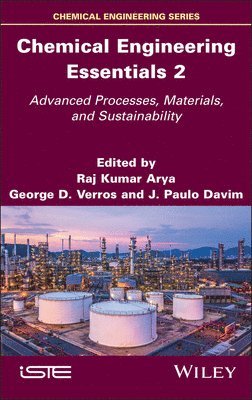
    Chemical Engineering Essentials, Volume 2

    Advanced Processes, Materials, and Sustainability

    AvRaj K. Arya,Raj K. Arya

    Inbunden, Engelska, 2025

    Del i serien ISTE Invoiced

    1 721 kr

    Beställningsvara. Skickas inom 5-8 vardagar. Fri frakt över 249 kr.

    Beskrivning

    In an era of rapid innovation and with a focus on sustainability, Chemical Engineering Essentials provides a definitive guide to mastering the discipline. Divided into two volumes, this series offers a seamless blend of foundational knowledge and advanced applications to address the evolving needs of academia and industry.Volume 1 lays a strong foundation with topics such as material and energy balances, thermodynamics, phase equilibrium, fluid mechanics, transport phenomena, and essential separation processes such as distillation and membrane technologies.This volume builds on these principles, delving into reaction engineering, reactor modeling with MATLAB and ASPEN PLUS, material properties, process intensification and nanotechnology. It also addresses critical global challenges, emphasizing green chemistry, waste minimization, resource recovery, and workplace safety.Together, these volumes provide a holistic understanding of chemical engineering, equipping readers with the tools to innovate and lead in a dynamic and sustainable future.

    Produktinformation

    • Utgivningsdatum:2025-07-06
    • Mått:156 x 234 x 19 mm
    • Vikt:626 g
    • Format:Inbunden
    • Språk:Engelska
    • Serie:ISTE Invoiced
    • Antal sidor:320
    • Förlag:ISTE Ltd
    • ISBN:9781836690177

    Utforska kategorier

    • Maskinteknik och material inom Naturvetenskap och teknik
    • Tillverkningsteknik inom Naturvetenskap och teknik

    Mer om författaren

    Raj Kumar Arya works at the Dr. B. R. Ambedkar National Institute of Technology in Jalandhar, India.George D. Verros works in the Public Sector in Thessaloniki, Greece.J. Paulo Davim works at the University of Aveiro in Aveiro, Portugal.

    Innehållsförteckning

    • Preface xiiiRaj Kumar ARYA, George D. VERROS and J. Paulo DAVIMPart 1. Reaction Engineering 1Chapter 1. Compaction, Compression and Consolidation in Pharmaceutical Industries 3Neha DHIMAN and Girish GUPTA1.1. Introduction to compression, compaction and consolidation 31.2. Definition and importance in pharmaceutical manufacturing 41.3. Powder properties and their characterization 71.4. Powdered characterization techniques 121.5. Tablet compression, compaction process and consolidation mechanisms 151.6. Tablet properties and quality control 191.7. Tablet manufacturing challenges 231.8. Compaction data analysis 251.9. Conclusion 281.10. References 28Chapter 2. Reactive Chromatography: A Concept of Multifunctional Reactors 31Praveen Kumar GHODKE, Sudip DAS and Rohidas BHOI2.1. Introduction 312.2. Concept of multifunctional reactor 322.3. Reactive distillation 322.4. Reactive chromatography 332.5. Types of chromatographic reactors 342.6. Comparative discussion 412.7. Applications of chromatographic reactors 412.8. Mathematical modeling of chromatographic reactors 442.9. Mathematical modeling of FBCRs 442.10. Equilibrium-based continuous models 462.11. General rate model and simplified versions 462.12. Phase distribution 462.13. Model parameters 512.14. Adsorption equilibrium isotherms 512.15. Challenges and future prospect of chromatographic reactors 572.16. References 58Chapter 3. Mathematical Modeling of a Batch Reactor and a Non-Isothermal CSTR with Their Respective Simulation Using MATLAB and ASPEN PLUS 63Karthikeyan C., Praveen Kumar V., Preetha V. and Faheem ARAKKAL3.1. Introduction 633.2. Modeling of a batch reactor 643.4. Conclusion 743.5. References 75Part 2. Material Properties and Advanced Applications 79Chapter 4. Properties of Materials and Selection Criteria 81Dharmesh SUR, Abhishek GUPTA, Swati DUBEY and Avanish KUMAR4.1. Introduction 814.2. Mechanical properties 834.3. Chemical properties 884.4. Other significant properties 914.5. Criteria for material selection with design consideration 944.6. References 106Chapter 5. Hydrogen Production Pathways and Role of Catalysts 109Anjali BAUDH, Sweta SHARMA and Rajesh Kumar UPADHYAY5.1. Introduction 1095.2. Hydrogen production mechanisms 1105.3. Renewable production methods 1175.4. Conventional and membrane reformers 1215.5. Catalysts for hydrogen production technologies 1225.6. Conclusion and future prospects 1265.7. References 127Chapter 6. Maximizing Vinyl Chloride Production: An ASPEN PLUS Simulation Approach 131Edwin Varghese THOMAS, Selva KUMAR RAJA K., Karthikeyan C., Muthamizhi K. and Akhila HARIHARAN6.1. Introduction 1316.2. Methodology 1356.3. Results and discussion 1376.4. Energy used 1406.5. Conclusion 1416.6. References 141Chapter 7. Process Intensification and Advanced Materials 143Madhura A. BODKHE7.1. Introduction 1437.2. Process intensification technologies 1467.3. Integration of process intensification and advanced materials 1537.4. Conclusion and future prospects 1657.5. References 167Chapter 8. Nanotechnology in Chemical Engineering 173Nandlal PINGUA, Avinash CHANDRA, Arvind K. GAUTAM, Raj Kumar ARYA and Akash KUMAR8.1. Introduction to nanotechnology 1748.2. Role of nanotechnology in chemical engineering 1748.3. Emerging trends in nanotechnology-based chemical engineering 1778.4. Challenges and solutions in nanotechnology for chemical engineers 1798.5. Impact of nanotechnology on the future of chemical engineering 1818.6. Case studies on the application of nanotechnology in chemical engineering 1848.7. Future prospects of nanotechnology in chemical engineering 1928.8. Conclusion 1968.9. References 199Part 3. Sustainability and Safety 205Chapter 9. Green Chemistry and Sustainable Processes 207Amit PARASHAR, Anurag TEWARI, Prahalad PRASAD PAROHA, Shikha GOVIL, Rajeev Kumar SINGH, Shailendra BADAL and Pastor ARGULLES9.1. Introduction 2089.2. The principles of green chemistry 2099.3. Applications of green chemistry 2189.4. Challenges and barriers 2239.5. Sustainable processes 2259.6. Case study: green chemistry in the textile industry 2269.7. Conclusion 2289.8. Acknowledgments 2299.9. References 229Chapter 10. Waste Minimization and Resource Recovery 235Swati DUBEY, Avanish KUMAR, Abhishek GUPTA and Dharmesh SUR10.1. Introduction 23510.2. Types of wastes and various waste minimization techniques 23710.3. Advantages of waste minimization 24010.4. Process enhancement through waste minimization in chemical engineering 24010.5. Resource recovery as an efficient way to minimize waste 24110.6. Sustaining waste minimization 24310.7. References 244Chapter 11. Safety Management: Hazard Identification and Risk Assessment at the Workplace 247Sushama AGARWALLA, Sunil Kumar SINGH, Mohammed Adil IBRAHIM and Suhanya DURAISWAMY11.1. Introduction 24711.2. Hazard identification 25111.3. Process hazards checklist 25211.4. Hazard survey 25511.5. Hazards and operability (HAZOP) studies 26411.6. Safety review 26511.7. Other methods 26711.8. Risk assessment 26811.9. Quantitative risk analysis 26911.10. Conclusion 27211.11. References 272List of Authors 277Index 281Summary of Volume 1 285