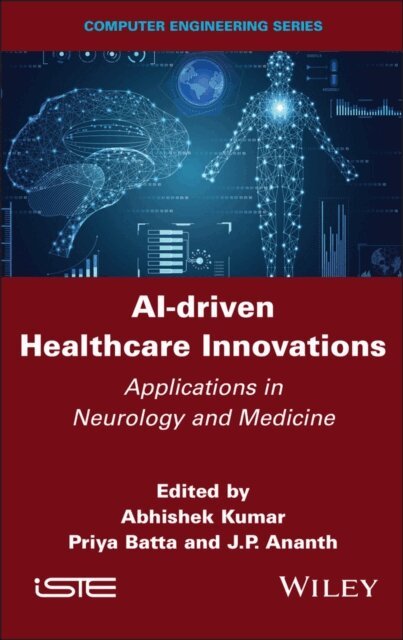
AI-driven Healthcare Innovations
Applications in Neurology and Medicine
1 819 kr
Beställningsvara. Skickas inom 5-8 vardagar. Fri frakt över 249 kr.
Beskrivning
Produktinformation
- Utgivningsdatum:2026-04-20
- Mått:156 x 234 x 22 mm
- Vikt:738 g
- Format:Inbunden
- Språk:Engelska
- Serie:ISTE Invoiced
- Antal sidor:400
- Förlag:ISTE Ltd
- ISBN:9781836690962
Utforska kategorier
Mer om författaren
Abhishek Kumar, Senior IEEE Member and Professor at Chandigarh University, India, is a prolific researcher with 170+ publications and has international postdoctoral experience. His expertise spans AI, renewable energy and image processing.Priya Batta is Associate Professor at Amity School of Engineering and Technology, Amity University Punjab, Mohali, India. She has over 12 years of academic experience and has edited several books. She actively contributes her research to reputed journals and conferences. Her expertise includes AI, blockchain and IoT.J.P. Ananth is Professor of CSE and Director of IQAC at Dayananda Sagar University, Bengaluru, India. With 23 years of experience, he is also a senior IEEE member and a key contributor to academic quality assurance and examination systems.
Innehållsförteckning
- Preface xxiiiAbhishek KUMAR, Priya BATTA and J.P. ANANTHChapter 1. Artificial Intelligence in Healthcare: Principles, Paradigms and Emerging Trends 1Shilpa C. PATIL and Salim Allauddin CHAVAN1.1. Introduction 21.2. Principles of AI in healthcare 31.3. Paradigms of AI in healthcare 51.4. Emerging trends in AI-driven healthcare 71.5. Challenges and limitations 101.6. Future directions 121.7. Conclusion 121.8. References 13Chapter 2. Machine Learning Models for Diagnostic Decision-Making in Neurology 17Sunil Ramrao YADAV and Kalpana MALPE2.1. Introduction 172.2. Overview of ML in healthcare 192.3. Supervised learning models in neurological diagnosis 202.4. Unsupervised and semi-supervised approaches 212.5. DL for neuroimaging and signal analysis 242.6. Multimodal and integrative diagnostic models 272.7. XAI and clinical interpretability 282.8. Future directions in ML for neurological diagnostics 302.9. Conclusion 312.10. References 31Chapter 3. Deep Learning Approaches to Neuroimaging and Brain Mapping 35G.V. RAMDAS and G.M. VAIDYA3.1. Introduction 353.2. Deep learning fundamentals for neuroimaging 373.3. Applications in structural neuroimaging (MRI, CT) 413.4. Applications in functional neuroimaging (fMRI, PET, EEG/MEG) 433.5. Brain mapping and connectomics with deep learning 453.6. Clinical applications and translational potential 463.7. Challenges, limitations and future directions 483.8. Conclusion 503.9. References 50Chapter 4. Predictive Analytics for Early Detection of Neurodegenerative Disorders 53Debabrata SAHANA and K. GAVHALE4.1. Introduction 534.2. Predictive analytics framework for neurodegenerative disorders 554.3. Applications of predictive analytics in specific neurodegenerative disorders 594.4. Emerging trends and methodological advances 624.5. Challenges, ethical considerations and future directions 644.6. Conclusion 674.7. References 67Chapter 5. AI-Enhanced Stroke Diagnosis, Prognosis and Rehabilitation Pathways 71Rahul PATIL and Fazil SHEIKH5.1. Introduction 715.2. AI in stroke diagnosis 735.3. AI in stroke prognosis 755.4. AI in stroke rehabilitation pathways 775.5. Integration into clinical workflows 795.6. Future directions 815.7. Conclusion 835.8. References 84Chapter 6. Computational Biomarker Discovery for Neurological and Psychiatric Disorders 87Chaitnya GODBOLE and Shamla MANTRI6.1. Introduction 876.2. Computational approaches for biomarker discovery 896.3. Machine learning and AI in biomarker identification 926.4. Biomarkers in neurological disorders 966.5. Biomarkers in psychiatric disorders 986.6. Challenges and future directions 1006.7. Conclusion 1026.8. References 103Chapter 7. Natural Language Processing for Clinical Narratives and Neurological Case Records 107Shrikrishna N. BAMNE and Swapna KAMBLE7.1. Introduction 1087.2. NLP fundamentals in clinical narratives 1097.3. Applications in neurology and case records 1117.4. Advances in model architectures 1137.5. Clinical Utility: diagnosis, prognosis and treatment support 1157.6. Integration with EHR and clinical workflows 1177.7. Challenges: bias, privacy, data scarcity and interpretability 1187.8. Future perspectives 1207.9. Conclusion 1217.10. References 122Chapter 8. AI-Integrated Wearable Technologies for Continuous Neurological Monitoring 125Swati JAGTAP and Ashish N. PATIL8.1. Introduction 1258.2. AI in wearable neurological monitoring 1278.3. Clinical applications 1298.4. System architecture and data integration 1338.5. Challenges and limitations 1368.6. Future directions 1388.7. Conclusion 1398.8. References 140Chapter 9. Epilepsy Forecasting and Seizure Prediction Through AI Algorithms 143Ashwini R. GARGATE and Komal M. JUJAR9.1. Introduction 1449.2. Pathophysiology and challenges of seizure prediction 1459.3. AI in epilepsy forecasting: an overview 1469.4. Machine learning approaches for seizure prediction 1489.5. Deep learning and neural network models 1509.6. Multimodal data integration for seizure forecasting 1529.7. Wearable devices and real-time forecasting 1549.8. Privacy, ethics and data challenges 1559.9. Future directions in AI-driven seizure forecasting 1569.10. Conclusion 1579.11. References 158Chapter 10. Intelligent Robotic Systems for Neurorehabilitation and Assistive Care 161Debabrata SAHANA and Atul Namdev PAWAR10.1. Introduction 16210.2. Principles of intelligent robotic systems 16210.3. Robotics in neurorehabilitation 16410.4. Assistive robotics for daily living 16610.5. Technological paradigms and enablers 16710.6. Clinical evidence and applications 16810.7. Challenges and limitations 17110.8. Emerging trends and future directions 17310.9. Conclusion 17410.10. References 175Chapter 11. Personalized Medicine in Multiple Sclerosis Through AI-Driven Analytics 179Chaitnya GODBOLE and Shrikant Rangrao KADAM11.1. Introduction 18011.2. Overview of multiple sclerosis and the need for personalization 18111.3. AI in MS diagnosis and early detection 18111.4. AI-driven prognostic modeling in MS 18311.5. Personalized treatment strategies through AI analytics 18411.6. Integration of multi-omics and biomarkers 18611.7. Role of neuroimaging and computer vision 18711.8. AI-powered monitoring and patient engagement 18811.9. Challenges, ethical concerns and limitations 19011.10. Future directions and clinical translation 19111.11. Conclusion 19311.12. References 193Chapter 12. Artificial Intelligence Applications in Sleep Medicine and Neurological Disorders 197Swati JAGTAP and Sharifnawaj Y. INAMDAR12.1. Introduction 19812.2. AI in sleep medicine 19912.3. AI in neurological disorders 20112.4. Multimodal data integration and predictive analytics 20312.5. Ethical, legal and clinical challenges 20612.6. Future directions 20712.7. Conclusion 20812.8. References 209Chapter 13. Virtual and Augmented Reality Coupled with AI for Cognitive Rehabilitation 213Omkar KULKARNI and Amruta B. KALE13.1. Introduction 21413.2. Foundations of cognitive rehabilitation 21513.3. VR in cognitive rehabilitation 21613.4. AR in cognitive rehabilitation 21713.5. AI for adaptive therapy 21813.6. Synergistic role of VR/AR coupled with AI 21913.7. Clinical applications and case studies 22113.8. Technological innovations and tools 22213.9. Challenges and ethical considerations 22313.10. Future directions and research opportunities 22413.11. Conclusion 22513.12. References 226Chapter 14. AI-Driven Drug Discovery Pipelines for Neurological and Mental Health Therapies 229Sharad KSHIRSAGAR and Ashish N. PATIL14.1. Introduction 22914.2. Principles of AI in drug discovery 23114.3. AI in target identification and biomarker discovery 23214.4. AI in hit discovery and lead optimization 23314.5. AI in drug repurposing for neurological and mental health disorders 23514.6. AI in preclinical and clinical trial design for neurological and mental health therapies 23614.7. Ethical, regulatory, and societal implications of AI in neurological and psychiatric drug discovery 23814.8. Future directions and emerging trends in AI-driven drug discovery for neurological and mental health therapies 24114.9. Conclusion 24214.10. References 242Chapter 15. Ethical, Legal and Societal Implications of AI in Neurology and Medicine 245Dipali JANKAR and Anil SAHU15.1. Introduction 24615.2. AI in neurology and medicine: an overview 24715.3. Ethical implications 24915.4. Legal implications 25115.5. Societal implications 25315.6. Challenges and future perspectives 25615.7. Conclusion 25815.8. References 258Chapter 16. Federated Learning and Collaborative AI Models in Neuroscience Research 261Dipali JANKAR and Sanjay L. BADJATE16.1. Introduction 26116.2. Fundamentals of FL in neuroscience 26316.3. Collaborative AI models in neuroscience 26516.4. Applications of FL and collaborative AI in neuroscience 26716.5. Challenges and limitations of FL and collaborative AI in neuroscience 27116.6. Future directions 27416.7. Conclusion 27416.8. References 275Chapter 17. AI-enabled Approaches for Pain Prediction, Assessment and Management 279Mario ANTONY and Salim Allauddin CHAVAN17.1. Introduction 27917.2. AI for pain prediction 28117.3. AI for pain assessment 28317.4. AI in pain management 28517.5. Challenges and limitations of AI in pain medicine 28717.6. Ethical, legal and future directions 29017.7. Conclusion 29117.8. References 292Chapter 18. Conversational AI and Virtual Assistants for Neurological Patient Support 295Nikhilchandra MAHAJAN and Piyush Ashokrao DALKE18.1. Introduction 29518.2. Technological foundations of conversational AI in healthcare 29618.3. Clinical applications of conversational AI in neurological care 29818.4. Benefits and opportunities of conversational AI for neurological support 30218.5. Challenges and limitations 30418.6. Future directions and research opportunities 30518.7. Conclusion 30818.8. References 308Chapter 19. Brain–Computer Interfaces Enhanced by Artificial Intelligence 311Rahul S.S. and Mrudula NIMBARTE19.1. Introduction 31119.2. Neural signal acquisition and preprocessing 31319.3. AI-driven neural decoding and feature extraction 31519.4. Applications of AI-enhanced BCIs 31819.5. Challenges, ethical considerations and future directions 32219.6. Conclusion 32419.7. References 325Chapter 20. The Future of AI in Neurology: Innovations, Challenges and Strategic Directions 329Sunil Ramrao YADAV and Mrudula NIMBARTE20.1. Introduction 32920.2. AI in neurological diagnostics 33120.3. AI in prognosis and disease progression modeling 33320.4. AI in therapeutics and rehabilitation 33520.5. Challenges and ethical considerations 33920.6. Strategic directions for the future 34120.7. Conclusion 34220.8. References 343List of Authors 347Index 351
Du kanske också är intresserad av
Physiotherapy Using Artificial Intelligence
S. Oswalt Manoj, J. P. Ananth, Sachin Ahuja, T. Ananth Kumar, Abhishek Kumar
3 082 kr
Classical and Quantum Principal Component Analysis in Data Engineering
Abhishek Kumar, J. P. Ananth, S. Oswalt Manoj, Naveet Kaur, A. Jayanthiladevi
Inbunden, 2026
2 263 kr
Physiotherapy Using Artificial Intelligence
S. Oswalt Manoj, J. P. Ananth, Sachin Ahuja, T. Ananth Kumar, Abhishek Kumar
3 082 kr
Agricultural Supply Chain Using Federated Learning
Abhishek Kumar, Pooja Dixit, J. P. Ananth, S. Oswalt Manoj, S. Panneerselvam
Inbunden, 2026
2 318 kr
Physiotherapy Using Artificial Intelligence
Abhishek Kumar, T. Ananth Kumar, Sachin Ahuja, J. P. Ananth, S. Oswalt Manoj
Inbunden, 2026
2 609 kr
- Nyhet
Agricultural Supply Chain Using Federated Learning
S. Panneerselvam, S. Oswalt Manoj, J. P. Ananth, Pooja Dixit, Abhishek Kumar
2 565 kr
Brain-Computer Interfaces for Neurorehabilitation
J. Reyes Juárez Ramírez, Abhishek Kumar, Pramod Singh Rathore, Priya Batta, Sachin Ahuja
Häftad, 2026
2 517 kr
AI-driven Innovations in Physiotherapy and Oncology, Volume 2
Pramod Singh Rathore, Sachin Ahuja, Priya Batta, Abhishek Kumar
1 981 kr