• Fri frakt över 249 kr
  • •
  • Snabba leveranser
  • •
  • Billiga böcker
Kundservice

Du är på sajten för privatpersoner.

Företag, bibliotek eller offentlig verksamhet?

Du handlar på classic.bokus.com, där alla dina funktioner finns intakta.
Till classic.bokus.com
Bokus logotyp. Gå till startsidan.
  • Erbjudanden
  • Nyheter
  • Student
  • Topplistor
  • Barn & ungdom
  • Bokus Play
  • E-böcker
  • Pocketböcker
  • Spel & pussel

10% rabatt på allt med kod: NYSTART10 →

Sidfot

Mina sidor

    Hjälp

    • Kundservice
    • Vanliga frågor och svar
    • Frakt och leverans
    • Retur vid ångerrätt
    • Reklamera vara
    • Betalning
    • Köpvillkor
    • Allmänna villkor
    • Information om webbplatsens tillgänglighet

    Om Bokus

    • Om oss
    • Pressrum
    • För studenter
    • För företag
    • För bibliotek och offentlig verksamhet
    • För leverantörer
    • Hållbarhet

    Populärt

    • Aktuella erbjudanden
    • Presentkort
    • Studentlitteratur
    • Nya böcker
    • Topplistor
    • Signerade böcker
    • Engelska böcker

    Inspiration

    • Boktips
    • BookTok
    • Populära bokserier
    • Barnbokskaraktärer
    • Populära författare
    Logotyp för Bokus
    Följ oss på Facebook (extern länk)Följ oss på Instagram (extern länk)Följ oss på YouTube (extern länk)Följ oss på TikTok (extern länk)
    bokus @ CookiesAnpassa cookiesIntegritetspolicyKöpvillkor
    Till Citymail hemsida (extern länk)Till Budbee hemsida (extern länk)Till Postnord hemsida (extern länk)Till Schenker hemsida (extern länk)Till Early Bird hemsida (extern länk)Till Walleys hemsida (extern länk)
    1. Ekonomi och Ledarskap
    2. Nationalekonomi

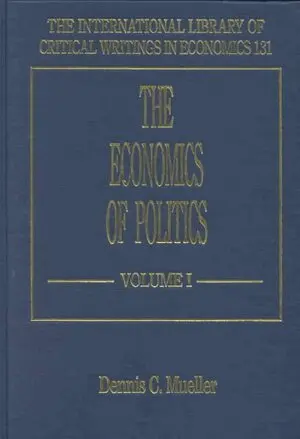
    Economics of Politics

    AvDennis C. Mueller

    Inbunden, Engelska, 2001

    Del 131 i serien The International Library of Critical Writings in Economics series

    9 705 kr

    Beställningsvara. Skickas inom 5-8 vardagar. Fri frakt över 249 kr.

    Beskrivning

    This two-volume anthology contains many of the classic articles from the public choice/rational politics field and includes a new introduction prepared by the editor.Volume I is divided into four parts: The Nature of Democratic Government, Majority Rule, Other Voting Rules and Clubs and Local Politics. Volume II is divided into the following four parts: Representative Democracy, Bureaucracy, Political Business Cycles, and Democratic Dilemmas. Included are excerpts from such classic pieces as Buchanan and Tullock's Calculus of Consent, Downs's Economic Theory of Democracy, Olson's Logic of Collective Action and Niskanen's Bureaucracy and Representative Government, as well as articles by Coase, May, Black, McKelvey, Groves, Ledyard, Vernon Smith, Tiebout, Breton, Stigler, Romer, Rosenthal, Arrow, Sen, Satterthwaite, Gibbard and many more.

    Produktinformation

    • Utgivningsdatum:2001-06-27
    • Mått:169 x 244 x undefined mm
    • Format:Inbunden
    • Språk:Engelska
    • Serie:The International Library of Critical Writings in Economics series
    • Förlag:Edward Elgar Publishing Ltd
    • ISBN:9781840644258

    Utforska kategorier

    • Nationalekonomi inom Ekonomi och Ledarskap
    • Ekonomisk politik inom Ekonomi och Ledarskap
    • Statsvetenskap och politisk teori inom Samhälle och politik

    Mer om författaren

    Edited by Dennis C. Mueller, Professor of Economics, University of Vienna, Austria

    Recensioner i media

    '. . . this new Elgar's collection of writings on public choice is a great monument to this new scientific area of economics. In addition, what makes it very useful is that the framework followed by Dennis Mueller reflects very closely the way he organised the contents of his volume on public choice, which makes these volumes a good complement to his landmark on the subject.'

    Innehållsförteckning

    • Contents:Volume IAcknowledgementsIntroduction Dennis C. MuellerPART ITHE NATURE OF DEMOCRATIC GOVERNMENT1. Knut Wicksell (1896/1967), ‘The Principle of (Approximate) Unanimity and Voluntary Consent in Taxation’2. James M. Buchanan and Gordon Tullock (1962), ‘The Organization of Human Activity’3. James M. Buchanan (1975), ‘Constitutional Contract: The Theory of Law’4. James M. Buchanan (1954), ‘Individual Choice in Voting and the Market’5. James M. Buchanan (1965), ‘Ethical Rules, Expected Values, and Large Numbers’6. Mancur Olson, Jr. (1965/71), ‘A Theory of Groups and Organizations’7. Ronald Coase (1960), ‘The Problem of Social Cost’8. Carl J. Dahlman (1979), ‘The Problem of Externality’PART IIMAJORITY RULE 9. Kenneth O. May (1952), ‘A Set of Independent Necessary and Sufficient Conditions for Simple Majority Decision’10. Douglas W. Rae (1969), ‘Decision-Rules and Individual Values in Constitutional Choice’11. Duncan Black (1948), ‘On the Rationale of Group Decision-Making’12. H.P. Young (1988), ‘Condorcet’s Theory of Voting’13. David Austen-Smith and Jeffrey S. Banks (1996), ‘Information Aggregation, Rationality, and the Condorcet Jury Theorem’14. Otto A. Davis, Morris H. DeGroot and Melvin J. Hinich (1972), ‘Social Preference Orderings and Majority Rule’15. Ted C. Bergstrom (1979), ‘When Does Majority Rule Supply Public Goods Efficiently?’16. Theodore C. Bergstrom and Robert P. Goodman (1973), ‘Private Demands for Public Goods’17. Gerald H. Kramer (1973), ‘On a Class of Equilibrium Conditions for Majority Rule’18. Peter Bernholz (1973), ‘Logrolling, Arrow Paradox and Cyclical Majorities’19. Thomas Stratmann (1992), ‘The Effects of Logrolling on Congressional Voting’20. Richard D. McKelvey (1976), ‘Intransitivities in Multidimensional Voting Models and Some Implications for Agenda Control’PART IIIOTHER VOTING RULES 21. H.P. Young (1974), ‘An Axiomatization of Borda’s Rule’22. Steven J. Brams and Peter C. Fishburn (1978), ‘Approval Voting’23. E.A. Thompson (1966), ‘A Pareto Optimal Group Decision Process’24. Theodore Groves and John Ledyard (1977), ‘Optimal Allocation of Public Goods: A Solution to the "Free Rider" Problem’25. Vernon L. Smith (1977), ‘The Principle of Unanimity and Voluntary Consent in Social Choice’26. T. Nicolaus Tideman and Gordon Tullock (1976), ‘A New and Superior Process for Making Social Choices’27. Dennis C. Mueller (1978), ‘Voting by Veto’28. Hervé Moulin (1981), ‘Prudence versus Sophistication in Voting Strategy’PART IVCLUBS AND LOCAL POLITICS 29. Charles M. Tiebout (1956), ‘A Pure Theory of Local Expenditures’30. Frank Flatters, Vernon Henderson and Peter Mieszkowski (1974), ‘Public Goods, Efficiency, and Regional Fiscal Equalization’31. Wallace E. Oates (1969), ‘The Effects of Property Taxes and Local Public Spending on Property Values: An Empirical Study of Tax Capitalization and the Tiebout Hypothesis’32. Wallace E. Oates and Robert M. Schwab (1988), ‘Economic Competition Among Jurisdictions: Efficiency Enhancing or Distortion Inducing?’33. James M. Buchanan (1965), ‘An Economic Theory of Clubs’34. Martin McGuire (1974), ‘Group Segregation and Optimal Jurisdictions’35. Mancur Olson, Jr. and Richard Zeckhauser (1966), ‘An Economic Theory of Alliances’Name IndexVolume IIAcknowledgementsAn introduction by the editor to both volumes appears in Volume IPART IREPRESENTATIVE DEMOCRACY 1. Anthony Downs (1957), ‘The Statics and Dynamics of Party Ideologies’2. Otto A. Davis, Melvin J. Hinich and Peter C. Ordeshook (1970), ‘An Expository Development of a Mathematical Model of the Electoral Process’3. Nicholas R. Miller (1980), ‘A New Solution Set for Tournaments and Majority Voting: Further Graph-Theoretical Approaches to the Theory of Voting’4. Nicholas R. Miller (1983), ‘The Covering Relation in Tournaments: Two Corrections’5. Peter Coughlin and Shmuel Nitzan (1981), ‘Electoral Outcomes with Probabilistic Voting and Nash Social Welfare Maxima’6. John O. Ledyard (1984), ‘The Pure Theory of Large Two-Candidate Elections’7. Albert Breton and Gianluigi Galeotti (1985), ‘Is Proportional Representation Always the Best Electoral Rule?’8. Norman Schofield (1987), ‘Stability of Coalition Governments in Western Europe: 1945–86’PART IIBUREAUCRACY 9. William A. Niskanen, Jr. (1971), ‘Budget and Output Behaviour’10. Jean-Luc Migué and Gérard Bélanger (1974), ‘Toward a General Theory of Managerial Discretion’11. Gary J. Miller and Terry M. Moe (1983), ‘Bureaucrats, Legislators, and the Size of Government’12. Thomas Romer and Howard Rosenthal (1979), ‘Bureaucrats Versus Voters: On the Political Economy of Resource Allocation by Direct Democracy’13. Barry R. Weingast and William J. Marshall (1988), ‘The Industrial Organization of Congress; or, Why Legislatures, Like Firms, Are Not Organized as Markets’PART IIIPOLITICAL BUSINESS CYCLES14. Gerald H. Kramer (1971), ‘Short-Term Fluctuations in U.S. Voting Behavior, 1896–1964’15. George J. Stigler (1973), ‘General Economic Conditions and National Elections’16. William D. Nordhaus (1975), ‘The Political Business Cycle’17. Bennett T. McCallum (1978), ‘The Political Business Cycle: An Empirical Test’18. Bruno S. Frey and Friedrich Schneider (1978), ‘A Politico-Economic Model of the United Kingdom’19. Douglas A. Hibbs, Jr. (1982), ‘On the Demand for Economic Outcomes: Macroeconomic Performance and Mass Political Support in the United States, Great Britain, and Germany’20. Alberto Alesina (1987), ‘Macroeconomic Policy in a Two-Party System as a Repeated Game’21. Alberto Alesina and Nouriel Roubini (1992), ‘Political Cycles in OECD Economies’PART IVDEMOCRATIC DILEMMAS 22. Kenneth J. Arrow (1950), ‘A Difficulty in the Concept of Social Welfare’23. James M. Buchanan (1954), ‘Social Choice, Democracy, and Free Markets’24. Mark Allen Satterthwaite (1975), ‘Strategy-Proofness and Arrow’s Conditions: Existence and Correspondence Theorems for Voting Procedures and Social Welfare Functions’25. Allan Gibbard (1973), ‘Manipulation of Voting Schemes: A General Result’26. Murray C. Kemp and Yew-Kwang Ng (1976), ‘On the Existence of Social Welfare Functions, Social Orderings and Social Decision Functions’27. Robert P. Parks (1976), ‘An Impossibility Theorem for Fixed Preferences: A Dictatorial Bergson-Samuelson Welfare Function’28. Amartya Sen (1970), ‘The Impossibility of a Paretian Liberal’29. Wulf Gaertner, Prasanta K. Pattanaik and Kotaro Suzumura (1992), ‘Individual Rights Revisited’30. Dennis C. Mueller (1974), ‘Achieving the Just Polity’Name Index