• Fri frakt över 249 kr
  • •
  • Snabba leveranser
  • •
  • Billiga böcker
Kundservice

Du är på sajten för privatpersoner.

Företag, bibliotek eller offentlig verksamhet?

Du handlar på classic.bokus.com, där alla dina funktioner finns intakta.
Till classic.bokus.com
Bokus logotyp. Gå till startsidan.
  • Erbjudanden
  • Nyheter
  • Student
  • Topplistor
  • Barn & ungdom
  • Bokus Play
  • E-böcker
  • Pocketböcker
  • Spel & pussel

10% rabatt på allt med kod: NYSTART10 →

Sidfot

Mina sidor

    Hjälp

    • Kundservice
    • Vanliga frågor och svar
    • Frakt och leverans
    • Retur vid ångerrätt
    • Reklamera vara
    • Betalning
    • Köpvillkor
    • Allmänna villkor
    • Information om webbplatsens tillgänglighet

    Om Bokus

    • Om oss
    • Pressrum
    • För studenter
    • För företag
    • För bibliotek och offentlig verksamhet
    • För leverantörer
    • Hållbarhet

    Populärt

    • Aktuella erbjudanden
    • Presentkort
    • Studentlitteratur
    • Nya böcker
    • Topplistor
    • Signerade böcker
    • Engelska böcker

    Inspiration

    • Boktips
    • BookTok
    • Populära bokserier
    • Barnbokskaraktärer
    • Populära författare
    Logotyp för Bokus
    Följ oss på Facebook (extern länk)Följ oss på Instagram (extern länk)Följ oss på YouTube (extern länk)Följ oss på TikTok (extern länk)
    bokus @ CookiesAnpassa cookiesIntegritetspolicyKöpvillkor
    Till Citymail hemsida (extern länk)Till Budbee hemsida (extern länk)Till Postnord hemsida (extern länk)Till Schenker hemsida (extern länk)Till Early Bird hemsida (extern länk)Till Walleys hemsida (extern länk)
    1. Ekonomi och Ledarskap
    2. Nationalekonomi

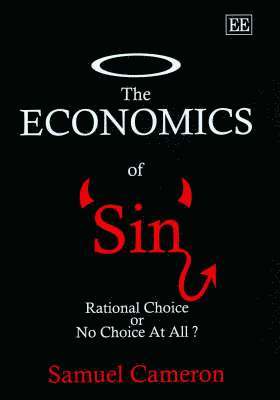
    Economics of Sin

    Rational Choice or No Choice at All?

    AvSamuel Cameron

    Inbunden, Engelska, 2002

    1 792 kr

    Beställningsvara. Skickas inom 5-8 vardagar. Fri frakt över 249 kr.

    Beskrivning

    The Economics of Sin examines the definition and evolution of sin from the perspective of rational choice economics, yet is conscious of the limitations of such an approach. The author argues that because engaging in activities deemed to be sinful is an act of choice, it can therefore be subject to the logic of choice in the economic model. The book considers the formation of religions, including the new age revival of 'wicca', as regulators of the quasi-market in sins, and goes on to appraise the role of specific sins such as lying, envy, jealousy, greed, lust, sloth, and waste in individual markets and in macroeconomic activity. Empirical evidence on issues such as cannibalism, capital punishment, addiction, adultery and prostitution is also explored. Samuel Cameron concludes that a large percentage of economic activity is intimately connected with forms of sin which are in some circumstances highly beneficial to the functioning of markets, particularly in the presence of market failure.This innovative, interdisciplinary study of the institution of sin will be of enormous interest to a wide-ranging readership, including researchers and teachers of economics, sociology and theology. It will also be of importance for anthropologists and philosophers.

    Produktinformation

    • Utgivningsdatum:2002-11-27
    • Mått:156 x 234 x undefined mm
    • Format:Inbunden
    • Språk:Engelska
    • Förlag:Edward Elgar Publishing Ltd
    • ISBN:9781840648676

    Utforska kategorier

    • Nationalekonomi inom Ekonomi och Ledarskap
    • Psykologi inom Psykologi och pedagogik
    • Mikroekonomi inom Ekonomi och Ledarskap

    Mer om författaren

    Samuel Cameron, formerly Professor of Economics, University of Bradford, UK

    Recensioner i media

    'This is a fascinating book. Readers will be surprised to discover the lengths to which the Von Neumann-Morgenstern, Becker, Lancaster and Knight models of rational choice can be applied to all forms of sinful behaviour. . . This volume is an interesting read and will be of interest to lecturers and students alike.'

    Innehållsförteckning

    • Contents: Part I: 1. Introduction 2. Tools of the Trade: Rational Choice 3. Religion Part II: 4. Greed, Lust, Sloth and Waste 5. Envy and Jealousy 6. Lies and Deceit Part III: 7. Matters of Life and Death 8. Addiction 9. Adultery 10. Prostitution 11. Conclusion Bibliography Index