• Fri frakt över 249 kr
  • •
  • Snabba leveranser
  • •
  • Billiga böcker
Kundservice

Du är på sajten för privatpersoner.

Företag, bibliotek eller offentlig verksamhet?

Du handlar på classic.bokus.com, där alla dina funktioner finns intakta.
Till classic.bokus.com
Bokus logotyp. Gå till startsidan.
  • Erbjudanden
  • Nyheter
  • Student
  • Topplistor
  • Barn & ungdom
  • Bokus Play
  • E-böcker
  • Pocketböcker
  • Spel & pussel

10% rabatt på allt med kod NYSTART10 →

Sidfot

Mina sidor

    Hjälp

    • Kundservice
    • Vanliga frågor och svar
    • Frakt och leverans
    • Retur vid ångerrätt
    • Reklamera vara
    • Betalning
    • Köpvillkor
    • Allmänna villkor
    • Information om webbplatsens tillgänglighet

    Om Bokus

    • Om oss
    • Pressrum
    • För studenter
    • För företag
    • För bibliotek och offentlig verksamhet
    • För leverantörer
    • Hållbarhet

    Populärt

    • Aktuella erbjudanden
    • Presentkort
    • Studentlitteratur
    • Nya böcker
    • Topplistor
    • Signerade böcker
    • Engelska böcker

    Inspiration

    • Boktips
    • BookTok
    • Populära bokserier
    • Barnbokskaraktärer
    • Populära författare
    Logotyp för Bokus
    Följ oss på Facebook (extern länk)Följ oss på Instagram (extern länk)Följ oss på YouTube (extern länk)Följ oss på TikTok (extern länk)
    bokus @ CookiesAnpassa cookiesIntegritetspolicyKöpvillkor
    Till Citymail hemsida (extern länk)Till Budbee hemsida (extern länk)Till Postnord hemsida (extern länk)Till Schenker hemsida (extern länk)Till Early Bird hemsida (extern länk)Till Walleys hemsida (extern länk)
    1. Psykologi och pedagogik
    2. Psykologi
    3. Kognitiv psykologi

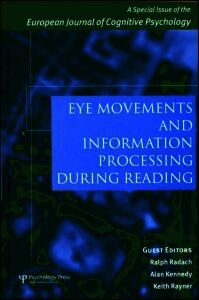
    Eye Movements and Information Processing During Reading

    A Special Issue of the European Journal of Cognitive Psychology

    AvRalph Radach,Alan Kennedy

    Inbunden, Engelska, 2004

    Del i serien Special Issues of the Journal of Cognitive Psychology

    1 353 kr

    Tillfälligt slut

    Beskrivning

    Measurement and analysis of eye movements are two of the most powerful ways to study the workings of the human mind. This Special Issue on eye movements and information processing in reading presents an overview of experimental research based on this methodology. Eye movements provide a unique opportunity to examine principles of human information processing in a well-structured visual environment while people engage in a natural cognitive task. At the same time, oculomotor measures can be used as a tool to develop and test psycholinguistic hypotheses about the processing of written language. The papers in this issue contribute to both aspects, addressing issues that dominate current debates in the field. Seen from the angle of visual information processing, a major theme is the role played by parafoveal information for different types and levels of processing and for oculomotor control in reading. This includes effects of visual and linguistic word properties on the selection of words for fixation and the specification of saccade amplitudes. Clearly the most controversial question in this context concerns the allocation of attention, with positions ranging from a sequentially moving spotlight to a gradient of spatially distributed processing. Related to this is the issue of serial vs. parallel word processing and the fundamental question as to what extent the duration of fixations in reading is related to lexical processing. Taking a psycholinguistic perspective, the topics addressed include several levels of language processing from orthography to pragmatic information in sentence reading. New approaches to the study of morphologically complex words are reported, together with novel work revealing the complex nature of the apparently accessible, but elusive, concept of word frequency. Other papers reflect current theoretical discussions centered on the development of computational models of the reading process and contribute to the empirical base of these discussions.Taken together, this collection of papers, supplemented by an introduction to the field and a commentary on major issues, presents a comprehensive and up-to-date perspective on a research area currently characterised by numerous theoretical and empirical disputes. The papers will be of particular appeal to readers interested in basic and applied psycholinguistics, attention and visual perception, motor control and the modelling of complex cognitive processes.

    Produktinformation

    • Utgivningsdatum:2004-01-22
    • Mått:156 x 234 x undefined mm
    • Vikt:676 g
    • Format:Inbunden
    • Språk:Engelska
    • Serie:Special Issues of the Journal of Cognitive Psychology
    • Antal sidor:360
    • Förlag:Taylor & Francis Ltd
    • ISBN:9781841699561

    Utforska kategorier

    • Kognitiv psykologi inom Psykologi och pedagogik

    Innehållsförteckning

    • R. Radach, A. Kennedy, K. Rayner Preface. R. Radach, A. Kennedy, Theoretical Perspectives on Eye Movements in Reading: Past Controversies, Current Issues and an Agenda for Future Research. R. Radach, A. Inhoff, D. Heller, Orthographic Regularity Gradually Modulates Saccade Amplitudes in Reading. S.J. White, S.P. Liversedge, Orthographic Familiarity Influences Initial Eye Fixation Positions in Reading. D. Drieghe, M. Brysbaert, T. Desmet, C. de Baecke, Word Skipping in Reading: On the Interplay of Linguistic and Visual Factors. J. Hyönä, R. Bertram, Do Frequency Characteristics of Non-Fixated Words Influence the Processing of Fixated Words during Reading? A. Kennedy, W.S. Murray, C. Boissiere, Parafoveal Pragmatics Revisited. F. Vitu, M. Brysbaert, D. Lancelin, A Test of Parafoveal-On-Foveal Effect with Pairs of Orthographically Related Words. J. Pynte, A. Kennedy, S. Ducrot, The Influence of Parafoveal Typographical Errors on Eye Movements in Reading. M.S. Starr, A.W. Inhoff, Attention Allocation to the Right and Left of a Fixated Word: Use of Orthographic Information from Multiple Words during Reading. S.N. Yang, G.W. McConkie, Saccade Generation during Reading: Are Words Necessary? R. Kliegl, E. Grabner, M. Rolfs, R. Engbert, Length, Frequency and Predictability Effects of Words on Eye Movements in Reading. S. Andrews, B. Miller, K. Rayner, Eye Movements and Morphological Segmentation of Compound Words: There is a Mouse in Mousetrap. R.S. Williams, R.K. Morris, Eye Movements, Word Familiarity and Vocabulary Acquisition. K. Rayner, J. Juhasz, Eye Movements in Reading: Old Questions and New Directions.