• Fri frakt över 249 kr
  • •
  • Snabba leveranser
  • •
  • Billiga böcker
Kundservice

Du är på sajten för privatpersoner.

Företag, bibliotek eller offentlig verksamhet?

Du handlar på classic.bokus.com, där alla dina funktioner finns intakta.
Till classic.bokus.com
Bokus logotyp. Gå till startsidan.
  • Erbjudanden
  • Nyheter
  • Student
  • Topplistor
  • Barn & ungdom
  • Bokus Play
  • E-böcker
  • Pocketböcker
  • Spel & pussel

10% rabatt på allt med kod: NYSTART10 →

Sidfot

Mina sidor

    Hjälp

    • Kundservice
    • Vanliga frågor och svar
    • Frakt och leverans
    • Retur vid ångerrätt
    • Reklamera vara
    • Betalning
    • Köpvillkor
    • Allmänna villkor
    • Information om webbplatsens tillgänglighet

    Om Bokus

    • Om oss
    • Pressrum
    • För studenter
    • För företag
    • För bibliotek och offentlig verksamhet
    • För leverantörer
    • Hållbarhet

    Populärt

    • Aktuella erbjudanden
    • Presentkort
    • Studentlitteratur
    • Nya böcker
    • Topplistor
    • Signerade böcker
    • Engelska böcker

    Inspiration

    • Boktips
    • BookTok
    • Populära bokserier
    • Barnbokskaraktärer
    • Populära författare
    Logotyp för Bokus
    Följ oss på Facebook (extern länk)Följ oss på Instagram (extern länk)Följ oss på YouTube (extern länk)Följ oss på TikTok (extern länk)
    bokus @ CookiesAnpassa cookiesIntegritetspolicyKöpvillkor
    Till Citymail hemsida (extern länk)Till Budbee hemsida (extern länk)Till Postnord hemsida (extern länk)Till Schenker hemsida (extern länk)Till Early Bird hemsida (extern länk)Till Walleys hemsida (extern länk)
    1. Samhälle och politik
    2. Samhälle och kultur
    3. Kultur och medier
    4. Referensverk och tvärvetenskap

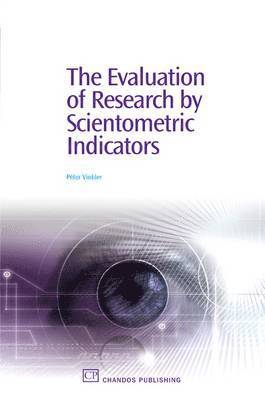
    The Evaluation of Research by Scientometric Indicators

    AvPeter Vinkler

    Häftad, Engelska, 2010

    Del i serien Chandos Learning and Teaching Series

    777 kr

    Beställningsvara. Skickas inom 10-15 vardagar. Fri frakt över 249 kr.

    Beskrivning

    Aimed at academics, academic managers and administrators, professionals in scientometrics, information scientists and science policy makers at all levels. This book reviews the principles, methods and indicators of scientometric evaluation of information processes in science and assessment of the publication activity of individuals, teams, institutes and countries. It provides scientists, science officers, librarians and students with basic and advanced knowledge on evaluative scientometrics. Especially great stress is laid on the methods applicable in practice and on the clarification of quantitative aspects of impact of scientific publications measured by citation indicators.

    • Written by a highly knowledgeable and well-respected scientist in the field
    • Provides practical and realistic quantitative methods for evaluating scientific publication activities of individuals, teams, countries and journals
    • Gives standardized descriptions and classification of the main categories of evaluative scientometrics

    Produktinformation

    • Utgivningsdatum:2010-01-20
    • Mått:156 x 234 x undefined mm
    • Vikt:500 g
    • Format:Häftad
    • Språk:Engelska
    • Serie:Chandos Learning and Teaching Series
    • Antal sidor:336
    • Förlag:Elsevier Science
    • ISBN:9781843345725

    Utforska kategorier

    • Referensverk och tvärvetenskap inom Samhälle och politik
    • Naturvetenskap:allmänt inom Naturvetenskap och teknik

    Mer om författaren

    Dr. Peter Vinkler is Scientific Secretary of the Chemical Research Center, Budapest and Director of the Scientific Publication Data Centre of the Hungarian Academy of Sciences. He worked as Head of the Biocomplex Research Department of the Chemical Research Center for several years. He has published extensively on scientometrics and information science, primarily on the indicators used for the evaluation of publication activities of individuals and teams. He serves as Associate Editor of Scientometrics and regularly reviews publications also for the Journal of Informetrics and Journal of the American Society for Information Science and Technology. In 2009 he was awarded the Derek de Solla Price Medal for his outstanding contributions to the field of quantitative studies of science.

    Innehållsförteckning

    • AcknowledgementAbout the authorList of figures and tablesChapter 1: IntroductionChapter 2: Basic categories of scientometricsConcluding remarksChapter 3: Classification of the indicators of evaluative scientometricsIntroductionClassification scheme of evaluative indicatorsConcluding remarksChapter 4: Publication growth in scienceIntroductionRelative publication growth indexConcluding remarksChapter 5: Scientific eminence of journals: the Garfield Factor and the Current Contribution IndexIntroductionStandardised description of the Garfield FactorChances for citation and chances for citednessThe Garfield Factor and relative publication growthSome empirical findingsAn empirical modelTowards understanding the Garfield FactorThe GF and the SIC indexRelationship between quantity and quality: growth and specific indicesThe Current Contribution Index (CCI)The πV-indexConcluding remarksChapter 6: The ageing of scientific informationIntroductionAnnual citedness and annual citedness ratesConversion of Journal Paper Citedness indices or Garfield Factors calculated for different time periodsCalculating the Estimated Number of Citations (ENC) by the Subsequent Impact Method (SIM)Concluding remarksChapter 7: Scientometric indicators for the assessment of publicationsIntroductionDefinition and function of comparative indicators of evaluative scientometricsRelationships between three relative impact indicators (RW, RCR, RPS)The Invitation ParadoxModel for the selection of relative publication impact indicatorsComposite scientometric indicatorsThe h-index and the π-indexConcluding remarksChapter 8: Reference strategy: model of manifested communication through publicationsIntroductionReference strategyLaws of reference strategyThe model of manifested communication through publicationsConcluding remarksChapter 9: Frequency of and strength of motives in referencing: the Reference Threshold ModelIntroductionThe frequency and strength of motives in referencingConcluding remarksChapter 10: Research contribution and share of credit of individual authorsIntroductionDistributing credit of publications among co-authorsConcluding remarksChapter 11: Standards in scientometric assessmentsIntroductionBibliometric factorsEffect of bibliometric factors on the GF of journalsSelecting sets of papers and journals as reference standardsStandardisation of citedness indicators using standardised publication and citation time windowsDependence of JPC on the type of publicationMethods for obtaining absolute reference standards for relative impact indicatorsDelineating journals by subject fieldMethods for standardising GFsMethods for determining ordinal rank scores in sets of different sizeStandardising part-indicatorsConcluding remarksChapter 12: Scientometric assessments: application of scientometrics for the purposes of science policyIntroductionScientometric methods for the evaluation of research organisationsEvaluating publications of research institutes by a composite scientometric indicatorScientometric indicators and GDPConcluding remarksChapter 13: Institutionalisation of Scientific Information: a scientometric model (ISI-S model)IntroductionThe ISI-S modelConcluding remarksChapter 14: ConclusionsReferencesAuthor indexSubject index