• Fri frakt över 249 kr
  • •
  • Snabba leveranser
  • •
  • Billiga böcker
Kundservice

Du är på sajten för privatpersoner.

Företag, bibliotek eller offentlig verksamhet?

Du handlar på classic.bokus.com, där alla dina funktioner finns intakta.
Till classic.bokus.com
Bokus logotyp. Gå till startsidan.
  • Erbjudanden
  • Nyheter
  • Student
  • Topplistor
  • Barn & ungdom
  • Bokus Play
  • E-böcker
  • Pocketböcker
  • Spel & pussel

Må bättre, för mindre! Upp till 50% rabatt på hälsoböcker

Sidfot

Mina sidor

    Hjälp

    • Kundservice
    • Vanliga frågor och svar
    • Frakt och leverans
    • Retur vid ångerrätt
    • Reklamera vara
    • Betalning
    • Köpvillkor
    • Allmänna villkor
    • Information om webbplatsens tillgänglighet

    Om Bokus

    • Om oss
    • Pressrum
    • För studenter
    • För företag
    • För bibliotek och offentlig verksamhet
    • För leverantörer
    • Hållbarhet

    Populärt

    • Aktuella erbjudanden
    • Presentkort
    • Studentlitteratur
    • Nya böcker
    • Topplistor
    • Signerade böcker
    • Engelska böcker

    Inspiration

    • Boktips
    • BookTok
    • Populära bokserier
    • Barnbokskaraktärer
    • Populära författare
    Logotyp för Bokus
    Följ oss på Facebook (extern länk)Följ oss på Instagram (extern länk)Följ oss på YouTube (extern länk)Följ oss på TikTok (extern länk)
    bokus @ CookiesAnpassa cookiesIntegritetspolicyKöpvillkor
    Till Citymail hemsida (extern länk)Till Budbee hemsida (extern länk)Till Postnord hemsida (extern länk)Till Schenker hemsida (extern länk)Till Early Bird hemsida (extern länk)Till Walleys hemsida (extern länk)
    1. Ekonomi och Ledarskap
    2. Företagsekonomi
    3. Organisationsteori

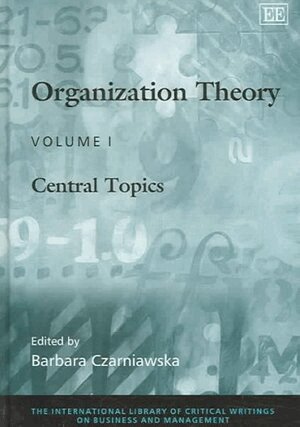
    Organization Theory

    AvBarbara Czarniawska

    Inbunden, Engelska, 2006

    Del 5 i serien The International Library of Critical Writings on Business and Management series

    6 925 kr

    Beställningsvara. Skickas inom 5-8 vardagar. Fri frakt över 249 kr.

    Beskrivning

    This comprehensive collection presents organization theory in its historical context. It includes an authoritative selection of seminal articles published since the 1960s, which exercise continuing influence on contemporary thinking about organizations. Volume one addresses classical themes, which predate and inform modern organization theory. The second volume examines current trends, and concludes with reflections on method and on theory writing. An excellent resource for those wishing to deepen their knowledge of organization theory. This collection will have particular appeal to people working in the fields of management studies, psychology, sociology, economics and political science.

    Produktinformation

    • Utgivningsdatum:2006-01-27
    • Mått:169 x 244 x undefined mm
    • Format:Inbunden
    • Språk:Engelska
    • Serie:The International Library of Critical Writings on Business and Management series
    • Förlag:Edward Elgar Publishing Ltd
    • ISBN:9781843769378

    Utforska kategorier

    • Organisationsteori inom Ekonomi och Ledarskap

    Mer om författaren

    Edited by the late Barbara Czarniawska, formerly Professor Emerita of Management Studies, GRI, School of Business, Economics and Law, University of Gothenburg, Sweden

    Recensioner i media

    'Czarniawska presents an authoritative overview of organization theory. Including the classics alongside the challenging and the provocative she gives an insight into the excitement that can be gained from the contemporary study of organized phenomena.'

    Innehållsförteckning

    • Contents:Volume I: Central Topics AcknowledgementsIntroduction Barbara Czarniawska PART ICREATING THE OBJECT OF ORGANIZATION THEORY 1. Dwight Waldo (1961), ‘Organization Theory: An Elephantine Problem’2. Charles Perrow (1991), ‘A Society of Organizations’3. Nils Brunsson and Kerstin Sahlin-Andersson (2000), ‘Constructing Organizations: The Example of Public Sector Reform’PART IISYSTEMS: OPEN, LOOSELY COUPLED OR AUTOPOIETIC? 4. Floyd H. Allport (1962), ‘A Structuronomic Conception of Behavior: Individual and Collective’5. Karl E. Weick (1976), ‘Educational Organizations as Loosely Coupled Systems’6. Niklas Luhmann (1986), ‘The Autopoiesis of Social Systems’PART IIIDECISION MAKING 7. Michael D. Cohen, James G. March and Johan P. Olsen (1972), ‘A Garbage Can Model of Organizational Choice’8. James G. March (1978), ‘Bounded Rationality, Ambiguity, and the Engineering of Choice’9. Nils Brunsson (1982), ‘The Irrationality of Action and Action Rationality: Decisions, Ideologies and Organizational Actions’PART IVORGANIZATIONAL LEARNING 10. Chris Argyris (1976), ‘Single-Loop and Double-Loop Models in Research on Decision Making’11. Bo Hedberg (1981), ‘How Organizations Learn and Unlearn’12. Scott D.N. Cook and Dvora Yanow (1993), ‘Culture and Organizational Learning’PART VLEADERSHIP 13. Gary Yukl (1971), ‘Toward A Behavioral Theory of Leadership’14. Jeffrey Pfeffer (1977), ‘The Ambiguity of Leadership’15. Linda Smircich and Gareth Morgan (1982), ‘Leadership: The Management of Meaning’PART VIPOWER AND CONTROL 16. D.J. Hickson, C.R. Hinings, C.A. Lee, R.E. Schneck and J.M. Pennings (1971), ‘A Strategic Contingencies' Theory of Intraorganizational Power’17. William G. Ouchi (1979), ‘A Conceptual Framework for the Design of Organizational Control Mechanisms’18. Stewart Clegg (1981), ‘Organization and Control’PART VIIORGANIZATIONAL CULTURE 19. Edgar H. Schein (1983), ‘The Role of the Founder in Creating Organizational Culture’20. Linda Smircich (1983), ‘Concepts of Culture and Organizational Analysis’21. John Van Maanen and Stephen R. Barley (1984), ‘Occupational Communities: Culture and Control in Organizations’Name IndexVolume II: Current Trends and Disciplinary Reflection AcknowledgementsAn introduction by the editor to both volumes appears in Volume IPART INEW INSTITUTIONALISM AND ORGANIZATION THEORY 1. Roland L. Warren (1967), ‘The Interorganizational Field as a Focus for Investigation’2. Paul J. DiMaggio and Walter W. Powell (1983), ‘The Iron Cage Revisited: Institutional Isomorphism and Collective Rationality in Organizational Fields’PART IIENACTMENT AND SENSEMAKING 3. Karl E. Weick (1988), ‘Enacted Sensemaking in Crisis Situations’PART IIIPOSTMODERN ORGANIZATION THEORY 4. Robert Cooper and Gibson Burrell (1988), ‘Modernism, Postmodernism and Organizational Analysis: An Introduction’5. Marta B. Calás and Linda Smircich (1991), ‘Voicing Seduction to Silence Leadership’PART IVFEMINIST ORGANIZATION THEORY 6. Joan Acker (1990), ‘Hierarchies, Jobs, Bodies: A Theory of Gendered Organizations’7. Joanne Martin (1990), ‘Deconstructing Organizational Taboos: The Suppression of Gender Conflict in Organizations’PART VREFLECTIONS ON METHODOLOGY 8. Egon Bittner (1965), ‘The Concept of Organization’9. Henry Mintzberg (1971), ‘Managerial Work: Analysis from Observation’10. John Van Maanen (1979), ‘The Fact of Fiction in Organizational Ethnography’11. Noel M. Tichy, Michael L. Tushman and Charles Fombrun (1979), ‘Social Network Analysis for Organizations’PART VIREFLECTIONS ON THEORY 12. J. Kenneth Benson (1977), ‘Organizations: A Dialectical View’13. Gareth Morgan (1980), ‘Paradigms, Metaphors, and Puzzle Solving in Organization Theory’14. Karl E. Weick (1989), ‘Theory Construction as Disciplined Imagination’15. W. Graham Astley and Raymond F. Zammuto (1992), ‘Organization Science, Managers, and Language Games’Name Index