• Fri frakt över 249 kr
  • •
  • Snabba leveranser
  • •
  • Billiga böcker
Kundservice

Du är på sajten för privatpersoner.

Företag, bibliotek eller offentlig verksamhet?

Du handlar på classic.bokus.com, där alla dina funktioner finns intakta.
Till classic.bokus.com
Bokus logotyp. Gå till startsidan.
  • Erbjudanden
  • Nyheter
  • Student
  • Topplistor
  • Barn & ungdom
  • Bokus Play
  • E-böcker
  • Pocketböcker
  • Spel & pussel

Må bättre, för mindre! Upp till 50% rabatt på hälsoböcker

Sidfot

Mina sidor

    Hjälp

    • Kundservice
    • Vanliga frågor och svar
    • Frakt och leverans
    • Retur vid ångerrätt
    • Reklamera vara
    • Betalning
    • Köpvillkor
    • Allmänna villkor
    • Information om webbplatsens tillgänglighet

    Om Bokus

    • Om oss
    • Pressrum
    • För studenter
    • För företag
    • För bibliotek och offentlig verksamhet
    • För leverantörer
    • Hållbarhet

    Populärt

    • Aktuella erbjudanden
    • Presentkort
    • Studentlitteratur
    • Nya böcker
    • Topplistor
    • Signerade böcker
    • Engelska böcker

    Inspiration

    • Boktips
    • BookTok
    • Populära bokserier
    • Barnbokskaraktärer
    • Populära författare
    Logotyp för Bokus
    Följ oss på Facebook (extern länk)Följ oss på Instagram (extern länk)Följ oss på YouTube (extern länk)Följ oss på TikTok (extern länk)
    bokus @ CookiesAnpassa cookiesIntegritetspolicyKöpvillkor
    Till Citymail hemsida (extern länk)Till Budbee hemsida (extern länk)Till Postnord hemsida (extern länk)Till Schenker hemsida (extern länk)Till Early Bird hemsida (extern länk)Till Walleys hemsida (extern länk)
    1. Ekonomi och Ledarskap
    2. Nationalekonomi
    3. Miljöekonomi

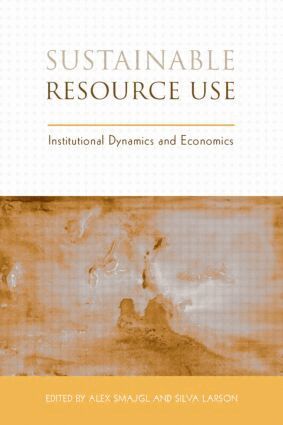
    Sustainable Resource Use

    Institutional Dynamics and Economics

    AvAlex Smajgl,Silva Larson

    Inbunden, Engelska, 2007

    Del i serien Earthscan Research Editions

    2 454 kr

    Beställningsvara. Skickas inom 3-6 vardagar. Fri frakt över 249 kr.

    Beskrivning

    The way that humans organize both resource access and resource use is vital to the management of natural resources. Within different contexts, institutional arrangements (such as the rules of common and private property rights) become levers by which human behaviours can be modified and steered towards the goals of sustainable natural resource management. Featuring contributions from leading thinkers in the field, this groundbreaking volume examines institutional dynamics from the perspective of natural resource management.The book is organized into four parts. The first discusses institutional diversity and contextual change. Following this, institutional misfit is analysed with a strong focus on the long-term impacts of colonial structures in the Asia-Pacific region. The book then discusses experiences with institutional dynamics in order to ease the tension of such misfits before examining future research needs.Ultimately, through careful argument and by deploying original research, the authors make the case that institutional arrangements cannot be perceived as a set of parameters that can be optimized and locked in for the most efficient functioning of a system; nor can institutions be evaluated outside the context in which they were developed. This is powerful, thought-provoking and important reading for academics, researchers, policy-makers and professionals in resource, institutional and environmental economics and land use planning and policy across the full range of natural resource sectors from forestry to agriculture.Published with CSIRO.Cover image: Blue Flower of Life (c) Theresa J. Richardson 2006

    Produktinformation

    • Utgivningsdatum:2007-06-20
    • Mått:156 x 234 x 29 mm
    • Vikt:566 g
    • Format:Inbunden
    • Språk:Engelska
    • Serie:Earthscan Research Editions
    • Antal sidor:288
    • Förlag:Taylor & Francis Ltd
    • ISBN:9781844074594

    Utforska kategorier

    • Miljöekonomi inom Ekonomi och Ledarskap
    • Miljövetenskap och miljöpolitik inom Naturvetenskap och teknik

    Mer om författaren

    Alex Smajgl has a PhD in Environmental Economics. Currently he works for the Commonwealth Scientific and Industrial Research Organization (CSIRO) and its Division Sustainable Ecosystems and develops multi-scale decision support tools for policy-makers in Australia and Indonesia in the context of climate change, water quantity and water quality issues, and land use change. Prior to this position he worked for European stakeholders on the implementation of an emissions trading scheme in the Post-Kyoto negotiations. Silva Larson is a Chartered Environmentalist (UK) and works for CSIRO Sustainable Ecosystems. Her main research interest is in human perceptions and wellbeing, and the role they play in strategic environmental assessment and social responsibility reporting.

    Innehållsförteckning

    • Preface * Part I: The Context * Institutional Dynamics and Natural Resource Management * Part II: Institutional Diversity and Contextual Change * Multiple Institutions for Multiple Outcomes * The Challenge of Maintaining the Salience of Common Property Rights with Increasing Cultural and Socio-economic Heterogeneity * Part III: Institutional Misfit * Traditional and Customary Land Tenure and Appurtenant Rights: Reflections on Critical Factors of an Ecologically Sustainable Australian Outback * Substantive and Procedural Dimensions of Old and New Forms of Property: IPRs, the CBD and the Protection of Traditional Ecological Knowledge * Myth, Embeddedness and Tradition: Property Rights Perceptions from the Pacific * Indigenous Property Right to Water: Environmental Flows, Cultural Values and Tradeable Property Rights * Commercial Forestry: An Economic Development Opportunity Consistent with the Property Rights of Wik People to Natural Resources * Coping with a Tragedy of the Australian Aboriginal Common * Part IV: Experiences in Dealing with Institutional Dynamics * Designing Robust Common Property Regimes for Collaboration towards Rural Sustainability * The Need to Consider the Administration of Property Rights and Restrictions before Creating them * Building Institutional Incentives in Dying Communities * The Potential for Market Mechanisms to Achieve Vegetation Protection in the Desert Uplands * A Metaphysical Grounding for Ecologically Sustainable Property Rights * Index