• Fri frakt över 249 kr
  • •
  • Snabba leveranser
  • •
  • Billiga böcker
Kundservice

Du är på sajten för privatpersoner.

Företag, bibliotek eller offentlig verksamhet?

Du handlar på classic.bokus.com, där alla dina funktioner finns intakta.
Till classic.bokus.com
Bokus logotyp. Gå till startsidan.
  • Erbjudanden
  • Nyheter
  • Student
  • Topplistor
  • Barn & ungdom
  • Bokus Play
  • E-böcker
  • Pocketböcker
  • Spel & pussel

10% rabatt på allt med kod: NYSTART10 →

Sidfot

Mina sidor

    Hjälp

    • Kundservice
    • Vanliga frågor och svar
    • Frakt och leverans
    • Retur vid ångerrätt
    • Reklamera vara
    • Betalning
    • Köpvillkor
    • Allmänna villkor
    • Information om webbplatsens tillgänglighet

    Om Bokus

    • Om oss
    • Pressrum
    • För studenter
    • För företag
    • För bibliotek och offentlig verksamhet
    • För leverantörer
    • Hållbarhet

    Populärt

    • Aktuella erbjudanden
    • Presentkort
    • Studentlitteratur
    • Nya böcker
    • Topplistor
    • Signerade böcker
    • Engelska böcker

    Inspiration

    • Boktips
    • BookTok
    • Populära bokserier
    • Barnbokskaraktärer
    • Populära författare
    Logotyp för Bokus
    Följ oss på Facebook (extern länk)Följ oss på Instagram (extern länk)Följ oss på YouTube (extern länk)Följ oss på TikTok (extern länk)
    bokus @ CookiesAnpassa cookiesIntegritetspolicyKöpvillkor
    Till Citymail hemsida (extern länk)Till Budbee hemsida (extern länk)Till Postnord hemsida (extern länk)Till Schenker hemsida (extern länk)Till Early Bird hemsida (extern länk)Till Walleys hemsida (extern länk)
    1. Naturvetenskap och teknik
    2. Teknik och industri
    3. Energiteknik

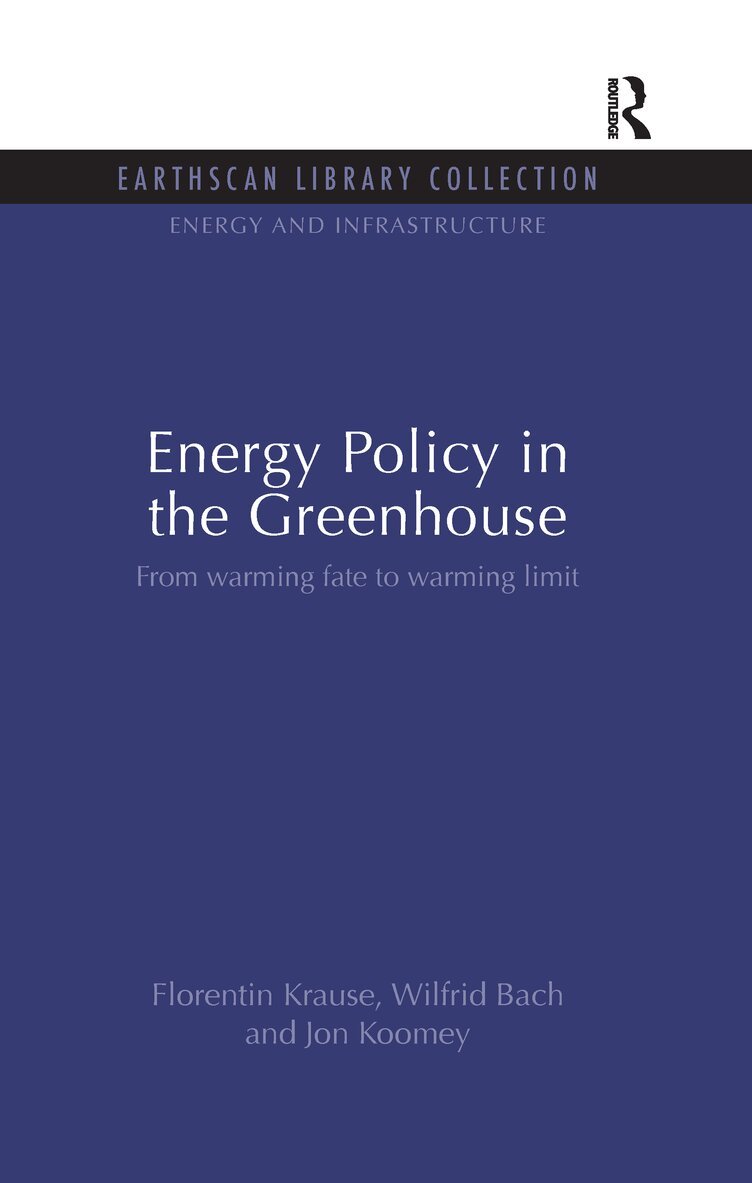
    Energy Policy in the Greenhouse

    From warming fate to warming limit

    AvFlorentin Krause,Wilfrid Bach

    Inbunden, Engelska, 2009

    Del i serien Energy and Infrastructure Set

    1 466 kr

    Beställningsvara. Skickas inom 10-15 vardagar. Fri frakt över 249 kr.

    Fler format och utgåvor

    Häftad

    540 kr

    Beskrivning

    The globe is warming and while no one knows what will happen as a result, it is clear that slowing the process is a necessary goal. Other studies have considered 'warming fates', this one brings sophisticated computer modeling to bear on ways of minimizing the risks.Fossil carbon emissions, other trace gases and releases from other sources are all taken into account, and the authors demonstrate the global need to produce a budget for cumulative releases between now and the year 2100. They also demonstrate the need to return to a rate of forest carbon storage equal to that of the mid-1980s. These budgets look at issues of international equity and the ways of moving to a binding agreement. The price of failure to control GHG emissions may be uncertain, but it will be more than anyone can afford. Political will lies at the root of successful climate stabilization and major capital and technology transfers to Third World countries will be needed if there is to be any chance of success. This book provides an agenda for advance.A book [which] throws into stark relief the mountain still to be climbed before the world community can agree on a credible programme to tackle global warming. David Thomas, Financial Times Originally published in 1991

    Produktinformation

    • Utgivningsdatum:2009-10-01
    • Mått:156 x 234 x 14 mm
    • Vikt:560 g
    • Format:Inbunden
    • Språk:Engelska
    • Serie:Energy and Infrastructure Set
    • Antal sidor:216
    • Förlag:Taylor & Francis Ltd
    • ISBN:9781844079766

    Utforska kategorier

    • Energiteknik inom Naturvetenskap och teknik
    • Miljövetenskap och miljöpolitik inom Naturvetenskap och teknik

    Mer om författaren

    Krause, Florentin ; Bach, Wilfrid ; Koomey, Jon

    Innehållsförteckning

    • Chapter 1.1 A Target-based, Least-cost Approach to Climate Stabilization A. Introduction B. Growing Awareness of the Climate Threat C. Driving Forces of Climate Change D. Greenhouse Risks and Consequences: Just Warmer Weather? E. Analytic Framework for the Prevention Paradigm Chapter 1.2 Is Climate Stabilization still Feasible? A. Overview B. Climate Modeling Approach C. How Much Warming is Already Locked in from the Past? D. What Further Warming will Future Emissions Bring? E. From Concentration Ceilings to Policy Targets Chapter 1.3 Control Requirements for Non-fossil Greenhouse Gases A. Overview B. CFC Releases and Other Urban-Industrial Emissions C. Greenhouse Gases and Agriculture D. Carbon Releases from Deforestation and Soil Destruction: How Significant Are they in Climate Warming? E. Restoring Biospheric Carbon Pools in Forests and Soils Chapter 1.4 How much Fossil Fuel can still be Burned? A. Overview B. Concentration Limit for Carbon Dioxide C. Fossil Reserves, Energy Content, Carbon Content, and Airborne Fraction D. Global Fossil Carbon Budget Chapter 1.5 How could the Global Carbon Budget be Shared? A. Climate Change and Global Equity B. How Could Equity Goals Be Quantified? C. Fossil Carbon Emissions and Interregional Equity: The Record to Date D. Equity-based Allocation of the Global Carbon Budget E. Person-year Equity and Compensatory International Assistance Chapter 1.6 How Quickly must Fossil Fuels be Phased Out? Global and Regional Milestones A. Introduction B. What Rates of Fossil Phase-out Could Be Viable? C. Milestones for the Global Fossil Phase-out D. Are There Any Other Options? E. C/GDP Ratios: Historic versus Required Future Changes F. Summary and Conclusions Chapter 1.7 A Global Compact on Climate Stabilization and Sustainable Development A. Climate Stabilization and Sustainable Development B. International Protocols versus Leadership by Example C. The Climate Convention D. Fossil Fuel Protocol E. Protocol on Reforestation and Agricultural Land-Use F. Protocol on Chlorofluorocarbons G. Protocol on Other Trace Gases H. Conclusion APPENDIX 1.1 APPENDIX 1.2