• Fri frakt över 249 kr
  • •
  • Snabba leveranser
  • •
  • Billiga böcker
Kundservice

Du är på sajten för privatpersoner.

Företag, bibliotek eller offentlig verksamhet?

Du handlar på classic.bokus.com, där alla dina funktioner finns intakta.
Till classic.bokus.com
Bokus logotyp. Gå till startsidan.
  • Erbjudanden
  • Nyheter
  • Student
  • Topplistor
  • Barn & ungdom
  • Bokus Play
  • E-böcker
  • Pocketböcker
  • Spel & pussel

10% rabatt på allt med kod: NYSTART10 →

Sidfot

Mina sidor

    Hjälp

    • Kundservice
    • Vanliga frågor och svar
    • Frakt och leverans
    • Retur vid ångerrätt
    • Reklamera vara
    • Betalning
    • Köpvillkor
    • Allmänna villkor
    • Information om webbplatsens tillgänglighet

    Om Bokus

    • Om oss
    • Pressrum
    • För studenter
    • För företag
    • För bibliotek och offentlig verksamhet
    • För leverantörer
    • Hållbarhet

    Populärt

    • Aktuella erbjudanden
    • Presentkort
    • Studentlitteratur
    • Nya böcker
    • Topplistor
    • Signerade böcker
    • Engelska böcker

    Inspiration

    • Boktips
    • BookTok
    • Populära bokserier
    • Barnbokskaraktärer
    • Populära författare
    Logotyp för Bokus
    Följ oss på Facebook (extern länk)Följ oss på Instagram (extern länk)Följ oss på YouTube (extern länk)Följ oss på TikTok (extern länk)
    bokus @ CookiesAnpassa cookiesIntegritetspolicyKöpvillkor
    Till Citymail hemsida (extern länk)Till Budbee hemsida (extern länk)Till Postnord hemsida (extern länk)Till Schenker hemsida (extern länk)Till Early Bird hemsida (extern länk)Till Walleys hemsida (extern länk)
    1. Filosofi och religion
    2. Religion och tro
    3. Andra religioner och trosföreställningar
    4. Östasiatiska religioner

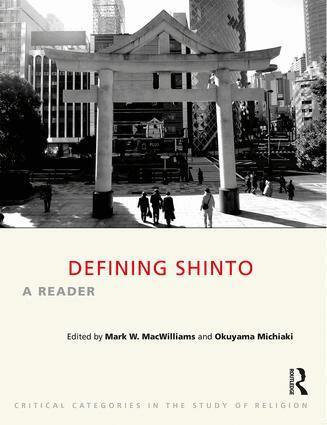
    Defining Shinto

    A Reader

    AvMark W. MacWilliams,Okuyama Michiaki

    Häftad, Engelska, 2019

    Del i serien Critical Categories in the Study of Religion

    779 kr

    Beställningsvara. Skickas inom 10-15 vardagar. Fri frakt över 249 kr.

    Beskrivning

    This book provides key official documents alongside political, religious-philosophical, and historical essays, illustrating how the term "Shinto" has metamorphosed terminologically from Japan’s emergence as a modern nation state in the late 19th century to the postmodern Japan of today. "Shinto" is one of the most contested categories in the field of Japanese religious studies. While the term "Shinto" has a long history in the pre-modern period, this volume focuses on how the term has evolved in modern Japan. Divided into five parts, the book covers: Shinto and the modern Japanese nation state Pre-war Japanese intellectuals on Shinto Shinto and ultra-nationalism of the 1930s and 1940s Post-war reforms and reformulations Contemporary ways of defining ShintoPresenting a wealth of documents, most of which have been translated here for the first time, the book is an invaluable resource for scholars and students of Japanese religion.

    Produktinformation

    • Utgivningsdatum:2019-10-16
    • Mått:174 x 246 x 23 mm
    • Vikt:720 g
    • Format:Häftad
    • Språk:Engelska
    • Serie:Critical Categories in the Study of Religion
    • Antal sidor:386
    • Förlag:Taylor & Francis Ltd
    • ISBN:9781844658381

    Utforska kategorier

    • Östasiatiska religioner inom Filosofi och religion

    Mer om författaren

    Mark W. MacWilliams is Professor of Religious Studies at St. Lawrence University, USA, and has published widely in the field of Japanese religions. Okuyama Michiaki is Research Fellow at the Nanzan Institute of Religion and Culture and Professor at the Faculty of Humanities at Nanzan University, Japan. He has written extensively on the concept of Shinto in the light of studies on comparative religion.

    Innehållsförteckning

    • Introduction: defining Shinto in modern Japan Parts 1 and 2: Introduction PART 1Shinto and the modern Japanese nation state: Official documents concerning Shinto and shrine administration 41 1 Proclamation concerning the restoration of the Council of Divinities (March 13, 1868) 2 Ordinance distinguishing divine and Buddhist matters, proclamation issued by the Council of State (March 28, 1868) 3 Imperial rescript for the promulgation of the Great Teachings (January 3, 1870) 4 Official notice issued by the Council of State—shrine rituals as a state religious practice (May 14, 1871) 5 Notification issued by the Council of State—the principal aim of the Great Teachings (July 4, 1871) 6 Three articles for teaching issued by the Ministry of Public Instruction (April 28, 1872) 7 Notification [regarding Yasukuni Shrine] issued by the Council of State. Issued with the Home Ministry and the Ministries of the Army, Navy, and Tokyo Prefecture (June 4, 1879) 8 Notification (no.1 in the fourth category) issued by the Home Ministry (January 24, 1882) 9 Notification (no. 30 in the second category) issued by the Home Ministry (May 15, 1882) 10 Notification (no. 19) issued by the Council of State (August 11, 1884) 11 The Constitution of the Empire of Japan—imperial oath at the sanctuary of the Imperial Palace, and Articles 1–3, and 28 (February 11, 1889) 12 Imperial edict (no. 220) on the disposition of vacant properties after the consolidation of shrines, temples, or Buddhist halls (August 10, 1906) 13 Dates of important subsequent ordinances issued by the Japanese imperial state 14 Imperial edict (no. 736) on the official institutionalization of the Board of Divinities (Jingiin) (November 9, 1940) PART 2Pre-war Japanese intellectuals on Shinto 15 KUME KUNITAKE Shinto as the ancient custom of worshipping heaven (1891)16 KAWAKAMI HAJIME Japan’s unique form of nationalism (1911)17 YANAGITA KUNIO My view of Shinto (1918)18 KATŌ GENCHIShinto, a religion of the theanthropic type, as distinguished from a religion of the theocratic type and Shinto as a national religion, not entirely devoid of a universal aspect and remarkably tolerant (1935)19 TSUDA SŌKICHI The various meanings of the word Shinto (1937–39) SUGGESTED READINGS (PARTS 1 AND 2) PART 3Shinto and ultra-nationalism in the 1930s and 1940s Introduction 20 KŌNO SEIZŌ Kannagara no michi (The way of kannagara, 1940)21 MINISTRY OF EDUCATION (MONBUSHŌ) The inherent character of the people and ceremonial rites and morality, from Kokutai no hongi (The Cardinal Principles of the National Polity, 1937)22 MINISTRY OF EDUCATION (MONBUSHŌ) Practicing the way of imperial subjects, from Shinmin no michi (The Way of Subjects, 1941)23 THE BOARD OF DIVINITIES (JINGIIN) National polity and the great way of the gods, national history and shrines, and the state and shrines, from Chapter 1, National Polity and Shrines from the Jinja hongi (The Cardinal Principles of Shrines, 1944) SUGGESTED READINGS PART 4Recasting Shinto—Post-war reforms and reformulationsIntroduction24 GENERAL HEADQUARTERS, SUPREME COMMANDER FOR THE ALLIED POWERS 207The Shinto Directive (December 15, 1945)25 ORIKUCHI SHINOBU A new direction for Shinto (1949)26 WATSUJI TETSURŌ Feudal thought and Shinto doctrine (1945) and Representative of the whole people (1948)27 ASHIZU UZUHIKO The various issues related to contemporary shrines (1951)28 MURAKAMI SHIGEYOSHI The emperor as a deity in human form and the development of imperial house rites (1977)29 KURODA TOSHIO Shinto in the history of Japanese religion (1981) SUGGESTED READINGS PART 5Contemporary ways of defining Shinto Introduction 30 MIYATA NOBORUState Shinto (1999)UEDA KENJI The structure of Shinto faith (1995)32 SONODA MINORU Our way of shrines and Shinto, Asking about what shrine Shinto will look like in the future, The local shrine grove—a Shinto model of one’s home, and Shrines and Shinto (1998)33 KAMATA TŌJI What is Shinto? (1999)34 INOUE HIROSHI Introduction and A syncretism based upon differentiation—the formation of ‘Shinto’ (2011) SUGGESTED READINGS