• Fri frakt över 249 kr
  • •
  • Snabba leveranser
  • •
  • Billiga böcker
Kundservice

Du är på sajten för privatpersoner.

Företag, bibliotek eller offentlig verksamhet?

Du handlar på classic.bokus.com, där alla dina funktioner finns intakta.
Till classic.bokus.com
Bokus logotyp. Gå till startsidan.
  • Erbjudanden
  • Nyheter
  • Student
  • Topplistor
  • Barn & ungdom
  • Bokus Play
  • E-böcker
  • Pocketböcker
  • Spel & pussel

10% rabatt på allt med kod: NYSTART10 →

Sidfot

Mina sidor

    Hjälp

    • Kundservice
    • Vanliga frågor och svar
    • Frakt och leverans
    • Retur vid ångerrätt
    • Reklamera vara
    • Betalning
    • Köpvillkor
    • Allmänna villkor
    • Information om webbplatsens tillgänglighet

    Om Bokus

    • Om oss
    • Pressrum
    • För studenter
    • För företag
    • För bibliotek och offentlig verksamhet
    • För leverantörer
    • Hållbarhet

    Populärt

    • Aktuella erbjudanden
    • Presentkort
    • Studentlitteratur
    • Nya böcker
    • Topplistor
    • Signerade böcker
    • Engelska böcker

    Inspiration

    • Boktips
    • BookTok
    • Populära bokserier
    • Barnbokskaraktärer
    • Populära författare
    Logotyp för Bokus
    Följ oss på Facebook (extern länk)Följ oss på Instagram (extern länk)Följ oss på YouTube (extern länk)Följ oss på TikTok (extern länk)
    bokus @ CookiesAnpassa cookiesIntegritetspolicyKöpvillkor
    Till Citymail hemsida (extern länk)Till Budbee hemsida (extern länk)Till Postnord hemsida (extern länk)Till Schenker hemsida (extern länk)Till Early Bird hemsida (extern länk)Till Walleys hemsida (extern länk)
    1. Samhälle och politik
    2. Sociologi och antropologi
    3. Antropologi

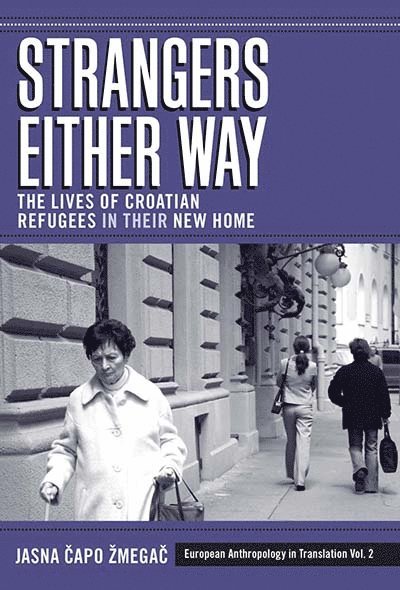
    Strangers Either Way

    The Lives of Croatian Refugees in their New Home

    AvJasna Čapo Zmegač

    Inbunden, Engelska, 2007

    Del i serien European Anthropology in Translation

    1 861 kr

    Beställningsvara. Skickas inom 5-8 vardagar. Fri frakt över 249 kr.

    Fler format och utgåvor

    Häftad

    511 kr

    E-bok

    315 kr

    Beskrivning

    Croatia gained the world's attention during the break-up of Yugoslavia in the early 1990s. In this context its image has been overshadowed by visions of ethnic conflict and cleansing, war crimes, virulent nationalism, and occasionally even emergent regionalism. Instead of the norm, this book offers a diverse insight into Croatia in the 1990s by dealing with one of the consequences of the war: the more or less forcible migration of Croats from Serbia and their settlement in Croatia, their "ethnic homeland." This important study shows that at a time in which Croatia was perceived as a homogenized nation-in-the-making, there were tensions and ruptures within Croatian society caused by newly arrived refugees and displaced persons from Serbia and Bosnia and Herzegovina. Refugees who, in spite of their common ethnicity with the homeland population, were treated as foreigners; indeed, as unwanted aliens.

    Produktinformation

    • Utgivningsdatum:2007-08-01
    • Mått:152 x 229 x 17 mm
    • Vikt:445 g
    • Format:Inbunden
    • Språk:Engelska
    • Serie:European Anthropology in Translation
    • Antal sidor:224
    • Förlag:Berghahn Books
    • ISBN:9781845453176

    Utforska kategorier

    • Antropologi inom Samhälle och politik
    • Sociala och etiska frågor inom Samhälle och politik

    Mer om författaren

    Jasna Capo Zmegac is a senior research fellow at the Institute of Ethnology and Folklore Research in Zagreb and adjunct professor at the University of Zagreb. She has a multi-disciplinary background in ethnology, cultural anthropology, demography and French literature. She studied at the University of Zagreb before doing her MA and PhD at Berkeley. She was a postdoctoral fellow in Strasbourg and Vienna, a Humboldt Fellow in Munich and Berlin, and a visiting fellow at various European universities. Her current research interests are in the field of anthropology of migration, especially forced and labor migration, and the politics of identity construction in diaspora settings. Her recent publications include the co-edited volume (with C. Voss and K. Roth) Co-ethnic Migrations Compared: Central and Eastern European Contexts (Munich: Kubon & Sagner, 2010), as well as refereed articles and chapters published in English, French, German, Croatian, and other European languages.

    Innehållsförteckning

    • List of MapsAcknowledgementsMapsIntroductionChapter 1. The Ethnology of IndividualsThe individual and her/his cultureThe relational notion of identityCase study: the Srijem CroatsPolyphony, hybridity, levels of reading: methodological-epistemological remarksThe Srijem case as an instance of coethnic migrationsChapter 2. Srijem Croats Talk about ThemselvesExchangesOne's own and other people's nostalgiaChapter 3. Identity Building in the Local Environment"If they are doing well, we are doing well too": resignation"We will never get over it": the Srijem sorrow"There's no going back, you have to go forward": integrationEthnocentrism of the newcomersChapter 4. The Older Generation and the MigrationBefore the migration: "There was money! What a life! Real life!"Reasons for leaving Srijem and making the decision to moveThe resettlement: the grandfathers decidingIn the new surroundingsFrom domination to dependenceChapter 5. Constructing Difference, Identifying the SelfAttribution of difference and symbolism of collective identity"Good" and "bad" Croats or how to measure Croatian-nessAbout the same thing from the other side: statements by the local population in GradinaChapter 6. Between Individual and Collective Integration into Croatian SocietyAt the outset: categorizing the settlersActivities of the migrant associationThe leaders' dilemma: equal citizens or a "sect of Srijem Croats"Chapter 7. Community, Identification, InteractionAntagonism between "the established" and "the outsiders"The local population's perspectiveThe stereotyped rhetoric of differenceStereotyping and individualizationThe ease of person-to-person interactionConclusionsEpilogue: Ethnologist and Her/His PublicTo take the standpoint of the researched or not?Reactions to the restitution of the researchFurther unwanted consequences of restitutionHow to protect the researched In the end: the distinct position of an ethnologist at homeBibliographyIndex