Inbunden, Engelska, 2010
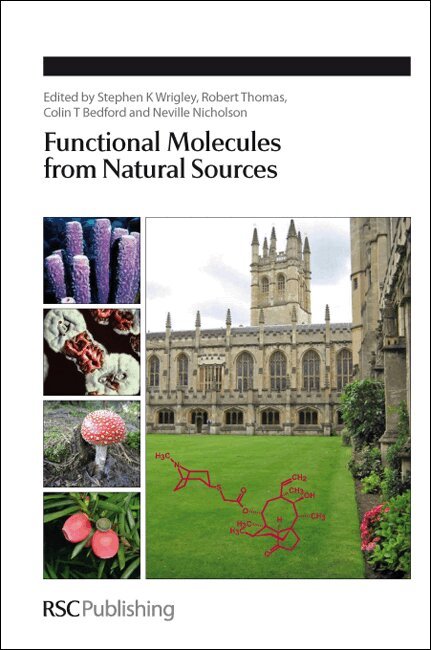
Functional Molecules from Natural Sources
Av Stephen K Wrigley, Robert Thomas, Neville Nicholson, Colin Bedford
Del i serien Special Publications
2031 kr
Beställningsvara. Skickas inom 7-10 vardagar. Fri frakt över 249 kr.
Beskrivning
Produktinformation
- Utgivningsdatum: 2010-11-26
- Mått: 156 x 234 x 14 mm
- Vikt: 520 g
- Format: Inbunden
- Språk: Engelska
- Serie: Special Publications
- Antal sidor: 244
- Förlag: Royal Society of Chemistry
- ISBN: 9781847552594
Utforska kategorier
Mer om författaren
Stephen K. Wrigley has worked in the field of industrial natural products discovery and development for twenty five years. He is currently Chief Technical Officer at Hypha Discovery Ltd., a company exploring basidiomycetes as a source of pharmaceutical lead compounds. He previously held managerial and scientific positions focusing on microbial products discovery at RecombinoGen, Ltd., Cubist Pharmaceuticals (UK) Ltd, TerraGen Discovery, Inc., Xenova Ltd. and Glaxo Group Research Ltd. after obtaining BSc and PhD degrees in chemistry at Imperial College, London. Robert Thomas has been involved in natural products research for over sixty years, completing his PhD on fungal metabolite structure elucidation in 1951 at the London School of Hygiene and Tropical Medicine. After working for the CSIRO in Australia and following postdoctoral studies in Canada and London, he joined the Squibb Institute for Medical Research in New Jersey. He subsequently held senior teaching positions at Imperial College, London and the University of Surrey and founded the plant product-based biotechnology company Biotics Ltd., based primarily at the University of Sussex. Professor Thomas was the chairman of the organising committee for Functional Molecules from Natural Sources and two previous natural products conferences organised by the RSC Biotechnology Group. Colin T. Bedford gained chemistry degrees from the Universities of Manchester and Glasgow and pursued postdoctoral research on the isolation, characterisation, biosynthesis and biomimetic synthesis of natural products at the Universities of Oxford, Sussex and British Columbia. He then joined Shell Research's Tunstall Laboratory undertaking research in chemical toxicology, where he progressed to Principal Scientist. He was then appointed to a senior lectureship at the University of Westminster pursuing research in natural product biosynthesis. Currently he is an Honorary Research Fellow at University College London. Following graduation with a London degree in physiology and chemistry, Neville Nicholson spent five years at the Chemical Defence Establishment at Porton Down before joining Beecham Pharmaceuticals. He remained with this company in its various forms for thirty years, participating in the elucidation of the biosynthetic pathway of the ?-lactamase inhibitor, clavulanic acid, and more recently specialising as a medicinal chemist with particular interests in small molecules of natural origin. He is now pursuing these interests as an Independent Scientist.
Recensioner i media
This book is based upon the proceedings of a conference, Functional Molecules from Natural Sources, organised by the Royal Society of Chemistry's Biotechnology Group and held at Magdalen College, Oxford, in July 2009. Most of the eighteen chapters are in the form of a transcript of an individual lecture given at the conference, while others are derived from a selection of the posters presented at it, and the final chapter provides a summary of those lectures for which a transcript was not available. In order to gain most benefit from the book, readers require some prior knowledge of medicinal or pharmaceutical chemistry and, consequently, its usefulness to many chemistry undergraduate students is likely to be limited. Moreover, at GBP109.99, it is priced well beyond that which most undergraduates would be willing to spend. As is to be expected from any book where individual chapters are written by different authors, the style of the writing varies considerably from chapter to chapter. In some of the best chapters the original 'transcript' appears to have been re-written by its author to make it a more readable chapter in the book. The book concentrates on the continuing importance of active compounds originally identified in and isolated from microbial, plant, and marine sources. The first chapter consists of a comprehensive survey of anticancer compounds that are currently undergoing clinical trials. This is followed by chapters that are case studies of the identification of functional compounds, their subsequent development and enhancement. While later chapters deal with the biosynthesis and genetics of active compounds. Altogether there is much to interest those working in drug discovery and development, or related fields. For undergraduate students, and their teachers, probably the two most useful chapters are "Discovery and Development of Antibiotics with Novel Modes of Action" (S B Singh), an interesting and elegantly written account of the discovery of platensimycin for development as a new antibiotic, and "High Capacity Countercurrent Chromatography for Fast Isolation of Natural Products" (I J Gerrard and D Fisher), a concise account of an important technique that is unlikely to be encountered in standard undergraduate chemistry textbooks. The book contains few errors, and these are simply printing mistakes. However, in some of the cases where the skeletal formula of a compound is included in the text it is on a different page to that in which the compound is first introduced, thus necessitating superfluous page turning and sometimes making it more difficult to compare molecular structures, while in others the size in which the formula has been printed is so small (e.g. page 63, figure 11) as to make comparison of structures hard work. Other figures too, including some photographs of cultures from a microbial strain collection (page 85, figure 2) have been printed too small to serve any useful purpose. The use of colour in the three dimensional molecular diagrams, especially where this had clearly been intended (e.g. page 179, figure 22), would also have been helpful. Although such flaws are not uncommon in contemporary chemistry texts, it would have made the reading of this book a more comfortable experience if they had been rectified prior to publication. It is possible that increasing the number of pages to accommodate larger figures or enable their position in the text to be changed, and the use of colour for diagrams, were rejected on grounds of cost. But if that is the case, a more appropriate economy would have been to publish the book as a paperback rather than a hardback. -- Julian Perfect - New York University in London Higher Phys Ed Sci Acad Cen - Journal 22 Vol 12 Issue 1
Betyg & recensioner
0 recensioner
Inga recensioner tillgängliga.