• Fri frakt över 249 kr
  • •
  • Snabba leveranser
  • •
  • Billiga böcker
Kundservice

Du är på sajten för privatpersoner.

Företag, bibliotek eller offentlig verksamhet?

Du handlar på classic.bokus.com, där alla dina funktioner finns intakta.
Till classic.bokus.com
Bokus logotyp. Gå till startsidan.
  • Erbjudanden
  • Student
  • Topplistor
  • Barn & ungdom
  • Bokus Play
  • E-böcker
  • Ljudböcker
  • Pocketböcker
  • Spel och pussel

5% studentrabatt – använd koden KURSBOK27 →

Sidfot

Mina sidor

    Hjälp

    • Kundservice
    • Vanliga frågor och svar
    • Frakt och leverans
    • Retur vid ångerrätt
    • Reklamera vara
    • Betalning
    • Köpvillkor
    • Allmänna villkor
    • Information om webbplatsens tillgänglighet

    Om Bokus

    • Om oss
    • Pressrum
    • För studenter
    • För företag
    • För bibliotek och offentlig verksamhet
    • För leverantörer
    • Hållbarhet

    Populärt

    • Aktuella erbjudanden
    • Presentkort
    • Studentlitteratur
    • Nya böcker
    • Topplistor
    • Signerade böcker
    • Engelska böcker

    Inspiration

    • Boktips
    • BookTok
    • Barnbokskaraktärer
    • Populära författare
    Logotyp för Bokus
    Följ oss på Facebook (extern länk)Följ oss på Instagram (extern länk)Följ oss på YouTube (extern länk)Följ oss på TikTok (extern länk)
    bokus @ CookiesAnpassa cookiesIntegritetspolicyKöpvillkor
    Till Citymail hemsida (extern länk)Till Budbee hemsida (extern länk)Till Postnord hemsida (extern länk)Till Schenker hemsida (extern länk)Till Early Bird hemsida (extern länk)Till Walleys hemsida (extern länk)
    1. Samhälle och politik
    2. Samhälle och kultur
    3. Kultur och medier
    4. Referensverk och tvärvetenskap

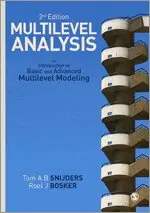
    Multilevel Analysis

    An Introduction to Basic and Advanced Multilevel Modeling

    AvTom A.B. Snijders,Roel Bosker

    Inbunden, Engelska, 2011

    3 234 kr

    Beställningsvara. Skickas inom 3-6 vardagar. Fri frakt över 249 kr.

    Fler format och utgåvor

    Häftad

    778 kr

    Beskrivning

    The Second Edition of this classic text introduces the main methods, techniques and issues involved in carrying out multilevel modeling and analysis.

    Snijders and Bosker's book is an applied, authoritative and accessible introduction to the topic, providing readers with a clear conceptual and practical understanding of all the main issues involved in designing multilevel studies and conducting multilevel analysis.

    This book provides step-by-step coverage of:

    • multilevel theories

    • ecological fallacies

    • the hierarchical linear model

    • testing and model specification

    • heteroscedasticity

    • study designs

    • longitudinal data

    • multivariate multilevel models

    • discrete dependent variables

    There are also new chapters on:

    • missing data

    • multilevel modeling and survey weights

    • Bayesian and MCMC estimation and latent-class models.

    This book has been comprehensively revised and updated since the last edition, and now discusses modeling using HLM, MLwiN, SAS, Stata including GLLAMM, R, SPSS, Mplus, WinBugs, Latent Gold, and SuperMix.

    This is a must-have text for any student, teacher or researcher with an interest in conducting or understanding multilevel analysis.

    Tom A.B. Snijders is Professor of Statistics in the Social Sciences at the University of Oxford and Professor of Statistics and Methodology at the University of Groningen.

    Roel J. Bosker is Professor of Education and Director of GION, Groningen Institute for Educational Research, at the University of Groningen.

    Produktinformation

    • Utgivningsdatum:2011-11-04
    • Mått:170 x 242 x 23 mm
    • Vikt:820 g
    • Format:Inbunden
    • Språk:Engelska
    • Antal sidor:368
    • Upplaga:2
    • Förlag:SAGE Publications
    • ISBN:9781849202008

    Utforska kategorier

    • Referensverk och tvärvetenskap inom Samhälle och politik

    Recensioner i media

    ′Overall, Snijders and Bosker provide an accessible and readable text on the subject of multilevel analysis. It is as much tailored to the needs of advanced quantitative researchers, as to relative beginners in the field. As a reader with limited experience in quantitative research, but an interest in advancing my knowledge and understanding of multilevel analysis, I found this text an ideal introduction to the area′ - Emma SmithMethodspace Book Reviews Club

    Innehållsförteckning

    • Preface second editionPreface to first editionIntroductionMultilevel analysisProbability modelsThis bookPrerequisitesNotationMultilevel Theories, Multi-Stage Sampling and Multilevel ModelsDependence as a nuisance Dependence as an interesting phenomenon Macro-level, micro-level, and cross-level relations GlommaryStatistical Treatment of Clustered DataAggregation Disaggregation The intraclass correlationWithin-group and between group variance Testing for group differences Design effects in two-stage samples Reliability of aggregated variables Within-and between group relations Regressions Correlations Estimation of within-and between-group correlations Combination of within-group evidence GlommaryThe Random Intercept ModelTerminology and notation A regression model: fixed effects onlyVariable intercepts: fixed or random parameters?When to use random coefficient models Definition of the random intercept model More explanatory variables Within-and between-group regressions Parameter estimation ′Estimating′ random group effects: posterior meansPosterior confidence intervals Three-level random intercept models GlommaryThe Hierarchical Linear Model Random slopesHeteroscedasticityDo not force ?01 to be 0! Interpretation of random slope variancesExplanation of random intercepts and slopesCross-level interaction effects A general formulation of fixed and random parts Specification of random slope modelsCentering variables with random slopes? Estimation Three or more levels GlommaryTesting and Model SpecificationTests for fixed parametersMultiparameter tests for fixed effects Deviance tests More powerful tests for variance parameters Other tests for parameters in the random part Confidence intervals for parameters in the random part Model specification Working upward from level one Joint consideration of level-one and level-two variables Concluding remarks on model specification GlommaryHow Much Does the Model Explain?Explained varianceNegative values of R2? Definition of the proportion of explained variance in two-level models Explained variance in three-level models Explained variance in models with random slopesComponents of varianceRandom intercept modelsRandom slope modelsGlommaryHeteroscedasticityHeteroscedasticity at level one Linear variance functionsQuadratic variance functionsHeteroscedasticity at level twoGlommaryMissing DataGeneral issues for missing data Implications for designMissing values of the dependent variableFull maximum likelihood Imputation The imputation method Putting together the multiple results Multiple imputations by chained equations Choice of the imputation model GlommaryAssumptions of the Hierarchical Linear ModelAssumptions of the hierarchical linear model Following the logic of the hierarchical linear model Include contextual effects Check whether variables have random effects Explained variance Specification of the fixed part Specification of the random part Testing for heteroscedasticity What to do in case of heteroscedasticity Inspection of level-one residuals Residuals at level two Influence of level-two units More general distributional assumptions GlommaryDesigning Multilevel StudiesSome introductory notes on powerEstimating a population meanMeasurement of subjects Estimating association between variables Cross-level interaction effects Allocating treatment to groups or individualsExploring the variance structureThe intraclass correlationVariance parametersGlommaryOther Methods and ModelsBayesian inference Sandwich estimators for standard errors Latent class modelsGlommaryImperfect HierarchiesA two-level model with a crossed random factor Crossed random effects in three-level models Multiple membership models Multiple membership multiple classification modelsGlommarySurvey WeightsModel-based and design-based inferenceDescriptive and analytic use of surveysTwo kinds of weights Choosing between model-based and design-based analysis Inclusion probabilities and two-level weights Exploring the informativeness of the sampling designExample: Metacognitive strategies as measured in the PISA studySampling designModel-based analysis of data divided into parts Inclusion of weights in the model How to assign weights in multilevel models Appendix. Matrix expressions for the single-level estimatorsGlommaryLongitudinal DataFixed occasionsThe compound symmetry models Random slopesThe fully multivariate modelMultivariate regression analysis Explained varianceVariable occasion designs Populations of curves Random functionsExplaining the functions 27415.2.4Changing covariates Autocorrelated residualsGlommaryMultivariate Multilevel ModelsWhy analyze multiple dependent variables simultaneously? The multivariate random intercept model Multivariate random slope models GlommaryDiscrete Dependent VariablesHierarchical generalized linear models Introduction to multilevel logistic regression Heterogeneous proportions The logit function: Log-odds The empty model The random intercept model Estimation Aggregation Further topics on multilevel logistic regression Random slope model Representation as a threshold model Residual intraclass correlation coefficient Explained variance Consequences of adding effects to the model Ordered categorical variables Multilevel event history analysis Multilevel Poisson regressionGlommarySoftware Special software for multilevel modelingHLMMLwiNThe MIXOR suite and SuperMixModules in general-purpose software packagesSAS procedures VARCOMP, MIXED, GLIMMIX, and NLMIXEDRStataSPSS, commands VARCOMP and MIXEDOther multilevel softwarePinTOptimal DesignMLPowSimMplusLatent GoldREALCOMWinBUGSReferencesIndex