• Fri frakt över 249 kr
  • •
  • Snabba leveranser
  • •
  • Billiga böcker
Kundservice

Du är på sajten för privatpersoner.

Företag, bibliotek eller offentlig verksamhet?

Du handlar på classic.bokus.com, där alla dina funktioner finns intakta.
Till classic.bokus.com
Bokus logotyp. Gå till startsidan.
  • Erbjudanden
  • Student
  • Topplistor
  • Barn & ungdom
  • Bokus Play
  • E-böcker
  • Ljudböcker
  • Pocketböcker
  • Spel och pussel

Pocketfynda! Hundratals böcker för 49 kr/st →

Sidfot

Mina sidor

    Hjälp

    • Kundservice
    • Vanliga frågor och svar
    • Frakt och leverans
    • Retur vid ångerrätt
    • Reklamera vara
    • Betalning
    • Köpvillkor
    • Allmänna villkor
    • Information om webbplatsens tillgänglighet

    Om Bokus

    • Om oss
    • Pressrum
    • För studenter
    • För företag
    • För bibliotek och offentlig verksamhet
    • För leverantörer
    • Hållbarhet

    Populärt

    • Aktuella erbjudanden
    • Presentkort
    • Studentlitteratur
    • Nya böcker
    • Topplistor
    • Signerade böcker
    • Engelska böcker

    Inspiration

    • Boktips
    • BookTok
    • Barnbokskaraktärer
    • Populära författare
    Logotyp för Bokus
    Följ oss på Facebook (extern länk)Följ oss på Instagram (extern länk)Följ oss på YouTube (extern länk)Följ oss på TikTok (extern länk)
    bokus @ CookiesAnpassa cookiesIntegritetspolicyKöpvillkor
    Till Citymail hemsida (extern länk)Till Budbee hemsida (extern länk)Till Postnord hemsida (extern länk)Till Schenker hemsida (extern länk)Till Early Bird hemsida (extern länk)Till Walleys hemsida (extern länk)
    1. Juridik
    2. Särskilda rättsområden
    3. Straffrätt: process och brott
    4. Straffprocessrätt

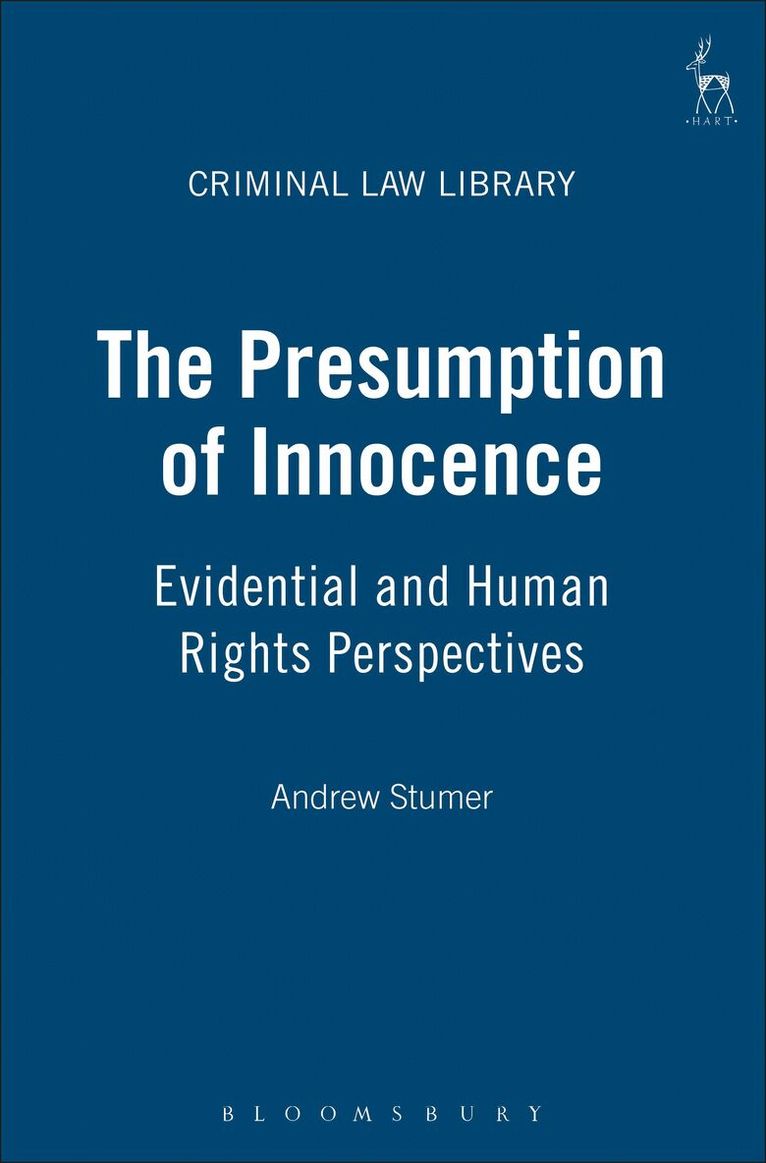
    Presumption of Innocence

    Evidential and Human Rights Perspectives

    AvAndrew Stumer

    Inbunden, Engelska, 2010

    Del i serien Criminal Law Library

    1 278 kr

    Beställningsvara. Skickas inom 10-15 vardagar. Fri frakt över 249 kr.

    Fler format och utgåvor

    E-bok

    1 388 kr

    Beskrivning

    The presumption of innocence is universally recognized as a fundamental human right and a core principle in the administration of criminal justice. Nonetheless, statutes creating criminal offences regularly depart from the presumption of innocence by requiring defendants to prove specific matters in order to avoid conviction. Legislatures and courts seek to justify this departure by asserting that the reversal of the burden of proof is necessary to meet the community interest in prosecuting serious crime and maintaining workable criminal sanctions. This book investigates the supposed justifications for limitation of the presumption of innocence. It does so through a comprehensive analysis of the history, rationale and scope of the presumption of innocence. It is argued that the values underlying the presumption of innocence are of such fundamental importance to individual liberty that they cannot be sacrificed on the altar of community interest.In particular, it is argued that a test of 'proportionality', which seeks to weigh individual rights against the community interest, is inappropriate in the context of the presumption of innocence and that courts ought instead to focus on whether an impugned measure threatens the values which the presumption is designed to protect. The book undertakes a complete and systematic review of the United Kingdom and Strasbourg authority on the presumption of innocence. It also draws upon extensive references to comparative material, both judicial and academic, from the United States, Canada and South Africa.

    Produktinformation

    • Utgivningsdatum:2010-06-14
    • Mått:156 x 234 x 20 mm
    • Vikt:558 g
    • Format:Inbunden
    • Språk:Engelska
    • Serie:Criminal Law Library
    • Antal sidor:258
    • Förlag:Bloomsbury Publishing PLC
    • ISBN:9781849460361

    Utforska kategorier

    • Straffprocessrätt inom Juridik

    Mer om författaren

    Andrew Stumer is a practising barrister in Brisbane, Australia. He obtained his DPhil in law from the University of Oxford in 2008.

    Recensioner i media

    The Presumption of Innocence is an engaging work, providing a thoroughly researched and thoughtfully reasoned thesis that is evident throughout the book. Readers will find that additional commentary is diligently supplied on almost every major issue presented. Further, Stumer avoids preaching to the converted. Opposing viewpoints are openly acknowledged and examined for their strengths and weaknesses. One of the book's great strengths is that it will appeal to readers beyond the legal profession, while also offering very astute observations about certain finer points of legal analysis. Faith Baron Saskatchewan Law Review Volume 74, 2011

    Innehållsförteckning

    • INTRODUCTION 1. THE PRESUMPTION BEFORE THE HUMAN RIGHTS ACT A. History of the Presumption of Innocence B. Burden of Proof 1. Persuasive Burdens 2. Evidential Burdens C. Standard of Proof D. Impact of the HRA E. Conclusion 2. RATIONALE FOR THE PRESUMPTION A. Two rationales for the Presumption 1. Protecting the Innocent 2. Promoting the Rule of Law B. Limitation of the Presumption 1. Limitation of Rights 2. Threat of Serious Crime 3. When the Rationale is Attenuated C. Conclusion 3. SCOPE OF THE PRESUMPTION A. Substantive Approach 1. Rejection in the English Cases 2. Case for a Substantive Approach 3. Other Constraints on Unfair Offences B. Narrow Procedural Approach 1. Confusion in the English Cases 2. Case for a Narrow Procedural Approach C. Broad Procedural Approach 1. Greater Power includes the Lesser 2. Risk of More Strict Liability Ofences D. Conclusion 4. THE PRESUMPTION IN STRASBOURG A. The Content of the Presumption 1. Official Decisions Reflecting Guilt 2. Burden of Proof 3. Presumptions Confined within Reasonable Limits 4. Article 6(2) and Substantive Law B. Limitation of Article 6 Rights 1. Community Interest under Article 6(2) 2. Community Interest and other Article 6 Rights C. Conclusion 5. PROPORTIONALITY AND THE PRESUMPTION A. Confusion in the English Cases 1. Necessity Approach 2. Balance Approach 3. A 'Difference of Emphasis' B. The Nature of the Proportionality Inquiry 1. Legitimate Objective 2. Suitability, Necessity and Balance 3. Proportionality and the Problem of Deference C. Conclusion 6. ALLOCATING THE BURDEN OF PROOF A. Seriousness of the Offence B. Penalty C. Regulatory Offences 1. Minimal Censure and Penalty 2. An Effective Regulatory Regime D. Knowledge and Ease of Proof 1. Relative Ease of Proof 2. 'Peculiar Knowledge' E. Importance of Matters Proved by Prosecution 1. Proof of Wrongfulness 2. Connection between Basic and Presumed Fact F. Conclusion Conclusion