• Fri frakt över 249 kr
  • •
  • Snabba leveranser
  • •
  • Billiga böcker
Kundservice

Du är på sajten för privatpersoner.

Företag, bibliotek eller offentlig verksamhet?

Du handlar på classic.bokus.com, där alla dina funktioner finns intakta.
Till classic.bokus.com
Bokus logotyp. Gå till startsidan.
  • Erbjudanden
  • Nyheter
  • Student
  • Topplistor
  • Barn & ungdom
  • Bokus Play
  • E-böcker
  • Pocketböcker
  • Spel & pussel

10% rabatt på allt med kod: NYSTART10 →

Sidfot

Mina sidor

    Hjälp

    • Kundservice
    • Vanliga frågor och svar
    • Frakt och leverans
    • Retur vid ångerrätt
    • Reklamera vara
    • Betalning
    • Köpvillkor
    • Allmänna villkor
    • Information om webbplatsens tillgänglighet

    Om Bokus

    • Om oss
    • Pressrum
    • För studenter
    • För företag
    • För bibliotek och offentlig verksamhet
    • För leverantörer
    • Hållbarhet

    Populärt

    • Aktuella erbjudanden
    • Presentkort
    • Studentlitteratur
    • Nya böcker
    • Topplistor
    • Signerade böcker
    • Engelska böcker

    Inspiration

    • Boktips
    • BookTok
    • Populära bokserier
    • Barnbokskaraktärer
    • Populära författare
    Logotyp för Bokus
    Följ oss på Facebook (extern länk)Följ oss på Instagram (extern länk)Följ oss på YouTube (extern länk)Följ oss på TikTok (extern länk)
    bokus @ CookiesAnpassa cookiesIntegritetspolicyKöpvillkor
    Till Citymail hemsida (extern länk)Till Budbee hemsida (extern länk)Till Postnord hemsida (extern länk)Till Schenker hemsida (extern länk)Till Early Bird hemsida (extern länk)Till Walleys hemsida (extern länk)
    1. Naturvetenskap och teknik
    2. Geovetenskap
    3. Miljövetenskap och miljöpolitik

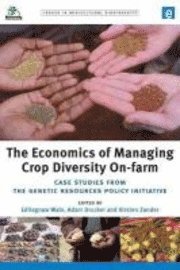
    Economics of Managing Crop Diversity On-farm

    Case studies from the Genetic Resources Policy Initiative

    AvEdilegnaw Wale,Adam G. Drucker

    Häftad, Engelska, 2010

    Del i serien Issues in Agricultural Biodiversity

    793 kr

    Beställningsvara. Skickas inom 10-15 vardagar. Fri frakt över 249 kr.

    Beskrivning

    The purpose of this book is to assess a variety of economic issues as they relate to agro-biodiversity and show how addressing these issues can assist in agro-biodiversity policy-making. This is illustrated using empirical data from some of the countries (Ethiopia, Nepal and Zambia) which are part of the Genetic Resources Policy Initiative. The empirical chapters apply the relevant economic methods, including regression analysis, choice experiments, hedonic pricing, contingent valuation and farm business income analysis.The authors discuss the economics of managing crop diversity on-farm in the context of crop variety attribute preferences, farmers' perception of agro-biodiversity loss, and value addition and marketing of the products of traditional crop varieties. The case studies include detailed analysis of traditional varieties of groundnut, maize, rice, sorghum, and teff. The results are relevant not only to GRPI countries but also to other countries concerned with the sustainable utilization of these resources. Overall, the studies illustrate how genetic resources issues can be integrated into rural development interventions.

    Produktinformation

    • Utgivningsdatum:2010-11-24
    • Mått:156 x 234 x 13 mm
    • Vikt:204 g
    • Format:Häftad
    • Språk:Engelska
    • Serie:Issues in Agricultural Biodiversity
    • Antal sidor:160
    • Förlag:Taylor & Francis Ltd
    • ISBN:9781849712224

    Utforska kategorier

    • Miljövetenskap och miljöpolitik inom Naturvetenskap och teknik
    • Agronomi och lantbruk inom Naturvetenskap och teknik
    • Lantbruksteknik inom Naturvetenskap och teknik

    Mer om författaren

    Edilegnaw Wale is a Senior Lecturer in the Department of Agricultural Economics, School of Agricultural Sciences and Agribusiness, University of KwaZulu-Natal, Pietermaritzburg, South Africa.Adam G. Drucker is a Senior Economist at Bioversity International, Rome, Italy. Kerstin K. Zander is a Research Fellow in the School for Environmental Research, Charles Darwin University, Darwin, Australia.

    Recensioner i media

    'The book by Wale and collaborators helps to enlighten us about the deep rooted causes of agro-biodiversity loss. A very valuable addition to the libraries of policy makers, scientists and environmental and development NGOs concerned with this global problem.' Dr. Unai Pascual, Lecturer, Department of Land Economy, Cambridge'Based on the Genetic Resources Policy Initiative (GRPI), which aims to strengthen the capacity of developing countries to design comprehensive policy frameworks for genetic resources, this book aims to document the range of economic issues of relevance to agro-biodiversity policy. In so doing, it succeeds to link results based on scientific, in this case economic, work to policy recommendations and thereby contributing to both the scientific as well as the policy discussion. Its major contribution to the scientific discussion is the application of various economic approaches (e.g., choice experiments, hedonic pricing, variety attribute preference ranking, contingent valuation and farm business income analysis) to empirically analyze the value chains of plant genetic resources used in food production. In that way the multi-dimensions of in situ conservation become better understood and it is easier to integrate in situ conservation policies into rural development interventions to address potential policy trade-offs. The enhanced economic understanding of the decision processes enables the improved design of well targeted conservation policies for both the traditional varieties well marketable (de facto conserved) and the threatened varieties, which need clear (financial) compensatory measures to be maintained by the farmers. By doing so, the book takes forward the policy discussion to make the conservation of plant genetic resources (used in food production) part of the broader rural development agenda.' Dr. Detlef Virchow, Food Security Center (FSC), University of Hohenheim, Germany

    Innehållsförteckning

    • PrefaceList of ContributorsPart I: Setting the Scene1. Introduction: Setting the Scene for GRPI EconomicsPart II: Variety Trait Preferences and On-Farm Conservation Policy2. Economic Analysis of Ethiopian Farmers' Preferences for Crop Variety Attributes: A Choice Experiment Approach3. Valuation of Rice Diversity in Nepal: A Trait-based Approach4. Farmers' Perceptions on Replacement and Loss of Traditional Crop Varieties: Examples from Ethiopia and ImplicationsPart III: Market Value Chains, Commercialization and On-farm Conservation Policy5. Consumers' Attribute Preferences and Traders' Challenges Affecting the Use of Local Maize and Groundnut Varieties in Lusaka: Implications for Crop Diversity Policy6. Commercialization and Market Linkages for Promoting the Use of Local Rice Varieties: A Nepalese Case StudyPart IV: Conclusions and Outlook7. Findings, Conclusions, Implications and OutlookIndex