• Fri frakt över 249 kr
  • •
  • Snabba leveranser
  • •
  • Billiga böcker
Kundservice

Du är på sajten för privatpersoner.

Företag, bibliotek eller offentlig verksamhet?

Du handlar på classic.bokus.com, där alla dina funktioner finns intakta.
Till classic.bokus.com
Bokus logotyp. Gå till startsidan.
  • Erbjudanden
  • Student
  • Topplistor
  • Barn & ungdom
  • Bokus Play
  • E-böcker
  • Ljudböcker
  • Pocketböcker
  • Spel och pussel

5% studentrabatt – använd koden KURSBOK27 →

Sidfot

Mina sidor

    Hjälp

    • Kundservice
    • Vanliga frågor och svar
    • Frakt och leverans
    • Retur vid ångerrätt
    • Reklamera vara
    • Betalning
    • Köpvillkor
    • Allmänna villkor
    • Information om webbplatsens tillgänglighet

    Om Bokus

    • Om oss
    • Pressrum
    • För studenter
    • För företag
    • För bibliotek och offentlig verksamhet
    • För leverantörer
    • Hållbarhet

    Populärt

    • Aktuella erbjudanden
    • Presentkort
    • Studentlitteratur
    • Nya böcker
    • Topplistor
    • Signerade böcker
    • Engelska böcker

    Inspiration

    • Boktips
    • BookTok
    • Barnbokskaraktärer
    • Populära författare
    Logotyp för Bokus
    Följ oss på Facebook (extern länk)Följ oss på Instagram (extern länk)Följ oss på YouTube (extern länk)Följ oss på TikTok (extern länk)
    bokus @ CookiesAnpassa cookiesIntegritetspolicyKöpvillkor
    Till Citymail hemsida (extern länk)Till Budbee hemsida (extern länk)Till Postnord hemsida (extern länk)Till Schenker hemsida (extern länk)Till Early Bird hemsida (extern länk)Till Walleys hemsida (extern länk)
    1. Naturvetenskap och teknik
    2. Teknik och industri
    3. Elektronik och kommunikationer

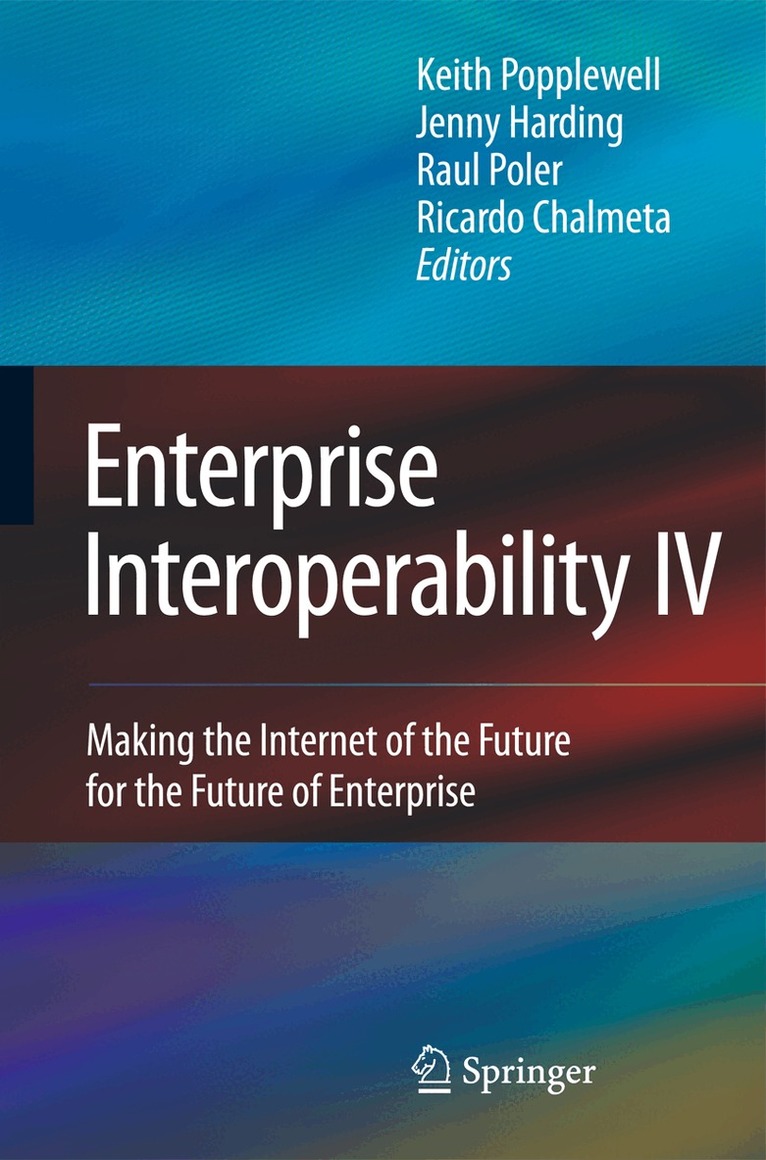
    Enterprise Interoperability IV

    Making the Internet of the Future for the Future of Enterprise

    AvKeith Popplewell,Jenny Harding

    Inbunden, Engelska, 2010

    Del i serien Proceedings of the I-ESA Conferences

    1 614 kr

    Beställningsvara. Skickas inom 10-15 vardagar. Fri frakt över 249 kr.

    Beskrivning

    Enterprise Interoperability is the ability of an enterprise or organisation to work with other enterprises or organisations without special effort. It is now recognised that interoperability of systems and thus sharing of information is not sufficient to ensure common understanding between enterprises. Knowledge of information meaning and understanding of how is to be used must also be shared if decision makers distributed between those enterprises in the network want to act consistently and efficiently. Industry’s need for Enterprise Interoperability has been one of the significant drivers for research into the Internet of the Future. EI research will embrace and extend contributions from the Internet of Things and the Internet of Services, and will go on to drive the future needs for Internets of People, Processes, and Knowledge.

    Produktinformation

    • Utgivningsdatum:2010-04-14
    • Mått:155 x 235 x 35 mm
    • Vikt:848 g
    • Format:Inbunden
    • Språk:Engelska
    • Serie:Proceedings of the I-ESA Conferences
    • Antal sidor:462
    • Upplaga:2010
    • Förlag:Springer London Ltd
    • ISBN:9781849962568

    Utforska kategorier

    • Elektronik och kommunikationer inom Naturvetenskap och teknik
    • Teknik: allmänt inom Naturvetenskap och teknik
    • Projektledning inom Ekonomi och Ledarskap

    Innehållsförteckning

    • Business Interoperability.- Ad-hoc Execution of Collaboration Patterns using Dynamic Orchestration.- Alternative Process Notations for Mobile Information Systems.- Conceptual Framework for the Interoperability Requirements of Collaborative Planning Process.- Improving Interoperability using a UML Profile for Enterprise Modelling.- Towards Test Framework for Efficient and Reusable Global e-Business Test Beds.- Unified Reversible Life Cycle for Future Interoperable Enterprise Distributed Information Systems.- Enterprise Modeling for Enterprise Interoperability.- A Meta-model for a Language for Business Process Characterizing Modelling.- A Tool for Interoperability Analysis of Enterprise Architecture Models using Pi-OCL.- A UML-based System Integration Modeling Language for the Application System Design of Shipborne Combat System.- Contribution to Interoperability of Executive Information Systems Focusing on Data Storage System.- GRAI-ICE Model Driven Interoperability Architecture for Developing Interoperable ESA.- Model for Trans-sector Digital Interoperability.- Transformation from a Collaborative Process to Multiple Interoperability Processes.- Semantics for Enterprise Interoperability.- A Manufacturing Foundation Ontology for Product Life Cycle Interoperability.- A Semantic Mediator for Data Integration in Autonomous Logistics Processes.- An Ontology Proposal for Resilient Multi-plant Networks.- Collaboration Knowledge Ontologies to Support Knowledge Management and Sharing in Virtual Organisations.- Mediation Information System Engineering for Interoperability Support in Crisis Management.- Service Value Meta-Model: An Engineering Viewpoint.- Architectures and Frameworks for Interoperability.- An Interoperable Enterprise Architecture to Support Decentralized Collaborative Planning Processes in Supply Chain Networks.- Business Cooperation-oriented Heterogeneous System Integration Framework and its Implementation.- Collaboration Knowledge Management and Sharing Services to Support a Virtual Organisation.- Developing a Science Base for Enterprise Interoperability.- From Pipes-and-Filters to Workflows.- Risk Sources Identification in Virtual Organisation.- Service-based Model for Enterprise Interoperability: Context-Driven Approach.- Transformation of UML Activity Diagram to YAWL.- Platforms for Enterprise Interoperability.- Gap Analysis of Ontology Mapping Tools and Techniques.- Networked Enterprise Transformation and Resource Management in Future Internet Enabled Innovation Clouds.- Opportunity Discovery Through Network Analysis.- Reflections on Aspects of Enterprise Interoperability.- Specification of SETU with WSMO.- Interoperability Scenarios and Case Studies.- A Success Story: Manufacturing Execution System Implementation.- Enabling Proactive Behaviour of Future Project Managers.- Gaps to Fill Between Theoretical Interoperable Quality and Food Safety Environment and Enterprise Implementations.- How to Develop a Questionnaire in Order to Measure Interoperability Levels in Enterprises.- Knowledge Sharing and Communities of Practices for Intra-organizational Interoperability.- Standards for Interoperability.- Aligning the UEML Ontology with SUMO.- Emerging Interoperability Directions in Electronic Government.- Enterprise Collaboration Maturity Model (ECMM): Preliminary Definition and Future Challenges.- Towards a Conceptualisation of Interoperability Requirements.- Use Profile Management for Standard Conformant Customisation.