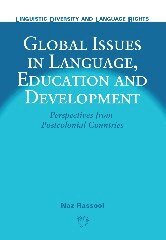
Häftad, Engelska, 2007
Global Issues in Language, Education and Development
Perspectives from Postcolonial Countries
Av Naz Rassool
Del 4 i serien Linguistic Diversity and Language Rights
485 kr
Beställningsvara. Skickas inom 5-8 vardagar. Fri frakt över 249 kr.
Beskrivning
Produktinformation
- Utgivningsdatum: 2007-03-12
- Mått: 148 x 210 x 16 mm
- Vikt: 396 g
- Format: Häftad
- Språk: Engelska
- Serie: Linguistic Diversity and Language Rights
- Antal sidor: 304
- Förlag: Channel View Publications Ltd
- ISBN: 9781853599514
Utforska kategorier
Mer om författaren
Professor Naz Rassool teaches in the Institute of Education at the University of Reading. She has published widely within the fields of the political economy of language in education; literacy and development and language relations within the global cultural economy, New Managerialism in education, and the sociology of technology in education. She is the author of Literacy for Sustainable Development in the Age of Information (1999), co-author, with Louise Morley, of School Effectiveness: Fracturing the Discourse (1999) and co-editor with Kevin Brehony, of Nationalisms Old and New (1999). She is also co-editor of the international journal Pedagogy, Culture and Society.
Recensioner i media
Naz Rasool’s work combines academic rigour with sensitiveness. The first comes from a careful study of the empirical data on the use of language in the domains of education and employment; the second from an understanding of how these realities actually impact the lives of ordinary people, especially the disadvantaged. She begins with a theoretical overview of how colonialism impacts the colonized and how language is used to construct new colonial identities and networks of the distribution of power and patronage. Two historical moments have been chosen to examine major transformations in colonized countries: the first, the carving up of Africa at the Berlin Conference in 1884-1885; the second, the partition of India in 1947. The fractures and displacement following these divisions have given rise to conflicts between ethnolinguistic groups which are still with us. The colonial discourse created hierarchies, especially in relation to the acquisition of the colonial language, which is also with us. The way these elites use the education system to perpetuate their privileged status is a theme which occurs several times in the book.Part-2 comprises case studies of Mali, South Africa and Pakistan. Contributed by scholars specializing in these areas, it provides the empirical evidence which supports the major arguments and conclusions of the book. The last part is about these conclusions, of which the most significant one is about the importance of pursuing multilingual language-in-education policies. This strategy seeks to secure indigenous cultural capital along with the development of knowledges and skills which are needed for operating in a globalized world.
Betyg & recensioner
0 recensioner
Inga recensioner tillgängliga.