• Fri frakt över 249 kr
  • •
  • Snabba leveranser
  • •
  • Billiga böcker
Kundservice

Du är på sajten för privatpersoner.

Företag, bibliotek eller offentlig verksamhet?

Du handlar på classic.bokus.com, där alla dina funktioner finns intakta.
Till classic.bokus.com
Bokus logotyp. Gå till startsidan.
  • Erbjudanden
  • Nyheter
  • Student
  • Topplistor
  • Barn & ungdom
  • Bokus Play
  • E-böcker
  • Pocketböcker
  • Spel & pussel

10% rabatt på allt med kod: NYSTART10 →

Sidfot

Mina sidor

    Hjälp

    • Kundservice
    • Vanliga frågor och svar
    • Frakt och leverans
    • Retur vid ångerrätt
    • Reklamera vara
    • Betalning
    • Köpvillkor
    • Allmänna villkor
    • Information om webbplatsens tillgänglighet

    Om Bokus

    • Om oss
    • Pressrum
    • För studenter
    • För företag
    • För bibliotek och offentlig verksamhet
    • För leverantörer
    • Hållbarhet

    Populärt

    • Aktuella erbjudanden
    • Presentkort
    • Studentlitteratur
    • Nya böcker
    • Topplistor
    • Signerade böcker
    • Engelska böcker

    Inspiration

    • Boktips
    • BookTok
    • Populära bokserier
    • Barnbokskaraktärer
    • Populära författare
    Logotyp för Bokus
    Följ oss på Facebook (extern länk)Följ oss på Instagram (extern länk)Följ oss på YouTube (extern länk)Följ oss på TikTok (extern länk)
    bokus @ CookiesAnpassa cookiesIntegritetspolicyKöpvillkor
    Till Citymail hemsida (extern länk)Till Budbee hemsida (extern länk)Till Postnord hemsida (extern länk)Till Schenker hemsida (extern länk)Till Early Bird hemsida (extern länk)Till Walleys hemsida (extern länk)
    1. Ekonomi och Ledarskap
    2. Nationalekonomi
    3. Ekonomisk historia

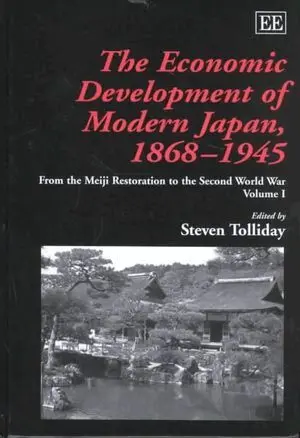
    Economic Development of Modern Japan, 1868–1945

    From the Meiji Restoration to the Second World War

    AvSteven Tolliday

    Inbunden, Engelska, 2001

    Del i serien Elgar Mini Series

    11 416 kr

    Beställningsvara. Skickas inom 5-8 vardagar. Fri frakt över 249 kr.

    Beskrivning

    This authoritative collection presents the key contributions on the economic history of Japan from the Meiji Restoration to the Second World War. It covers broad patterns of economic development and also focuses specifically on the zaibatsu and Japanese management techniques; technology transfer; banking and financial systems; labour, education and human capital; the economic role of Japanese women; and the economic dimensions of imperialism and war. This two-volume set brings together important texts around these themes, including less well-known work first published in Japan. It will be a valuable reference work for scholars and students of history, economics, political science and Asian studies.

    Produktinformation

    • Utgivningsdatum:2001-05-25
    • Mått:169 x 244 x undefined mm
    • Format:Inbunden
    • Språk:Engelska
    • Serie:Elgar Mini Series
    • Förlag:Edward Elgar Publishing Ltd
    • ISBN:9781858981901

    Utforska kategorier

    • Ekonomisk historia inom Ekonomi och Ledarskap
    • Internationell ekonomi inom Ekonomi och Ledarskap
    • Asiens historia inom Historia och arkeologi

    Mer om författaren

    Edited by Steven Tolliday, Professor of Economic and Social History, University of Leeds, UK

    Recensioner i media

    ’It is consequently important to conclude by praising Tolliday for his achievement, given the undoubted quality of what has been included. Moreover, he has also edited a two-volume set covering the period 1945-95, allowing those who teach this subject to provide reading lists that ought to be much more focused.’

    Innehållsförteckning

    • Contents:Volume I:AcknowledgementsIntroduction Steven TollidayPART ITHE PATTERN OF ECONOMIC DEVELOPMENT 1. Kozo Yamamura (1973), ‘Towards a Reexamination of the Economic History of Tokugawa Japan, 1600–1867’2. Susan B. Hanley (1983), ‘A High Standard of Living in Nineteenth-Century Japan: Fact or Fantasy?’3. Yasukichi Yasuba (1986), ‘Standard of Living in Japan Before Industrialization: From What Level Did Japan Begin? A Comment’4. Susan B. Hanley (1986), ‘Standard of Living in Nineteenth-Century Japan: Reply to Yasuba’5. Thomas C. Smith (1973), ‘Pre-Modern Economic Growth: Japan and the West’6. Kozo Yamamura (1974), ‘The Japanese Economy, 1911–1930: Concentration, Conflicts, and Crises’7. Kaoru Sugihara (1989), ‘Japan’s Industrial Recovery, 1931–6’8. Sugihara Kaoru (1990), ‘Japan as an Engine of the Asian International Economy, c. 1880–1936’PART IILAND AND AGRICULTURE 9. Penelope Francks (1990), ‘Peasantry, Proletariat or Private Enterprise? – The Japanese Farmer in the Industrialisation Process’10. Osamu Saito (1986), ‘The Rural Economy: Commercial Agriculture, By-Employment, and Wage Work’11. Loren Brandt (1993), ‘Interwar Japanese Agriculture: Revisionist Views on the Impact of the Colonial Rice Policy and the Labor-Surplus Hypothesis’12. Ann Waswo (1974), ‘The Origins of Tenant Unrest’PART IIIMANAGEMENT AND ENTERPRISE SYSTEM AGeneral13. Keiichiro Nakagawa (1993), ‘Business Management in Japan – A Comparative Historical Study’14. Hisashi Masaki (1986), ‘The Formation and Evolution of the Corporate Business System in Japan’15. Tsunehiko Yui (1988), ‘Development, Organization, and Business Strategy of Industrial Enterprises in Japan (1915–1935)’BZaibatsu 16. Kozo Yamamura (1967), ‘The Founding of Mitsubishi: A Case Study in Japanese Business History’17. Seiichiro Yonekura (1985), ‘The Emergence of the Prototype of Enterprise Group Capitalism: The Case of Mitsui’18. Hisashi Masaki (1978), ‘The Financial Characteristics of the Zaibatsu in Japan: The Old Zaibatsu and Their Closed Finance’19. Kozo Yamamura (1976), ‘General Trading Companies in Japan: Their Origins and Growth’CNon-Zaibatsu Business Development20. Tessa Morris-Suzuki (1992), ‘Sericulture and the Origins of Japanese Industrialization’21. Steven J. Ericson (1989), ‘Private Railways in the Meiji Era: Forerunners of Modern Japanese Management?’22. Tetsuji Okazaki (1987), ‘The Japanese Iron and Steel Industry, 1929–33, and the Establishment of the Nippon Steel Co.’23. W. Miles Fletcher III (1996), ‘The Japan Spinners Association: Creating Industrial Policy in Meiji Japan’24. William Mass and Hideaki Miyajima (1993), ‘The Organization of the Developmental State: Fostering Private Capabilities and the Roots of the Japanese "Miracle"’PART IVMANAGEMENT AND TECHNOLOGY TRANSFER 25. Tetsuro Nakaoka (1991), ‘The Transfer of Cotton Manufacturing Technology from Britain to Japan’26. Kozo Yamamura (1986), ‘Japan’s Deus ex Machina: Western Technology in the 1920s’27. Mark Mason (1990), ‘With Reservations: Prewar Japan as Host to Western Electric and ITT’Name IndexVolume II:AcknowledgementsIntroduction Steven TollidayPART IBANKING AND FINANCE 1. Hugh T. Patrick (1967), ‘Japan, 1868–1914’2. Kozo Yamamura (1972), ‘Japan 1868–1930: A Revised View’3. Kanji Ishii (1991), ‘Japan’4. W. Miles Fletcher III (1991), ‘Japanese Banks and National Economic Policy, 1920–1936’PART IIEDUCATION AND HUMAN CAPITAL 5. R.P. Dore (1964), ‘Education: Japan’6. Koji Taira (1971), ‘Education and Literacy in Meiji Japan: An Interpretation’7. James R. Bartholomew (1978), ‘Japanese Modernization and the Imperial Universities, 1876–1920’PART IIILABOUR 8. Akiko Chimoto (1986), ‘Employment in the Meiji Period: From "Tradition" to "Modernity"’9. Thomas C. Smith (1984), ‘The Right to Benevolence: Dignity and Japanese Workers, 1890–1920’10. E. Patricia Tsurumi (1984), ‘Female Textile Workers and the Failure of Early Trade Unionism in Japan’11. Andrew Gordon (1989), ‘Business and the Corporate State: The Business Lobby and Bureaucrats on Labor, 1911–41’12. Ron Napier (1982), ‘The Transformation of the Japanese Labor Market, 1894–1937’13. Yasukichi Yasuba (1976), ‘The Evolution of Dualistic Wage Structure’14. Andrew Gordon (1990), ‘Japanese Labor Relations During the Twentieth Century’PART IVWOMEN 15. Sharon H. Nolte and Sally Ann Hastings (1991), ‘The Meiji State’s Policy Towards Women, 1890–1910’16. Janet Hunter (1990), ‘Women’s Labour Force Participation in Interwar Japan’17. Kathleen Uno (1993), ‘One Day at a Time: Work and Domestic Activities of Urban Lower-Class Women in Early Twentieth-Century Japan’18. Robert J. Smith (1983), ‘Making Village Women into "Good Wives and Wise Mothers" in Prewar Japan’PART VIMPERIALISM AND WAR 19. K. Yamamura (1977), ‘Success Illgotten? The Role of Meiji Militarism in Japan’s Technological Progress’20. Kaoru Sugihara (1997), ‘The Economic Motivations Behind Japanese Aggression in the Late 1930s: Perspectives of Freda Utley and Nawa Toichi’21. Peter Duus (1989), ‘Zaikabo: Japanese Cotton Mills in China, 1895–1937’22. Masaru Udagawa (1990), ‘The Move into Manchuria of the Nissan Combine’23. Richard Rice (1979), ‘Economic Mobilization in Wartime Japan: Business, Bureaucracy, and the Military in Conflict’24. Takao Shiba (1994), ‘Business Activities of Japanese Manufacturing Industries During World War II’Name Index