• Fri frakt över 249 kr
  • •
  • Snabba leveranser
  • •
  • Billiga böcker
Kundservice

Du är på sajten för privatpersoner.

Företag, bibliotek eller offentlig verksamhet?

Du handlar på classic.bokus.com, där alla dina funktioner finns intakta.
Till classic.bokus.com
Bokus logotyp. Gå till startsidan.
  • Erbjudanden
  • Nyheter
  • Student
  • Topplistor
  • Barn & ungdom
  • Bokus Play
  • E-böcker
  • Pocketböcker
  • Spel & pussel

10% rabatt på allt med kod: NYSTART10 →

Sidfot

Mina sidor

    Hjälp

    • Kundservice
    • Vanliga frågor och svar
    • Frakt och leverans
    • Retur vid ångerrätt
    • Reklamera vara
    • Betalning
    • Köpvillkor
    • Allmänna villkor
    • Information om webbplatsens tillgänglighet

    Om Bokus

    • Om oss
    • Pressrum
    • För studenter
    • För företag
    • För bibliotek och offentlig verksamhet
    • För leverantörer
    • Hållbarhet

    Populärt

    • Aktuella erbjudanden
    • Presentkort
    • Studentlitteratur
    • Nya böcker
    • Topplistor
    • Signerade böcker
    • Engelska böcker

    Inspiration

    • Boktips
    • BookTok
    • Populära bokserier
    • Barnbokskaraktärer
    • Populära författare
    Logotyp för Bokus
    Följ oss på Facebook (extern länk)Följ oss på Instagram (extern länk)Följ oss på YouTube (extern länk)Följ oss på TikTok (extern länk)
    bokus @ CookiesAnpassa cookiesIntegritetspolicyKöpvillkor
    Till Citymail hemsida (extern länk)Till Budbee hemsida (extern länk)Till Postnord hemsida (extern länk)Till Schenker hemsida (extern länk)Till Early Bird hemsida (extern länk)Till Walleys hemsida (extern länk)
    1. Ekonomi och Ledarskap
    2. Nationalekonomi
    3. Mikroekonomi

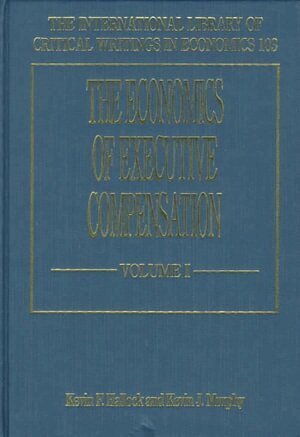
    Economics of Executive Compensation

    AvKevin F. Hallock,Kevin J. Murphy

    Inbunden, Engelska, 1999

    Del 103 i serien The International Library of Critical Writings in Economics series

    10 757 kr

    Beställningsvara. Skickas inom 5-8 vardagar. Fri frakt över 249 kr.

    Beskrivning

    The rapid rise in the earnings of top executives is a distinctive feature of modern capitalism. This important two volume collection presents some of the most influential published theoretical and empirical papers on executive compensation. Topics include: Theoretical Foundations of Executive Pay; Executive Compensation and Company Performance; Relative Performance Evaluation; Determinants of Executive Compensation; The Effects of CEO Pay; Accounting Measures in Executive Contracts; CEO Turnover; CEO Pay Internationally; Economic Environments and Executive Pay.The Economics of Executive Compensation draws together a wide range of literature and will be an essential reference guide for students, researchers and practioners.

    Produktinformation

    • Utgivningsdatum:1999-02-24
    • Mått:169 x 244 x undefined mm
    • Format:Inbunden
    • Språk:Engelska
    • Serie:The International Library of Critical Writings in Economics series
    • Förlag:Edward Elgar Publishing Ltd
    • ISBN:9781858987941

    Utforska kategorier

    • Mikroekonomi inom Ekonomi och Ledarskap
    • Nationalekonomi inom Ekonomi och Ledarskap
    • Arbetsmarknaden inom Ekonomi och Ledarskap

    Mer om författaren

    Edited by Kevin F. Hallock, Dean, SC Johnson College of Business, Cornell University and Kevin J. Murphy, Professor of Finance and Business Economics, Marshall School of Business, University of Southern California, US

    Innehållsförteckning

    • Contents:Volume I: IntroductionPart I: Theoretical Foundations of Executive Pay1. Michael C. Jensen and William H. Meckling (1976), ‘Theory of the Firm: Managerial Behavior, Agency Costs and Ownership Structure’2. Bengt Holmstrom (1979), ‘Moral Hazard and Observability’3. Eugene F. Fama (1980), ‘Agency Problems and the Theory of the Firm’4. Edward P. Lazear and Sherwin Rosen (1981), ‘Rank-Order Tournaments as Optimum Labor Contracts’5. Bengt Holmstrom (1982), ‘Moral Hazard in Teams’6. Sherwin Rosen (1982), ‘Authority, Control, and the Distribution of Earnings’7. Sanford J. Grossman and Oliver D. Hart (1983), ‘An Analysis of the Principal-Agent Problem’Part II: Executive Compensation and Company Performance8. Wilbur G. Lewellen and Blaine Huntsman (1970), ‘Managerial Pay and Corporate Performance’9. Kevin J. Murphy (1985), ‘Corporate Performance and Managerial Remuneration: An Empirical Analysis’10. Anne T. Coughlan and Ronald M. Schmidt (1985), ‘Executive Compensation, Management Turnover, and Firm Performance: An Empirical Investigation’11. Michael C. Jensen and Kevin J. Murphy (1990), ‘Performance Pay and Top-Management Incentives’12. Sherwin Rosen (1992), ‘Contracts and the Market for Executives’13. Joseph G. Haubrich (1994), ‘Risk Aversion, Performance Pay, and the Principal-Agent Problem’Part III: Relative Performance Evaluation14. Rick Antle and Abbie Smith (1986), ‘An Empirical Investigation of the Relative Performance Evaluation of Corporate Executives’15. Robert Gibbons and Kevin J. Murphy (1990), ‘Relative Performance Evaluation for Chief Executive Officers’Part IV: Determinants of Executive Compensation16. Kevin J. Murphy (1986), ‘Incentives, Learning, and Compensation: A Theoretical and Empirical Investigation of Managerial Labor Contracts’17. Wilbur Lewellen, Claudio Loderer and Kenneth Martin (1987), ‘Executive Compensation and Executive Incentive Problems: An Empirical Analysis’18. Charles A. O’Reilly III, Brian G. Main and Graef S. Crystal (1988), ‘CEO Compensation as Tournament and Social Comparison: A Tale of Two Theories’19. Jonathan S. Leonard (1990), ‘Executive Pay and Firm Performance’20. Richard A. Lambert, David F. Larcker and Robert E. Verrecchia (1991), ‘Portfolio Considerations in Valuing Executive Compensation’21. Robert Gibbons and Kevin J. Murphy (1992), ‘Optimal Incentive Contracts in the Presence of Career Concerns: Theory and Evidence’22. David Yermack (1995), ‘Do Corporations Award CEO Stock Options Effectively?’Name IndexVolume II:Part I: The Effects of CEO Pay1. Robert Tempest Masson (1971), ‘Executive Motivations, Earnings, and Consequent Equity Performance’2. James A. Brickley, Sanjai Bhagat and Ronald C. Lease (1985), ‘The Impact of Long-Range Managerial Compensation Plans on Shareholder Wealth’3. Hassan Tehranian and James F. Waegelein (1985), ‘Market Reaction to Short-Term Executive Compensation Plan Adoption’4. Anup Agrawal and Gershon N. Mandelker (1987), ‘Managerial Incentives and Corporate Investment and Financing Decisions’5. John M. Abowd (1990), ‘Does Performance-Based Managerial Compensation Affect Corporate Performance?’6. Patricia M. Dechow and Richard G. Sloan (1991), ‘Executive Incentives and the Horizon Problem: An Empirical Investigation’7. Keith C. Brown, W.V. Harlow and Laura T. Starks (1996), ‘Of Tournaments and Temptations: An Analysis of Managerial Incentives in the Mutual Fund Industry’Part II: Accounting Measures in Executive Contracts8. Paul M Healy (1985), ‘The Effect of Bonus Schemes on Accounting Decisions’9. Robert M. Bushman and Raffi J. Indjejikian (1993), ‘Accounting Income, Stock Price, and Managerial Compensation’10. Richard G. Sloan (1993), ‘Accounting Earnings and Top Executive Compensation’11. Jennifer J. Gaver, Kenneth M. Gaver and Jeffrey R. Austin (1995), ‘Additional Evidence on Bonus Plans and Income Management’12. Robert W. Holthausen, David F. Larcker and Richard G. Sloan (1995), ‘Annual Bonus Schemes and the Manipulation of Earnings’Part III: CEO Turnover13. Jerold B. Warner, Ross L. Watts and Karen H. Wruck (1988), ‘Stock Prices and Top Management Changes’14. Michael S. Weisbach (1988), ‘Outside Directors and CEO Turnover’15. Kevin J. Murphy and Jerold L. Zimmerman (1993), ‘Financial Performance Surrounding CEO Turnover’Part IV: CEO Pay Internationally16. Steven N. Kaplan (1994), ‘Top Executive Rewards and Firm Performance: A Comparison of Japan and the United States’17. Steven N. Kaplan (1994), ‘Top Executives, Turnover, and Firm Performance in Germany’18. Martin Conyon, Paul Gregg and Stephen Machin (1995), ‘Taking Care of Business: Executive Compensation in the United Kingdom’19. John M. Abowd and Michael L. Bognanno (1995), ‘International Differences in Executive and Managerial Compensation’Part V: Economic Environments and Executive Pay20. Clifford W. Smith, Jr. and Ross L. Watts (1992), ‘The Investment Opportunity Set and Corporate Financing, Dividend, and Compensation Policies’21. Stuart C. Gilson and Michael R. Vetsuypens (1993), ‘CEO Compensation in Financially Distressed Firms: An Empirical Analysis’22. R. Glenn Hubbard and Darius Palia (1995), ‘Executive Pay and Performance: Evidence from the U.S. Banking Industry’23. Paul L. Joskow, Nancy L. Rose and Catherine D. Wolfram (1996), ‘Political Constraints on Executive Compensation: Evidence From the Electric Utility Industry’Name Index