• Fri frakt över 249 kr
  • •
  • Snabba leveranser
  • •
  • Billiga böcker
Kundservice

Du är på sajten för privatpersoner.

Företag, bibliotek eller offentlig verksamhet?

Du handlar på classic.bokus.com, där alla dina funktioner finns intakta.
Till classic.bokus.com
Bokus logotyp. Gå till startsidan.
  • Erbjudanden
  • Nyheter
  • Student
  • Topplistor
  • Barn & ungdom
  • Bokus Play
  • E-böcker
  • Pocketböcker
  • Spel & pussel

10% rabatt på allt med kod: NYSTART10 →

Sidfot

Mina sidor

    Hjälp

    • Kundservice
    • Vanliga frågor och svar
    • Frakt och leverans
    • Retur vid ångerrätt
    • Reklamera vara
    • Betalning
    • Köpvillkor
    • Allmänna villkor
    • Information om webbplatsens tillgänglighet

    Om Bokus

    • Om oss
    • Pressrum
    • För studenter
    • För företag
    • För bibliotek och offentlig verksamhet
    • För leverantörer
    • Hållbarhet

    Populärt

    • Aktuella erbjudanden
    • Presentkort
    • Studentlitteratur
    • Nya böcker
    • Topplistor
    • Signerade böcker
    • Engelska böcker

    Inspiration

    • Boktips
    • BookTok
    • Populära bokserier
    • Barnbokskaraktärer
    • Populära författare
    Logotyp för Bokus
    Följ oss på Facebook (extern länk)Följ oss på Instagram (extern länk)Följ oss på YouTube (extern länk)Följ oss på TikTok (extern länk)
    bokus @ CookiesAnpassa cookiesIntegritetspolicyKöpvillkor
    Till Citymail hemsida (extern länk)Till Budbee hemsida (extern länk)Till Postnord hemsida (extern länk)Till Schenker hemsida (extern länk)Till Early Bird hemsida (extern länk)Till Walleys hemsida (extern länk)
    1. Historia och arkeologi
    2. Historia
    3. Historia: särskilda händelser och ämnen
    4. Industrialismen och industrihistoria

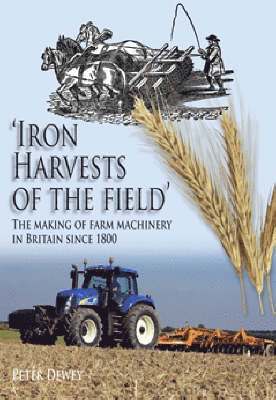
    Iron Harvests of the Field

    The Making of Farm Machinery in Britain Since 1800

    AvPeter Dewey

    Häftad, Engelska, 2008

    208 kr

    Beställningsvara. Skickas inom 11-20 vardagar. Fri frakt över 249 kr.

    Fler format och utgåvor

    Inbunden

    324 kr

    Beskrivning

    In many ways this book tells a familiar story in British industry: of innovation and enterprise in the early decades ...of worldwide dominance at a time when Britain was the workshop of the world ...of wars and economic downturns ...of foreign competition ...and of relative and absolute decline on the path of de-industrialisation in the latter part of the twentieth century. For most of this period the farm machine industry grew and matured. It is an inspiring story of technological achievement and of industrial success, as farmers and engineers brought iron and steel to fields which had previously been the domain of locally made timber implements and power provided by horses.Agricultural technology moved on, inexorably, from broad-cast seed and the sound of the threshing flail, via the portable steam engine and the threshing machine, right through to the modern world of giant tractors - each with the power of 200 horses - combine harvesters and impressively efficient farming methods.This book traces the broad sweep of the whole industry over 200 years, looking at many individual companies and products to explain how and why the farm machinery industry developed in the way it did.Important individual machines are described and illustrated in detail. The British farm machine industry is unlikely ever again to be large by world standards, nor to dominate the world stage as once it did. Yet the author traces a rich vein of innovation, enterprise and technological inspiration, often taking place within the large number of relatively small-scale, craft-based workshops which were so prevalent in the early decades. Rather than mere manufacturing, therefore, perhaps it is this tradition of technical innovation and invention which marked out the British farm machinery industry for historical greatness, and perhaps it is this tradition which will continue to mark it out in the future.

    Produktinformation

    • Utgivningsdatum:2008-03-27
    • Mått:169 x 243 x 24 mm
    • Vikt:902 g
    • Format:Häftad
    • Språk:Engelska
    • Antal sidor:368
    • Förlag:Carnegie Publishing Ltd
    • ISBN:9781859361603

    Utforska kategorier

    • Industrialismen och industrihistoria inom Historia och arkeologi
    • Lantbruksteknik inom Naturvetenskap och teknik

    Mer om författaren

    Peter Dewey graduated from the universities of Exeter and Reading, and became a lecturer in economic history at Royal Holloway, University of London, in 1974, retiring as Emeritus Reader in 2002. He was awarded the T.S. Ashton Prize by the Economic History Society in 1975 and the Alexander Prize by the Royal Historical Society in 1979. He was the Secretary of the British Agricultural History Society from 1998 to 2002. He has published extensively in leading history journals, and has two previous books to his credit: British Agriculture in the First World War (Routledge, 1989), and War and Progress: Britain 1914A-45 (Longman, 1996), a volume in the Longman Economic and Social History of Britain series.

    Innehållsförteckning

    • List of tables ixPreface and acknowledgements xi1The origins of an industry, 1750A-1820 1The agricultural revolution1Farming implements before 18004The technological revolution9The entrepreneurs and their businesses11The primacy of East Anglia15Conclusion182Towards a national market, 1820A-1850 19The economic background19The agricultural background20Growth of the industry23Products and technical change28Transport developments32Sales and marketing353At the works around 1850 39The growth of the factories39Work in the factory45Conclusion494A brief supremacy, 1850A-1875 50The expansion of the home market50Technical and product change51Steam Power I: Evolution of the portable engine52The spread of the threshing machine57Steam Power II: The steam plough58Reaping machines66Mowing machines70Improved field machinery73The growth and prosperity of firms79Marketing81The rise of the export trade87Conclusion915Exports to the rescue, 1875A-1913 92Problems in the home market92The shift to exports94Marketing, agents and overseas depots97The rise of North American competition98The last export boom101Conclusions1036A mature industry, 1875A-1913 104The rise of some firms and the fall of others104Specialisation in steam112Portable engines113Ploughing engines115New products120Dairy machinery120Internal combustion engines123Tractors126The legal framework, scale of production, and profits131Conclusion1367At the works in 1913 137Expansion and the larger factory137Work in the factory c.1913141Labour conditions and trade unions142Masters and men1468Dynasties around 1914 147Founding families147Local influence and social responsibilities150Gracious living for the third generation?152Conclusion1569War work, 1914A-1918 157The background157Government armament contracts157Labour during the war162The loss of exports and overseas assets164Profits and taxes166The agricultural market and the food production programme169Fears for the future17810A new world, 1919A-1939 183The boom of 1918A-19 and the slump of 1920A-23183The collapse of export markets187Attempts at restructuring the industry191Changing patterns of demand at home200The search for new products206Diversification saves some firms212Fordson, Ferguson and the revival of the market214Conclusion22411War work again, 1939A-1945 225Early preparations225New opportunities in agriculture A- Plough for Victory228Tractors228Other machinery232Government regulation and control233Loss of export markets241Armament work242Imports and Lend-Lease244Profits and taxes247The industry in 194525012A very brief supremacy, 1945A-1973 254The new post-war world and the long economic boom254Post-war readjustment255Agricultural policy and prosperity256The tractor boom258Growth and structure of the industry269New opportunities, new products274The export boom284Conclusion28613Coping with the competition, 1973A-2000 288The new economic environment: deindustrialisation288Changes in home demand290The industry's output291The maturity of the market293New products and new versions of old products295Tractors295Field machinery300Changes in the global machinery business302The rise of foreign competition304Readjustment and restructuring306The industry at the end of the twentieth century31214Retrospect 315Long-term factors in the development of the industry: technical change, demand and entrepreneurship315A part of the British economic decline?319Conclusion: a story of continuing change321Notes and references 323Bibliography 338Index 345