• Fri frakt över 249 kr
  • •
  • Snabba leveranser
  • •
  • Billiga böcker
Kundservice

Du är på sajten för privatpersoner.

Företag, bibliotek eller offentlig verksamhet?

Du handlar på classic.bokus.com, där alla dina funktioner finns intakta.
Till classic.bokus.com
Bokus logotyp. Gå till startsidan.
  • Erbjudanden
  • Nyheter
  • Student
  • Topplistor
  • Barn & ungdom
  • Bokus Play
  • E-böcker
  • Pocketböcker
  • Spel & pussel

10% rabatt på allt med kod NYSTART10 →

Sidfot

Mina sidor

    Hjälp

    • Kundservice
    • Vanliga frågor och svar
    • Frakt och leverans
    • Retur vid ångerrätt
    • Reklamera vara
    • Betalning
    • Köpvillkor
    • Allmänna villkor
    • Information om webbplatsens tillgänglighet

    Om Bokus

    • Om oss
    • Pressrum
    • För studenter
    • För företag
    • För bibliotek och offentlig verksamhet
    • För leverantörer
    • Hållbarhet

    Populärt

    • Aktuella erbjudanden
    • Presentkort
    • Studentlitteratur
    • Nya böcker
    • Topplistor
    • Signerade böcker
    • Engelska böcker

    Inspiration

    • Boktips
    • BookTok
    • Populära bokserier
    • Barnbokskaraktärer
    • Populära författare
    Logotyp för Bokus
    Följ oss på Facebook (extern länk)Följ oss på Instagram (extern länk)Följ oss på YouTube (extern länk)Följ oss på TikTok (extern länk)
    bokus @ CookiesAnpassa cookiesIntegritetspolicyKöpvillkor
    Till Citymail hemsida (extern länk)Till Budbee hemsida (extern länk)Till Postnord hemsida (extern länk)Till Schenker hemsida (extern länk)Till Early Bird hemsida (extern länk)Till Walleys hemsida (extern länk)
    1. Naturvetenskap och teknik
    2. Geovetenskap
    3. Miljövetenskap och miljöpolitik

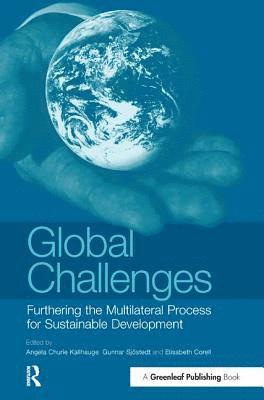
    Global Challenges

    Furthering the Multilateral Process for Sustainable Development

    AvAngela Churie-Kallhauge,Gunnar Sjöstedt

    Inbunden, Engelska, 2005

    962 kr

    Beställningsvara. Skickas inom 10-15 vardagar. Fri frakt över 249 kr.

    Beskrivning

    The World Summit on Sustainable Development (WSSD) in Johannesburg 2002 was the latest conference in an international process to manage environment and development issues that can be traced back to the late 1960s. Three milestones mark this 30-year process of social and political interaction: the United Nations Conference on the Human Environment (UNCHE), held in Stockholm in 1972, the first international meeting at a high political level convened to address environmental issues; the 1992 United Nations Conference on Environment and Development (UNCED), held in Rio de Janeiro; and the WSSD, which attempted to set policy goals and targets for the global environmental and developmental challenges previously identified.But what did the WSSD achieve? Following the summit there have been various opinions of its significance and its outputs, many of them negative. This book argues that there is a need to place the WSSD in its broader context. Understanding the connections between the WSSD and its precedents as well as those between this overall process and individual environmental decision-making processes (such as on climate change), and how they all contribute to the overall global policy process, adds a critical dimension to the analysis of the WSSD outcomes.This book examines the challenges facing the global policy process for sustainable development as it continues beyond Johannesburg into the future. It combines a forward outlook with a historical perspective in tracing the evolution of selected cross-cutting themes on the agenda of the three conferences, the institutions and formal results of the process, and the actors and their patterns of interaction over time. The focus is on the decision-making dimension – the multilateral negotiations-which can be seen as the development over time of a pattern of interlinked political activities.Global Challenges has four operational objectives: first, to define the ongoing process that formally began with the Stockholm Conference in 1972 and evolved towards its latest major manifestation at the WSSD; second, to present some dynamics of the Stockholm–Rio–Johannesburg (SRJ) process by exploring the themes identified; third, to introduce an approach on how to consider the outcomes of this process as a way of reflecting on what the process has actually accomplished; and, finally, to discuss lessons learned for theory and practice from this exercise. The practical lessons include reflections on how the continued SRJ process should best be organised and supported into the future.The book takes a uniquely broad outlook and interdisciplinary approach in addressing important lessons relating to the emergence of substantive issues as well as to process and institutional dynamics. It is a bridge-building exercise from academic analysis to long-term strategic thinking in environmental regime building.Global Challenges provides a new perspective on the continuing and increasingly complex global environment and development policy process and analyses the interlinkages between the process, trends and cross-cutting issues that set the conditions for the global efforts to achieve sustainable development. It will be essential reading for academics and practitioners interested in seeing the big picture of the global challenges facing people and planet in the 21st century.

    Produktinformation

    • Utgivningsdatum:2005-11-01
    • Mått:156 x 234 x 24 mm
    • Vikt:660 g
    • Format:Inbunden
    • Språk:Engelska
    • Antal sidor:320
    • Förlag:Taylor & Francis Ltd
    • ISBN:9781874719519

    Utforska kategorier

    • Miljövetenskap och miljöpolitik inom Naturvetenskap och teknik

    Mer om författaren

    Angela Churie Kallhauge works on climate change issues at the Swedish Energy Agency. Until recently she was a researcher at the Division of Urban Studies at the Royal Institute of Technology in Stockholm where she focused on decision-making processes and planning. She has over a decade's experience as an observer in international environmental negotiations, in particular the climate change and desertification processes and in working with issues relating primarily to capacity development and environmental policy in Africa. She has published several articles on aspects relating to capacity development, climate change policy in Africa and has participated in a number of capacity development initiatives focused specifically on improving the negotiation capacities in the South. She holds a Licentiate degree in Regional Planning and an MSc in Environmental Engineering.Gunnar Sjöstedt is a research fellow at Swedish Institute of International Affairs and an associate professor at the University of Stockholm since 1977. He is a member of the Steering Committee for the Program of International Negotiation (PIN) at the International Institute for Applied Systems Analysis (IIASA) and member of the Advisory Board for Negotiation Journal. A principal area of research has in recent years been negotiations about issues related to the international economy and environment, publications relating to which include: International Environmental Negotiations (co-editor with B. Spector and W. Zartman; Sage, 1993); Negotiating International Regimes: Lessons Learned from UNCED (co-editor with R. Löfstedt; Graham & Trotman/Martinus Nijhoff, 1994); Environmental Aid Programmes to Eastern Europe (co-editor with V. Kremenyuk; Avebury Studies in Green Research, 1996); International Economic Negotiation: Models versus Reality (co-editor with J. Linneroth-Bayer and R.G. Löfstedt; Edgar Elgar, 2000); Transboundary Risk Management (editor; London: Earthscan Publications, 2001); and Professional Cultures in International Negotiation: Bridge or Rift? (editor; Lexington Books, 2003).Elisabeth Corell works as a Wallenberg Fellow in Environment and Sustainability at the Swedish Institute of International Affairs, Stockholm. She holds a doctoral degree in international relations from the University of Linköping in Sweden. Her research interests are in the field of international decision-making for sustainable development and centre on the role of experts and scientific advisors as well as actors who represent practical and experience-based knowledge.

    Innehållsförteckning

    • ForewordI. William Zartman, School of Advanced International Studies, The Johns Hopkins UniversityIntroduction1. The multilateral process for sustainable development: past, present and futureAngela Churie Kallhauge, Royal Institute of Technology, Stockholm, Sweden, and Elisabeth Corell and Gunnar Sjöstedt, Swedish Institute of International Affairs2. What did the World Summit on Sustainable Development (WSSD) accomplish? Suggestions for an outcome assessmentGunnar Sjöstedt, Swedish Institute of International AffairsPart 1: Institutions and the development of the process3. The road to Rio: early efforts on environment and developmentBjörn-Ola Linnér, Linköping University, Sweden, and Henrik Selin, Boston University, USA4. The negotiating system of environment and development: a ten-year reviewPamela Chasek, Manhattan College, USA5. A commission will lead them? The UN Commission on Sustainable Development and UNCED follow-upLynn M. Wagner, International Institute for Sustainable DevelopmentPart 2: Actors and their interplay6. A tale of three cities: developing countries in global environmental negotiationsAdil Najam, Tufts University, USA7. Friends and foes: industrialised countries in multilateral environmental negotiationsDuncan R. Marsh, United Nations Foundation, USA8. Three decades of NGO activism in international environmental negotiations: who influences NGOs?Wagaki Mwangi, Syracuse University, USA9. Street-wise provocations: the Global Justice Movement's take on sustainable developmentPeter Doran, Research Fellow, Queen's University, Belfast; Research Officer, Northern Ireland Assembly, Belfast10. Partnerships for sustainable development: the role of Type II agreementsClaire Norris, Consultant, UKPart 3: Process functions/cross-cutting themes11. Knowledge processes in decision-making on sustainability: challenges for the futureElisabeth Corell, Swedish Institute of International Affairs, and Göran Sundqvist, Göteborg University, Sweden12. Financing for sustainable developmentKonrad von Moltke13. Capacity development for the environment: North and SouthStacy D. VanDeveer, University of New Hampshire, USA, and Ambuj D. Sagar, Harvard University, USA14. Making the link: synergies in international regime governanceAngela Churie Kallhauge and Lisa van Well, Royal Institute of Technology, Stockholm, SwedenConclusion15. An evolving sustainable development regimeGunnar Sjöstedt, Swedish Institute of International Affairs, and Lisa van Well and Angela Churie Kallhauge, Royal Institute of Technology, Stockholm, Sweden