Gunnar Sjöstedt - Böcker
Visar alla böcker från författaren Gunnar Sjöstedt. Handla med fri frakt och snabb leverans.
8 produkter
8 produkter
Containing the Atom
International Negotiations on Nuclear Security and Safety
Inbunden, Engelska, 2002
1 833 kr
Skickas inom 10-15 vardagar
Containing the Atom, the product of three years of research by the members of the Processes of International Negotiations (PIN) network, is a comprehensive study of the theory and practice of international nuclear negotiations. Well-known experts in the field test eleven cases of international nuclear negotations covering: strategic arms control; Comprehensive Test Ban Treaty; Nuclear Weapons Free Zones; Non-Proliferation Treaty and its Review Conference; Nuclear Materials removed from the defense weapons programs; Nuclear diplomacy with North Korea; Nuclear risks in the Barents region; Nuclear safety; French-Japanese nuclear negotiations; and the nuclear plant perspective on negotiations. Each case study analyzes the actors, strategies, processes, structures, and outcomes and weighs the impact of the negotiations on security, energy, trade, and the environment.
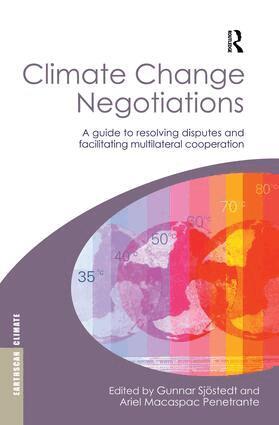
Climate Change Negotiations
A Guide to Resolving Disputes and Facilitating Multilateral Cooperation
Häftad, Engelska, 2015
617 kr
Skickas inom 10-15 vardagar
As the Kyoto Protocol limps along without the participation of the US and Australia, on-going climate negotiations are plagued by competing national and business interests that are creating stumbling blocks to success. Climate Change Negotiations: A Guide to Resolving Disputes and Facilitating Multilateral Cooperation asks how these persistent obstacles can be down-scaled, approaching them from five professional perspectives: a top policy-maker, a senior negotiator, a leading scientist, an international lawyer, and a sociologist who is observing the process. The authors identify the major problems, including great power strategies (the EU, the US and Russia), leadership, the role of NGOs, capacity and knowledge-building, airline industry emissions, insurance and risk transfer instruments, problems of cost benefit analysis, the IPCC in the post-Kyoto situation, and verification and institutional design. A new key concept is introduced: strategic facilitation. 'Strategic facilitation' has a long time frame, a forward-looking orientation and aims to support the overall negotiation process rather than individual actors. This book is aimed at academics, university students and practitioners who are directly or indirectly engaged in the international climate negotiation as policy makers, diplomats or experts.
1 064 kr
Skickas inom 10-15 vardagar
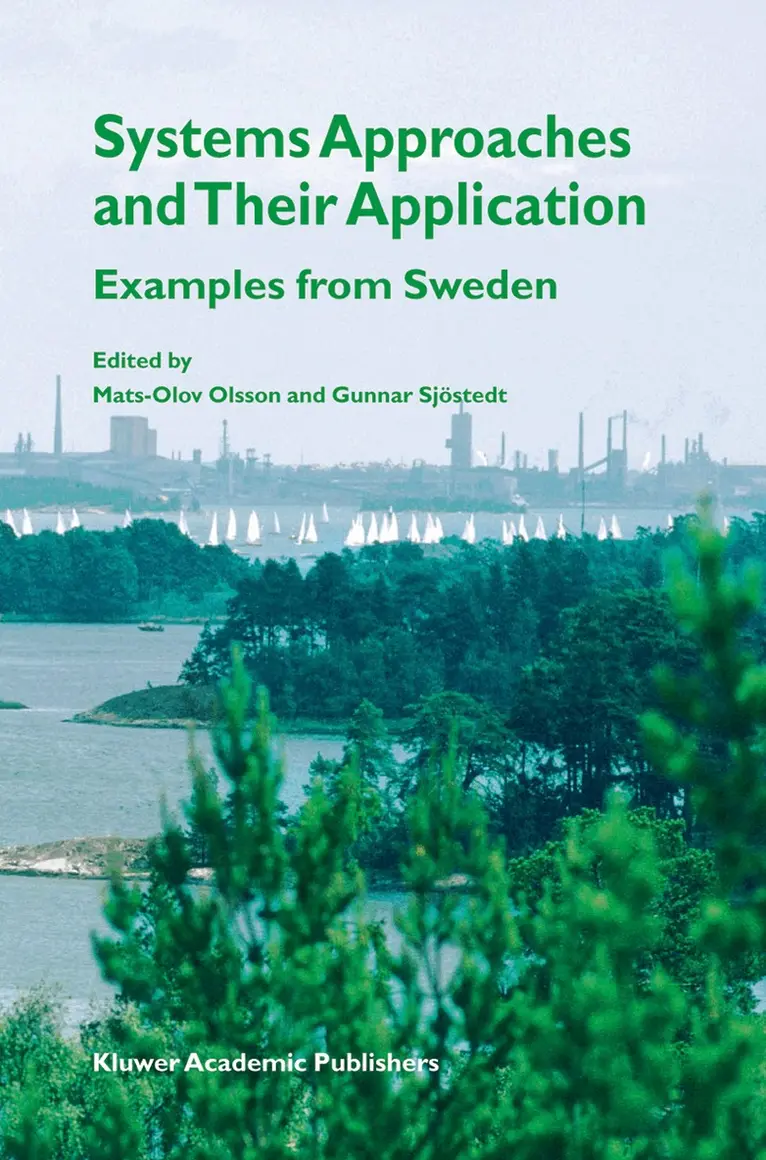
In the development of an international agenda for applied systems analysis Swedish experience, developed over a considerable number of years, embraces a wide range of application domains. One international focal point for the Swedish interest in systems analysis has been – the International Institute for Applied Systems Analysis, with its headquarters in Laxenburg outside Vienna. The Swedish Research Council for Env- onment, Agricultural Sciences and Spatial Planning (Formas) is currently responsible for the Swedish contacts with . When Formas was established in it inherited the Swedish national committee for the promotion of contacts and systems a- lysis that was originally set up by the Swedish Council for Planning and Coordination of Research (frn ), which was abolished in conjunction with a major reform of the Swedish research ?nancing system. Within the framework of the Committee a special project was launched in line with a proposal by Gunnar Sjöstedt dealing with the Swedish experience in s- tems analysis and thus, indirectly, with themes related to most of ’s activities. The project co-ordination and editorial tasks were given to Mats-Olov Olsson and Gunnar Sjöstedt under the direct surveillance of the Committee. Many of the Committee m- bers and their co-workers as well as several other Swedish scholars have contributed to this book. Several years of work have gone into bringing together Swedish experience in this ?eld, and we hope that the book will be interesting for an international as well as for a Swedish audience.
2 384 kr
Skickas inom 7-10 vardagar
Historians and diplomats often claim that each international negotiation is a unique event. In contrast, negotiation theory, building on several academic disciplines, argues that international bargaining is characterized by recurrent patterns that can be generalized and formalized. In the context of that debate, this book addresses whether international economic negotiations differ from other types of negotiation and examines what might be typical and, possibly, special about economic negotiation. It also studies the extent to which economic theory as opposed to negotiation theory can explain the outcome of international economic negotiations. Using the framework of a comparative case study, the authors look at the most important economic issues that are traditionally at stake: trade, money, finance, macroeconomic affairs and direct investment. The cases represent government-to-government, business-to-business and business-to-government negotiations and are described by those who were either personally involved in the negotiations or were close observers.This excellent book will be of great interest to students and scholars of international economics, international business, management and game theory.
Climate Change Negotiations
A Guide to Resolving Disputes and Facilitating Multilateral Cooperation
Inbunden, Engelska, 2013
2 106 kr
Skickas inom 10-15 vardagar
As the Kyoto Protocol limps along without the participation of the US and Australia, on-going climate negotiations are plagued by competing national and business interests that are creating stumbling blocks to success. Climate Change Negotiations: A Guide to Resolving Disputes and Facilitating Multilateral Cooperation asks how these persistent obstacles can be down-scaled, approaching them from five professional perspectives: a top policy-maker, a senior negotiator, a leading scientist, an international lawyer, and a sociologist who is observing the process. The authors identify the major problems, including great power strategies (the EU, the US and Russia), leadership, the role of NGOs, capacity and knowledge-building, airline industry emissions, insurance and risk transfer instruments, problems of cost benefit analysis, the IPCC in the post-Kyoto situation, and verification and institutional design. A new key concept is introduced: strategic facilitation. 'Strategic facilitation' has a long time frame, a forward-looking orientation and aims to support the overall negotiation process rather than individual actors. This book is aimed at academics, university students and practitioners who are directly or indirectly engaged in the international climate negotiation as policy makers, diplomats or experts.
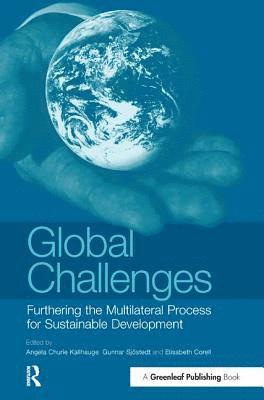
Global Challenges
Furthering the Multilateral Process for Sustainable Development
Inbunden, Engelska, 2005
793 kr
Skickas inom 10-15 vardagar
The World Summit on Sustainable Development (WSSD) in Johannesburg 2002 was the latest conference in an international process to manage environment and development issues that can be traced back to the late 1960s. Three milestones mark this 30-year process of social and political interaction: the United Nations Conference on the Human Environment (UNCHE), held in Stockholm in 1972, the first international meeting at a high political level convened to address environmental issues; the 1992 United Nations Conference on Environment and Development (UNCED), held in Rio de Janeiro; and the WSSD, which attempted to set policy goals and targets for the global environmental and developmental challenges previously identified.But what did the WSSD achieve? Following the summit there have been various opinions of its significance and its outputs, many of them negative. This book argues that there is a need to place the WSSD in its broader context. Understanding the connections between the WSSD and its precedents as well as those between this overall process and individual environmental decision-making processes (such as on climate change), and how they all contribute to the overall global policy process, adds a critical dimension to the analysis of the WSSD outcomes.This book examines the challenges facing the global policy process for sustainable development as it continues beyond Johannesburg into the future. It combines a forward outlook with a historical perspective in tracing the evolution of selected cross-cutting themes on the agenda of the three conferences, the institutions and formal results of the process, and the actors and their patterns of interaction over time. The focus is on the decision-making dimension – the multilateral negotiations-which can be seen as the development over time of a pattern of interlinked political activities.Global Challenges has four operational objectives: first, to define the ongoing process that formally began with the Stockholm Conference in 1972 and evolved towards its latest major manifestation at the WSSD; second, to present some dynamics of the Stockholm–Rio–Johannesburg (SRJ) process by exploring the themes identified; third, to introduce an approach on how to consider the outcomes of this process as a way of reflecting on what the process has actually accomplished; and, finally, to discuss lessons learned for theory and practice from this exercise. The practical lessons include reflections on how the continued SRJ process should best be organised and supported into the future.The book takes a uniquely broad outlook and interdisciplinary approach in addressing important lessons relating to the emergence of substantive issues as well as to process and institutional dynamics. It is a bridge-building exercise from academic analysis to long-term strategic thinking in environmental regime building.Global Challenges provides a new perspective on the continuing and increasingly complex global environment and development policy process and analyses the interlinkages between the process, trends and cross-cutting issues that set the conditions for the global efforts to achieve sustainable development. It will be essential reading for academics and practitioners interested in seeing the big picture of the global challenges facing people and planet in the 21st century.
1 064 kr
Skickas inom 10-15 vardagar
The International Institute for Applied Systems Analysis (IIASA) has had risk as a research topic on its agenda right from its inception in 1972. Risk has played a - jor role in the Energy Program, with research being carried out both in-house and in cooperationwith other internationalinstitutions like the InternationalAtomic - ergy Agency (IAEA) and national research centers. Research areas were primarily the evaluationof all possible risks within one categoryof energysupply like nuclear ?ssion or fusion or fossil fuels and, even more important,the comparisonof risks of different energy-supplystrategies. Later on an independent program was started which still exists today under the name Risk and Vulnerability. There is a large amount of literature on risks to which IIASA’s research programs have contributed signi?cantly over the years, and there is, of course, an abundance of published work on international negotiations, part of which is a result of the work of the Processes of International Negotiation (PIN) Program. There are, however, so far no studies on the combination of these two strands. Therefore, and as research on both topics is housed at IIASA, we are happy that our PIN Program has undertaken the dif?cult and important task of analyzing what the editors of this book have called negotiated risks.
1 064 kr
Skickas inom 10-15 vardagar
The International Institute for Applied Systems Analysis (IIASA) has had risk as a research topic on its agenda right from its inception in 1972. Risk has played a - jor role in the Energy Program, with research being carried out both in-house and in cooperationwith other internationalinstitutions like the InternationalAtomic - ergy Agency (IAEA) and national research centers. Research areas were primarily the evaluationof all possible risks within one categoryof energysupply like nuclear ?ssion or fusion or fossil fuels and, even more important,the comparisonof risks of different energy-supplystrategies. Later on an independent program was started which still exists today under the name Risk and Vulnerability. There is a large amount of literature on risks to which IIASA’s research programs have contributed signi?cantly over the years, and there is, of course, an abundance of published work on international negotiations, part of which is a result of the work of the Processes of International Negotiation (PIN) Program. There are, however, so far no studies on the combination of these two strands. Therefore, and as research on both topics is housed at IIASA, we are happy that our PIN Program has undertaken the dif?cult and important task of analyzing what the editors of this book have called negotiated risks.