• Fri frakt över 249 kr
  • •
  • Snabba leveranser
  • •
  • Billiga böcker
Kundservice

Du är på sajten för privatpersoner.

Företag, bibliotek eller offentlig verksamhet?

Du handlar på classic.bokus.com, där alla dina funktioner finns intakta.
Till classic.bokus.com
Bokus logotyp. Gå till startsidan.
  • Erbjudanden
  • Nyheter
  • Student
  • Topplistor
  • Barn & ungdom
  • Bokus Play
  • E-böcker
  • Pocketböcker
  • Spel & pussel

10% rabatt på allt med kod NYSTART10 →

Sidfot

Mina sidor

    Hjälp

    • Kundservice
    • Vanliga frågor och svar
    • Frakt och leverans
    • Retur vid ångerrätt
    • Reklamera vara
    • Betalning
    • Köpvillkor
    • Allmänna villkor
    • Information om webbplatsens tillgänglighet

    Om Bokus

    • Om oss
    • Pressrum
    • För studenter
    • För företag
    • För bibliotek och offentlig verksamhet
    • För leverantörer
    • Hållbarhet

    Populärt

    • Aktuella erbjudanden
    • Presentkort
    • Studentlitteratur
    • Nya böcker
    • Topplistor
    • Signerade böcker
    • Engelska böcker

    Inspiration

    • Boktips
    • BookTok
    • Populära bokserier
    • Barnbokskaraktärer
    • Populära författare
    Logotyp för Bokus
    Följ oss på Facebook (extern länk)Följ oss på Instagram (extern länk)Följ oss på YouTube (extern länk)Följ oss på TikTok (extern länk)
    bokus @ CookiesAnpassa cookiesIntegritetspolicyKöpvillkor
    Till Citymail hemsida (extern länk)Till Budbee hemsida (extern länk)Till Postnord hemsida (extern länk)Till Schenker hemsida (extern länk)Till Early Bird hemsida (extern länk)Till Walleys hemsida (extern länk)
    1. Psykologi och pedagogik
    2. Pedagogik
    3. Pedagogisk metodik

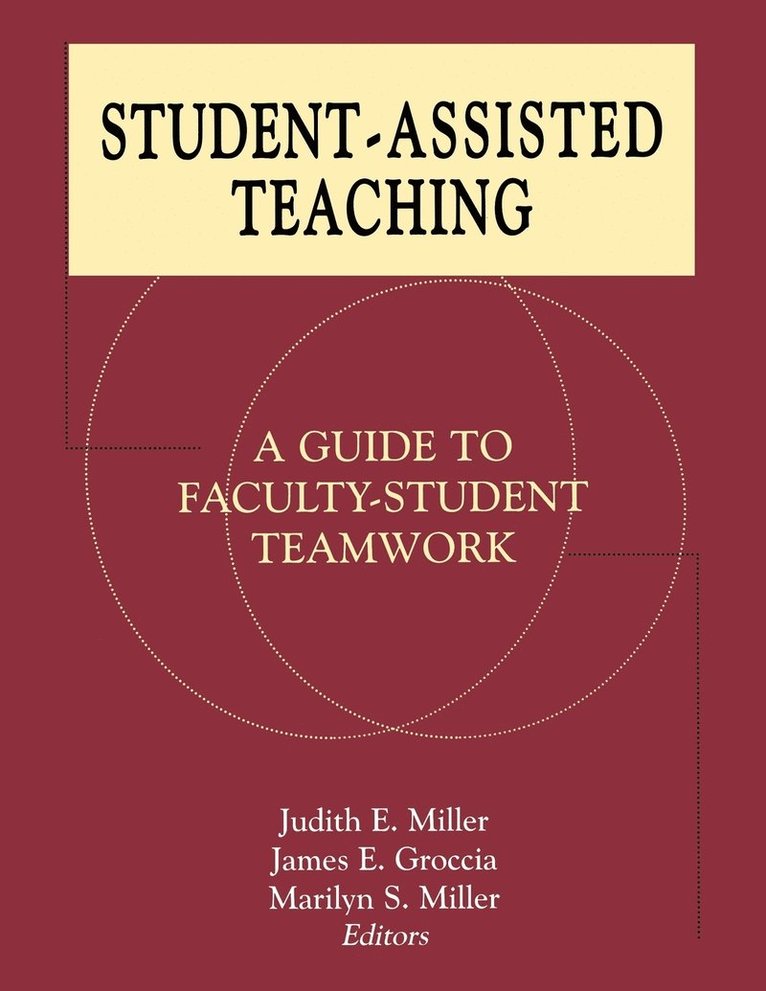
    Student-Assisted Teaching

    A Guide to Faculty-Student Teamwork

    AvMiller,Groccia

    Häftad, Engelska, 2007

    Del 19 i serien JB - Anker

    418 kr

    Beställningsvara. Skickas inom 5-8 vardagar. Fri frakt över 249 kr.

    Beskrivning

    This innovative handbook provides a range of models for undergraduate student-assisted teaching partnerships to help faculty, faculty developers, and administrators make learning more student-centered, more effective, and more productive. Each of the 31 models included in this volume is supported by practical details and focuses on four main aspects of a specific peer-assisted learning environment: implementation, evidence of effectiveness and learning benefits, analysis of time and cost expenditures, and suggestions for replication. Contents include discussions of working with undergraduate partners in several areas: Programs for first-year studentsDifficult coursesSpecial groupsCourses and programs for all studentsFaculty developmentThe chapters present a range of approaches, applications, disciplines, institutions, and contexts, and demonstrate that student-faculty partnerships can be adapted to meet diverse needs in a variety of situations. Extensive appendices aid implementation by providing concrete examples of hiring documents, training syllabi, teaching materials, and evaluation methods.

    Produktinformation

    • Utgivningsdatum:2007-06-19
    • Mått:219 x 280 x 13 mm
    • Vikt:617 g
    • Format:Häftad
    • Språk:Engelska
    • Serie:JB - Anker
    • Antal sidor:252
    • Förlag:John Wiley & Sons Inc
    • ISBN:9781882982424

    Utforska kategorier

    • Pedagogisk metodik inom Psykologi och pedagogik

    Mer om författaren

    JUDITH E. MILLER is Director of Educational development, Technology, and Assessment, and Professor of Biology and Biotechnology at Worcester Polytechnic Institute. She has published and presented extensively in the areas of cooperative learning and educational productivity. She received the Outstanding Undergraduate Science Teacher award from the Society for College Science teachers and Kendall-Hunt Publishers in 1997. JAMES E. GROCCIA is Director of the Program for Excellence in Teaching Adjunct Associate Professor in the Department of Psychology, and a member of the Graduate faculty in Educational Leadership and Policy Analysis at the University of Missouri-Columbia. His teaching and research interests, center on student-assisted learning, college teaching, educational innovation and productivity, and cross-cultural psychology.MARILYN S. MILLER is Assistant Director of the Program for Excellence in Teaching, and Adjunct Professor in the Department of Educational Leadership and Policy Analysis at the University of Missouri-Columbia. She has presented nationally on issues of communication across linguistic and cultural lines, and the role of inactive learning in compensating for linguistic difficulties of foreign instructors and students.

    Innehållsförteckning

    • About the editors. Foreword.Preface.Introduction.Model Matrix.Part I. Undergraduate Students Assisting with Programs for First-Year Students.1. Establishing a Common Ground: A Cojoint Training Model for Instructors and Peer Educators. (Eve M. Adams, Susan C. Brown, and Terry L. Cook).2. Lessons From Peers: The Design Exchange Mark J. Chidister, Frank H. Bell, Jr., and Kurt M. Earnest).3. Peer Teaching in the Experimental College (Robyn Gittleman and Howard Woolf).4. Peer Facilitators as Lead Freshman Seminar Instructors Jean M. Henscheid).5. The Teaching Teams Program: A Just-in-Time model for Peer Assistance Harold P. Larson, Reed Mencke, Stacy J. Tollefson, Elizabeth Harrison, and Elena Berman).6. The Teaching Teams Program: Transforming the Role of the Graduate Teaching Assistant (David A. Wood, Jr., Jennifer L. Hart, Stacy J. Tollefson, Dawn E. DeToro, and Julie Libarkin).7. The Teaching Teams Program: Empowering Undergraduates in a Student-Centered Research University (Lacey A. Stover, Kristen A. Story, Amanda M. Skousen, Cynthia E. Jacks, Heather Logan, and Benjamin T. Bush).8. Peer-Assisted Cooperative Learning: An Experiment in Educational Quality and Productivity (Judith E. Miller, david DiBiasio, John Minasian, and James S. Catterall).9. Students: Managing to Learn; Teachers: Learning to Manage (Martin H. Murray).10. Undergraduates Teaching in a Collaborative Learning Paradigm (Samuel B. Thompson, Sarah B. Westfall, and Christine Reimers).11. Peers at Work: Tutors at Spelman College (Anne B. Warner and Christine K. Farris).12. Students Mentoring Students in Portfolio Development (W. Alan Wright and Bruce Barton).Part II. Undergraduate Students Assisting with Difficult Courses.13. The Experimental Study Group: An Alternative First-Year Program at MIT (David Custer and Peter Dourmashkin).14. MASH (Math and Science Help): Supplemental Instruction at a Technological University (Ann garvin and Dale Snyder).15. Undergraduate Peer Mentors in Mathematics (Miguel Paredes, Paul Pontius, Rene Torres, and Joseph Chance).16. A Model for Integrating Technical Preceptors into the Classroom (Mary Poulton and John Kemeny).17. Academic Excellence Workshops: Boosting Success in Technical Courses (Ruth A. Streveler).18. Supplemental Instruction at an Urban Community College (Joyce Ship Zaritsky).Part III. Undergraduate Students Assisting with Special Groups.19. Peer-Assisted Teaching and Learning in Distance education (Judith A. Couchman).20. Using Structured Study Groups to Create Chemistry Honors Sections (Brian P. Coppola, Douglas S. Daniels, and Jason K. Pontrello).21. Student Mentoring and Community in a University Honors Program (Ronald E. Mickel).22. Where Undergraduates are the Experts: Peer-Based Instruction in the Writing Center (Dennis Paoli and Eric Hobson).Part IV. Undergraduate Students Assisting in Courses and Programs for All Students.23. Peer Facilitators of In-Class Groups: Adapting Problem-Based Learning to the Undergraduate Setting (Deborah E. Allen and Harold B. White, III).24. Student-Directed Instruction in an Undergraduate Psychopathology Course (Cheryl Golden and Calverta McMorris).25. Peer Writing Tours (Lisa Lebduska).26. The Workshop Project: Peer-Led team Learning in Chemistry (Jerry L. Sarquis. Linda J. Dixon, David K. Gosser, Jack A. Kampmeier, Vicki Roth, Victor S. Strozak, and Pratibha varma-Nelson).27. An Introductory Psychology Laboratory designed and Taught by Undergraduate Teaching Interns (Stephen P. Stelzner, Michael G. Livingston, and Thomas Creed).28. Undergraduate Teaching Assistants Bring Active Learning to Class (Melissa A. Thibodeau).Part V. Undergraduate Students Assisting in Faculty Development.29. Student-Faculty Partnerships to develop Teaching and Enhance Learning (Milton D. Cox).30. Educating the Critic: Student Driven Quality (Elizabeth Kinland, Lisa Firing Lenze, Lynn Melander Moore, and Larry D. Spence).31. College Teachers and Student Consultants: Collaborating about Teaching and Learning (D. Lynn Sorenson).