• Fri frakt över 249 kr
  • •
  • Snabba leveranser
  • •
  • Billiga böcker
Kundservice

Du är på sajten för privatpersoner.

Företag, bibliotek eller offentlig verksamhet?

Du handlar på classic.bokus.com, där alla dina funktioner finns intakta.
Till classic.bokus.com
Bokus logotyp. Gå till startsidan.
  • Erbjudanden
  • Nyheter
  • Student
  • Topplistor
  • Barn & ungdom
  • Bokus Play
  • E-böcker
  • Pocketböcker
  • Spel & pussel

10% rabatt på allt med kod: NYSTART10 →

Sidfot

Mina sidor

    Hjälp

    • Kundservice
    • Vanliga frågor och svar
    • Frakt och leverans
    • Retur vid ångerrätt
    • Reklamera vara
    • Betalning
    • Köpvillkor
    • Allmänna villkor
    • Information om webbplatsens tillgänglighet

    Om Bokus

    • Om oss
    • Pressrum
    • För studenter
    • För företag
    • För bibliotek och offentlig verksamhet
    • För leverantörer
    • Hållbarhet

    Populärt

    • Aktuella erbjudanden
    • Presentkort
    • Studentlitteratur
    • Nya böcker
    • Topplistor
    • Signerade böcker
    • Engelska böcker

    Inspiration

    • Boktips
    • BookTok
    • Populära bokserier
    • Barnbokskaraktärer
    • Populära författare
    Logotyp för Bokus
    Följ oss på Facebook (extern länk)Följ oss på Instagram (extern länk)Följ oss på YouTube (extern länk)Följ oss på TikTok (extern länk)
    bokus @ CookiesAnpassa cookiesIntegritetspolicyKöpvillkor
    Till Citymail hemsida (extern länk)Till Budbee hemsida (extern länk)Till Postnord hemsida (extern länk)Till Schenker hemsida (extern länk)Till Early Bird hemsida (extern länk)Till Walleys hemsida (extern länk)
    1. Samhälle och politik
    2. Politik och statsskick
    3. Statsskick och politiska processer
    4. Politiskt ledarskap

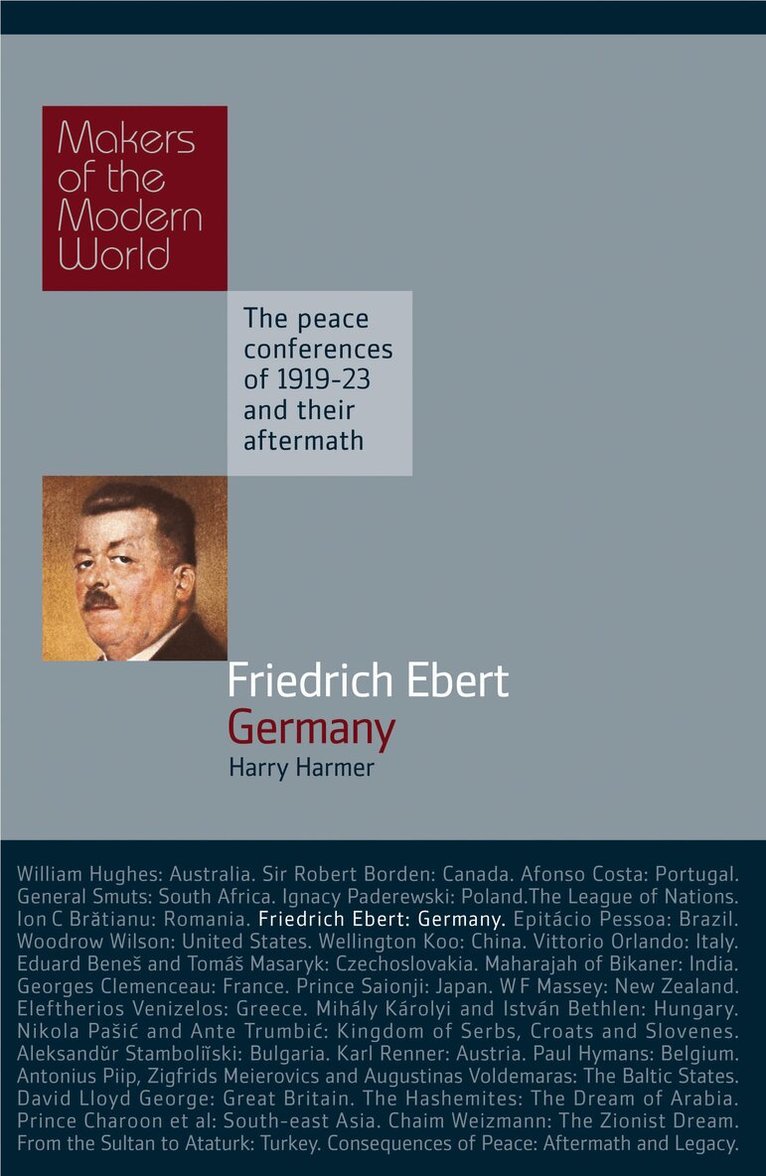
    Friedrich Ebert: Germany

    The Peace Conferences of 1919-23 and Their Aftermath

    AvHarry Harmer

    Inbunden, Engelska, 2008

    Del i serien Makers of the Modern World

    141 kr

    Tillfälligt slut

    Beskrivning

    This title is about Friedrich Ebert (1871-1925). Ebert was influential in securing SPD support for the war in 1914. On the eve of war he travelled to Switzerland to arrange the movement of SPD funds if the party was outlawed. As the leader of organized labour, Ebert had close relations with government and military authorities throughout the war. Two of his sons were killed during the war, something he used to emphasise his patriotism. On 9 November, 1918, Ebert became Imperial Chancellor as revolution broke out in Berlin. He opposed the radical left, declaring, 'Without democracy there is no freedom. Violence, no matter who is using it, is always reactionary', but he compromised Weimar democracy by his dependence on the army command and his use of the para-military Freikorps against the left.Ebert headed a joint SPD-USPD government until elections were held to a National Constituent Assembly in January 1919. Ebert became president of the new Weimar Republic (Germany's first democratically elected head of state) and retained office in a turbulent period in German politics.Ebert reluctantly accepted the need for Germany to sign the Treaty of Versailles, at one point saying he might be prepared to resume the war. It was left to Johannes Bell (depicted by Sir William Orpen from behind) and Hermann Muller (shown leaning over him) to sign on behalf of Germany. There were arguments among the Allies over how Germany should be treated, as France, Britain and the United States prioritised different objectives.In May 1919, the terms of the Treaty - on reparations, war guilt clause, loss of territories in Europe and colonies, limitations on armed forces - were presented to German representatives, precipitating opposition in government and the Armed Forces, and heated discussion in Cabinet. He continued as President until 1925, forced to confront the issues that arose from the Treaty and its political and economic consequences. After his death came the unravelling of the Treaty and the book examines how much of a part it played in creating the circumstances of the Second World War.

    Produktinformation

    • Utgivningsdatum:2008-11-01
    • Mått:129 x 198 x 20 mm
    • Vikt:680 g
    • Format:Inbunden
    • Språk:Engelska
    • Serie:Makers of the Modern World
    • Antal sidor:208
    • Förlag:Haus Publishing
    • ISBN:9781905791637

    Utforska kategorier

    • Politiskt ledarskap inom Samhälle och politik
    • Biografi: historia, politik och försvar inom Biografier
    • Europas historia inom Historia och arkeologi

    Mer om författaren

    Harry Harmer's particular interest is modern British and European history. He has studied the history of the Weimer Republic and the rise of Hitler, and his PhD involved research into the Communist International and the European parties, of which the German was the most significant. He is the author of Rosa Luxemburg and Tom Paine. Professor Alan Sharp is Provost of the Coleraine Campus at the University of Ulster. He joined the History Department at Ulster in 1971 and has been successively Professor of International Studies, a post in which he helped to set up degrees in International Studies and, later, International Politics and Head of the School of History and International Affairs. His major publications include The Versailles Settlement: Peacemaking in Paris, 1919 (1991) amongst others.

    Recensioner i media

    'Harry Harmer gives a long overdue introduction in English to the saddler's son who, though not present at Versailles, shakily presided over the establishment of Germany's Weimar Republic. ... a beautifully produced series' Nigel Jones, Literary Review, November 2008 -- Nigel Jones Literary Review 20081101