• Fri frakt över 249 kr
  • •
  • Snabba leveranser
  • •
  • Billiga böcker
Kundservice

Du är på sajten för privatpersoner.

Företag, bibliotek eller offentlig verksamhet?

Du handlar på classic.bokus.com, där alla dina funktioner finns intakta.
Till classic.bokus.com
Bokus logotyp. Gå till startsidan.
  • Erbjudanden
  • Nyheter
  • Student
  • Topplistor
  • Barn & ungdom
  • Bokus Play
  • E-böcker
  • Pocketböcker
  • Spel & pussel

10% rabatt på allt med kod: NYSTART10 →

Sidfot

Mina sidor

    Hjälp

    • Kundservice
    • Vanliga frågor och svar
    • Frakt och leverans
    • Retur vid ångerrätt
    • Reklamera vara
    • Betalning
    • Köpvillkor
    • Allmänna villkor
    • Information om webbplatsens tillgänglighet

    Om Bokus

    • Om oss
    • Pressrum
    • För studenter
    • För företag
    • För bibliotek och offentlig verksamhet
    • För leverantörer
    • Hållbarhet

    Populärt

    • Aktuella erbjudanden
    • Presentkort
    • Studentlitteratur
    • Nya böcker
    • Topplistor
    • Signerade böcker
    • Engelska böcker

    Inspiration

    • Boktips
    • BookTok
    • Populära bokserier
    • Barnbokskaraktärer
    • Populära författare
    Logotyp för Bokus
    Följ oss på Facebook (extern länk)Följ oss på Instagram (extern länk)Följ oss på YouTube (extern länk)Följ oss på TikTok (extern länk)
    bokus @ CookiesAnpassa cookiesIntegritetspolicyKöpvillkor
    Till Citymail hemsida (extern länk)Till Budbee hemsida (extern länk)Till Postnord hemsida (extern länk)Till Schenker hemsida (extern länk)Till Early Bird hemsida (extern länk)Till Walleys hemsida (extern länk)
    1. Naturvetenskap och teknik
    2. Geovetenskap
    3. Miljövetenskap och miljöpolitik

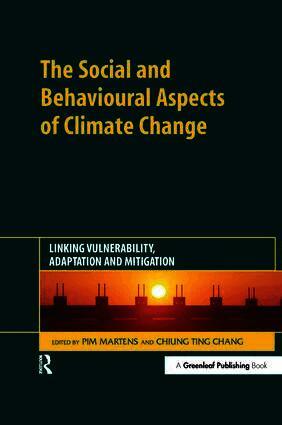
    Social and Behavioural Aspects of Climate Change

    Linking Vulnerability, Adaptation and Mitigation

    AvPim Martens,Chiung Ting Chang

    Inbunden, Engelska, 2010

    2 645 kr

    Beställningsvara. Skickas inom 10-15 vardagar. Fri frakt över 249 kr.

    Beskrivning

    Over the past few years, and certainly since the publication of the "Stern Report", there has been increasing recognition that climate change is not only an environmental crisis, but one with important social and economic dimensions. There is now a growing need for multi-disciplinary research and for the science of climate change to be usefully translated for policy-makers.Until very recently, scientific and policy emphasis on climate change has focused almost exclusively on mitigation efforts: mechanisms and regulations to reduce greenhouse gas emissions. The success of such efforts to date is debatable. In fact, the impact of ever more stringent emission control programmes could potentially have enormous social consequences. Little effort has been expended on the exploration of a systematic evaluation of climate stabilization benefits or the costs of adapting to a changed climate, let alone attempting to integrate different approaches. There is an increasing recognition that the key actors in the climate crisis also need to be preparing for change that is unavoidable. This has resulted in a greater consideration of vulnerability and adaptation.The book, based on the research programme "Vulnerability, Adaptation and Mitigation" (VAM) which ran from 2004 to 2010, funded by the Netherlands Organisation for Scientific Research (NWO), presents a cluster of case studies of industries, communities and institutions which each show how vulnerability, adaptation and mitigation analyses can be integrated using social behavioural sciences. Each chapter makes specific recommendations for the studied industry sector, community or institution, analyses the latest research developments of the field and identifies priorities for future research.The book argues that the inherent complexity of climate change will ultimately require a much more integrated response both scientifically – to better understand multiple causes and impacts – as well as at the scientific/policy interface, where new forms of engagement between scientists, policy-makers and wider stakeholder groups can make a valuable contribution to more informed climate policy and practice.The book is particularly timely as the scientific research and policy debate is shifting from one of problem-framing to new agendas that are much more concerned with implementation, the improvement of assessment methodologies from a multi-disciplinary perspective, and the reframing of current scientific understanding towards mitigation, adaptation and vulnerability. A critical element in responding to the climate change challenge will be to ensure the translation of these new scientific insights into innovative policy and practice "on the ground". This book provides some fundamental elements to answer this need.The Social and Behavioural Aspects of Climate Change: Linking Vulnerability, Adaptation and Mitigation will be essential reading for social science researchers and policy managers in the area of climate change, as well as for those who want to know what the social and behavioural sciences can contribute toward coping with climate hazards. NGOs, law firms and businesses in the energy sector or other climate related fields will also find the book of great value.

    Produktinformation

    • Utgivningsdatum:2010-09-01
    • Mått:156 x 234 x 22 mm
    • Vikt:690 g
    • Format:Inbunden
    • Språk:Engelska
    • Antal sidor:320
    • Förlag:Taylor & Francis Ltd
    • ISBN:9781906093426

    Utforska kategorier

    • Miljövetenskap och miljöpolitik inom Naturvetenskap och teknik

    Mer om författaren

    PIM MARTENS holds the Chair of Sustainable Development at Maastricht University. CHIUNG TING CHANG is research fellow at the International Centre for Integrated Assessment and Sustainable Development, Maastricht University.

    Recensioner i media

    Climate Change is a topic that affects everyone in some way. Those not yet convinced of this statement are well advised to read The Social and Behavioural Aspects of Climate Change. In 12 case studies and five essays, mostly written by Dutch academics, the book successfully presents the variety of ways in which Climate Change influences businesses, science, policies and individuals. The Social and Behavioural Aspects of Climate Change is a product of the research programme VAM (Vulnerability, Adaptation and Mitigation) which was conducted by the NWO (Netherlands Organisation for Scientific Research) since 2004. The main objective of the efforts is to underline the need for input of the social sciences in the battle against Climate Change. The programme ran until 2010 and has its key results summarised in the book. The editors and authors of the individual chapters put great effort to taking the reader with them at every step. This is to meet the challenge that naturally comes from writing a book about a rather new topic that is being discussed from many different perspectives. The reader gains insights into complex topics without getting frustrated about lacking background knowledge in these specialised fields. As a result, every reader can benefit from the thought-provoking text, regardless of whether they are an old hand at Climate Change matters or comparatively new to the topics. The case studies are categorised in three clusters – "Industry", "Local Communities" and "Institutions". To pick out an example, the opening case study deals with the consequences climate change has for the inland navigation between the Netherlands and Germany. As the water level rises and drops more dramatically and more unpredictably due to Climate Change, the economic impact on welfare has to be taken seriously. Unresolved questions of how to distribute the costs of infrastructural investments and other adaptation measures between the two countries stimulate further research investments. Beside the case studies the book presents a synthesis of six essays on the societal effects of abrupt and extreme Climate Change in Europe. What might sound like a script for a Hollywood movie turns out to be a serious roundup of scenarios taking historical, legal, sectoral, institutional and economical aspects into account. After the case studies and the essays the reader is not left alone with the new input. As a wrap-up, the editors analyse the outcomes of all studies in the light of recent developments and challenges experienced by Climate Change research. By doing this, the results of the individual chapters are placed elegantly into a broader dimension than just the Dutch climate change research. http://www.csrinternational.org/?p=9289

    Innehållsförteckning

    • Preface  1. The social and behavioural aspects of climate change: linking vulnerability, adaptation and mitigation Chiung Ting Chang and Pim Martens, ICIS, Maastricht University, The Netherlands, and Bas Amelung, Amelung Advies, The Netherlands  Part I: Industries2. Climate change and inland navigation between the Netherlands and Germany: an economic analysis Erhan Demirel, Jos van Ommeren and Piet Rietveld, Department of Spatial Economics, VU University, The Netherlands  3. Climate change impacts: the vulnerability of tourism in coastal Europe Alvaro Moreno, ICIS, Maastricht University, The Netherlands  4. Corporate responses to climate change: the role of partnerships Ans Kolk and Jonatan Pinkse, University of Amsterdam Business School, The Netherlands Lia Hull Van Houten, Van Houten Communications, USA  5. Energy conservation in Dutch housing renovation projects Thomas Hoppe, Hans Bressers and Kris Lulofs, Centre for Studies in Technology and Sustainable Development (CSTM), The Netherlands   Part II: Local communities6. Natural hazards, poverty traps and adaptive livelihoods in Nicaragua Marrit van den Berg and Kees Burger, Development Economics, Wageningen University, The Netherlands7. Climate change adaptation in MozambiqueLuís Artur and Dorothea Hilhorst, Wageningen Disaster Studies8. Adaptation to climate change induced flooding in Dutch municipalitiesMaya M. van den Berg, William M. Lafferty and Frans J.H.M. Coenen, Twente Centre for Studies in Technology and Sustainable Development (CSTM), The Netherlands9. Human responses to climate change: flooding experiences in the NetherlandsRuud Zaalberg and Cees J.H. Midden, Department of Industrial Engineering and Innovation Sciences, Eindhoven University of Technology, The NetherlandsPart III: Institutions10. Interactions between white certificates for energy efficiency and other energy and climate policy instrumentsVlasis Oikonomou, SOM Research Institute, University of Groningen, The Netherlands11. Distributional choices in EU climate change policy seen through the lens of legal principlesJavier de Cendra de Larragán and Marjan Peeters, Law Faculty, Metro Institute, Maastricht University, The Netherlands12. Climate change liability and the application of the precautionary principleMiriam Haritz, Department of International and European Law and Institute of Transnational Legal Research METRO, Maastricht University, The Netherlands13. Incentives for international cooperation on adaptation and mitigationRob Dellink, Kelly de Bruin and Ekko van Ierland, Environmental Economics and Natural Resources Group, Wageningen University and Research Centre (WUR), The Netherlands14. Imagining the unimaginable: synthesis of essays on abrupt and extreme climate changeDarryn McEvoy, Chiung Ting Chang and Pim Martens, ICIS, University of Maastricht, The Netherlands15. ConclusionChiung Ting Chang and Pim Martens, ICIS, Maastricht University, The Netherlands Bas Amelung, Amelung Advies, The Netherlands