• Fri frakt över 249 kr
  • •
  • Snabba leveranser
  • •
  • Billiga böcker
Kundservice

Du är på sajten för privatpersoner.

Företag, bibliotek eller offentlig verksamhet?

Du handlar på classic.bokus.com, där alla dina funktioner finns intakta.
Till classic.bokus.com
Bokus logotyp. Gå till startsidan.
  • Erbjudanden
  • Nyheter
  • Student
  • Topplistor
  • Barn & ungdom
  • Bokus Play
  • E-böcker
  • Pocketböcker
  • Spel & pussel

10% studentrabatt med kod TERM26

Sidfot

Mina sidor

    Hjälp

    • Kundservice
    • Vanliga frågor och svar
    • Frakt och leverans
    • Retur vid ångerrätt
    • Reklamera vara
    • Betalning
    • Köpvillkor
    • Allmänna villkor
    • Information om webbplatsens tillgänglighet

    Om Bokus

    • Om oss
    • Pressrum
    • För studenter
    • För företag
    • För bibliotek och offentlig verksamhet
    • För leverantörer
    • Hållbarhet

    Populärt

    • Aktuella erbjudanden
    • Presentkort
    • Studentlitteratur
    • Nya böcker
    • Topplistor
    • Signerade böcker
    • Engelska böcker

    Inspiration

    • Boktips
    • BookTok
    • Populära bokserier
    • Barnbokskaraktärer
    • Populära författare
    Logotyp för Bokus
    Följ oss på Facebook (extern länk)Följ oss på Instagram (extern länk)Följ oss på YouTube (extern länk)Följ oss på TikTok (extern länk)
    bokus @ CookiesAnpassa cookiesIntegritetspolicyKöpvillkor
    Till Citymail hemsida (extern länk)Till Budbee hemsida (extern länk)Till Postnord hemsida (extern länk)Till Schenker hemsida (extern länk)Till Early Bird hemsida (extern länk)Till Walleys hemsida (extern länk)
    1. Djur och Natur
    2. Djurböcker
    3. Vilda djur
    4. Fågelböcker

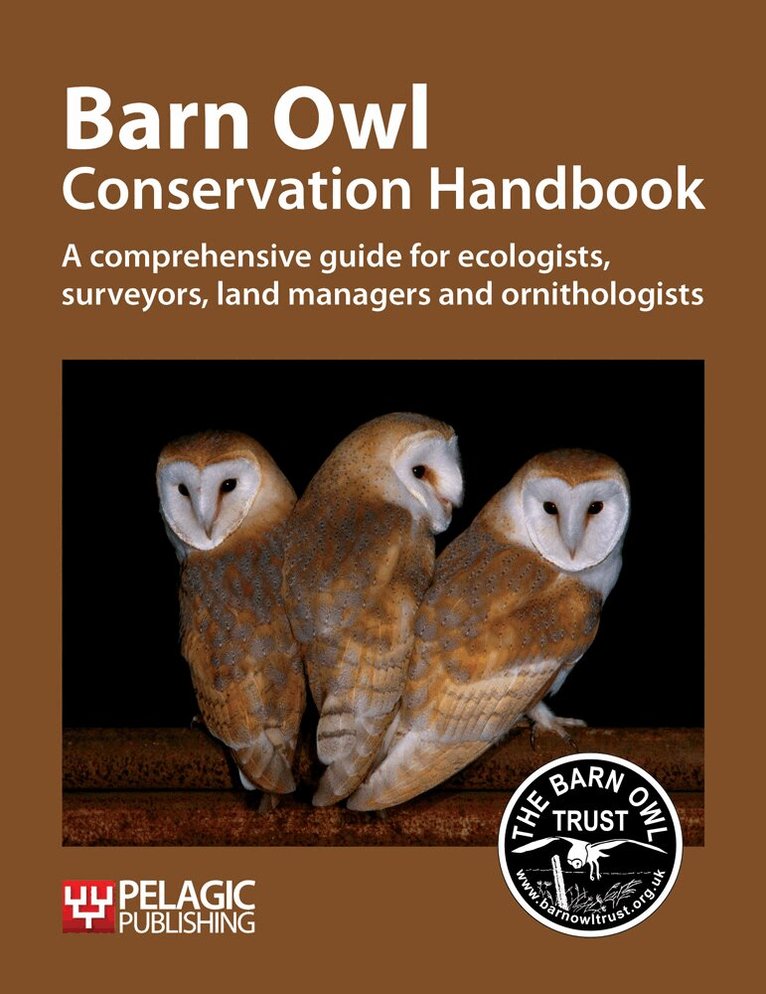
    Barn Owl Conservation Handbook

    A comprehensive guide for ecologists, surveyors, land managers and ornithologists

    AvBarn Owl Trust

    Häftad, Engelska, 2012

    Del i serien Conservation Handbooks

    725 kr

    Beställningsvara. Skickas inom 5-8 vardagar. Fri frakt över 249 kr.

    Fler format och utgåvor

    E-bok

    671 kr

    Beskrivning

    A comprehensive handbook covering all aspects of the conservation of Barn Owls. Written by the Barn Owl Trust, this book includes in-depth information on Barn Owl survey techniques, relevant ecology, Barn Owls and the law, mortality, habitat management, use of nest boxes and barn Owl rehabilitation. Essential reading for ecologists, planners, land managers and ornithologists.

    Produktinformation

    • Utgivningsdatum:2012-06-25
    • Mått:189 x 246 x 23 mm
    • Vikt:1 060 g
    • Format:Häftad
    • Språk:Engelska
    • Serie:Conservation Handbooks
    • Antal sidor:395
    • Förlag:Pelagic Publishing
    • ISBN:9781907807145

    Utforska kategorier

    • Fågelböcker inom Djur och Natur
    • Miljövetenskap och miljöpolitik inom Naturvetenskap och teknik
    • Fåglar inom Naturvetenskap och teknik

    Recensioner i media

    The Barn Owl Tyto alba must surely be one of the most charismatic of Britain’s birds. Its unique appearance, nocturnal habits and tendency to nest close to human habitation ensure that it is familiar to anyone with even a passing interest in wildlife, resulting in its adoption as a figurehead species for farmland conservation. Given its high profile and enduring popularity, it should come as no surprise that there has been a plethora of publications on British Barn Owls over the last 30 years, from the classic monograph of Bunn et al. (1982) to the survey results of Shawyer (1987) and the study of predator-prey interactions undertaken by Taylor (1994); for reviews of these works, see, respectively, Ibis 125: 424, 132: 140–141, and 137: 130–131. All of which raises the valid question: do we really need another book on Barn Owls?The fact that I am able to respond in the affirmative is largely because the Barn Owl Conservation Handbook differs significantly from the aforementioned works in terms of both content and target audience. As its title suggests, this is very much a hands-on tome, aiming to provide practical advice to those working in the field, be they consultants surveying for breeding pairs, developers renovating properties or conservationists keen to improve environmental conditions for local populations. The Barn Owl Trust have offered this type of support via helplines and through their website since the charity was founded in 1988 and are therefore ideally placed to produce such a guide.The strongest sections of the Handbook are unsurprisingly those that discuss methods used to detect the presence of Barn Owls at a site and techniques for improving the local environment for breeding pairs. Chapter 3 provides a comprehensive overview of the legal protection afforded to species on Schedule 1 of the Wildlife & Countryside Act and the licensing required when undertaking survey work. Chapter 4 concentrates on the survey methods themselves, providing a framework for site-occupancy assessment and a comprehensive summary of the signs left by roosting and nesting birds; the illustrated descriptions of typical nest locations, pellets of different ages and feather remains are likely to be extremely useful to all fieldworkers. Furthermore, information about the pellets, eggs and chicks of potential confusion species is presented alongside information about Barn Owls, a frequent omission in such publications. My only disappointment, given the authors’ experience in monitoring nests and ringing chicks, was the absence of an equivalent section on protocols for these activities, or any discussion of the importance of such work in contributing to national monitoring schemes.The following two chapters explore options for site improvement and focus, respectively, on creation of foraging habitat and provision of artificial breeding sites. Maximizing the area of rough grassland is key to maintaining healthy populations of small mammals, but it is important to ensure that the quality of the sward is also maintained once the habitat is created. Appropriate management regimes are suggested for each of the options explored in Chapter 5 and guidance as to the most appropriate options under Entry Level (Environmental) Stewardship is also given. Detailed designs for interior, exterior and pole-mounted boxes are presented in Chapter 6, with extensive discussion of construction techniques and siting, clearly displaying the considerable knowledge accrued by the authors over the last 25 years. Other options outlined for the more ambitious reader include building a box into the structure of the property or even creating a bespoke owl tower. Further information on planning regulations and mitigation for the species can be found in Chapter 8, while Chapter 9 deals, again in considerable depth, with the rehabilitation of injured birds.Another positive feature of the Handbook is the collation of results from a large number of commissioned reports and PhD theses that researchers may otherwise be unaware of. While this is extremely useful, it mustbe remembered that the interpretation of these results has not necessarily been subject to peer review. In the chapters relating to ecology and population dynamics, there is an over-reliance on such references to support factual statements, and it is often difficult to weigh up the evidence for the conclusions drawn in the absence of more extensive discussion concerning the data structure and analyses used. While I have no doubt that many Barn Owls are killed on roads, for example, the extent to which this mortality has influenced population trends is currently difficult to assess. Demographic modelling of Barn Owl populations is particularly challenging: whereas temporal changes in productivity and juvenile survival rates are relatively well monitored, at least in recent years, little is known about trends in abundance at a national scale and data pertaining to numbers of breeding attempts and dispersal behaviour are also sparse.Overall, however, the Barn Owl Conservation Handbook provides an accessible, well-illustrated guide to the practicalities of Barn Owl fieldwork that will doubtless be of interest and use to the key target audience, namely those professionals and volunteers involved in surveying, developing and managing sites for the species.

    Innehållsförteckning

    • Introduction; Ecology; Legal issues; Surveys; Habitat; Nestboxes; Mortality; Planning; Rehabilitation.