• Fri frakt över 249 kr
  • •
  • Snabba leveranser
  • •
  • Billiga böcker
Kundservice

Du är på sajten för privatpersoner.

Företag, bibliotek eller offentlig verksamhet?

Du handlar på classic.bokus.com, där alla dina funktioner finns intakta.
Till classic.bokus.com
Bokus logotyp. Gå till startsidan.
  • Erbjudanden
  • Nyheter
  • Student
  • Topplistor
  • Barn & ungdom
  • Bokus Play
  • E-böcker
  • Pocketböcker
  • Spel & pussel

10% rabatt på allt med kod: NYSTART10 →

Sidfot

Mina sidor

    Hjälp

    • Kundservice
    • Vanliga frågor och svar
    • Frakt och leverans
    • Retur vid ångerrätt
    • Reklamera vara
    • Betalning
    • Köpvillkor
    • Allmänna villkor
    • Information om webbplatsens tillgänglighet

    Om Bokus

    • Om oss
    • Pressrum
    • För studenter
    • För företag
    • För bibliotek och offentlig verksamhet
    • För leverantörer
    • Hållbarhet

    Populärt

    • Aktuella erbjudanden
    • Presentkort
    • Studentlitteratur
    • Nya böcker
    • Topplistor
    • Signerade böcker
    • Engelska böcker

    Inspiration

    • Boktips
    • BookTok
    • Populära bokserier
    • Barnbokskaraktärer
    • Populära författare
    Logotyp för Bokus
    Följ oss på Facebook (extern länk)Följ oss på Instagram (extern länk)Följ oss på YouTube (extern länk)Följ oss på TikTok (extern länk)
    bokus @ CookiesAnpassa cookiesIntegritetspolicyKöpvillkor
    Till Citymail hemsida (extern länk)Till Budbee hemsida (extern länk)Till Postnord hemsida (extern länk)Till Schenker hemsida (extern länk)Till Early Bird hemsida (extern länk)Till Walleys hemsida (extern länk)
    1. Naturvetenskap och teknik
    2. Matematik och naturvetenskap
    3. Biologi
    4. Groddjur och reptiler

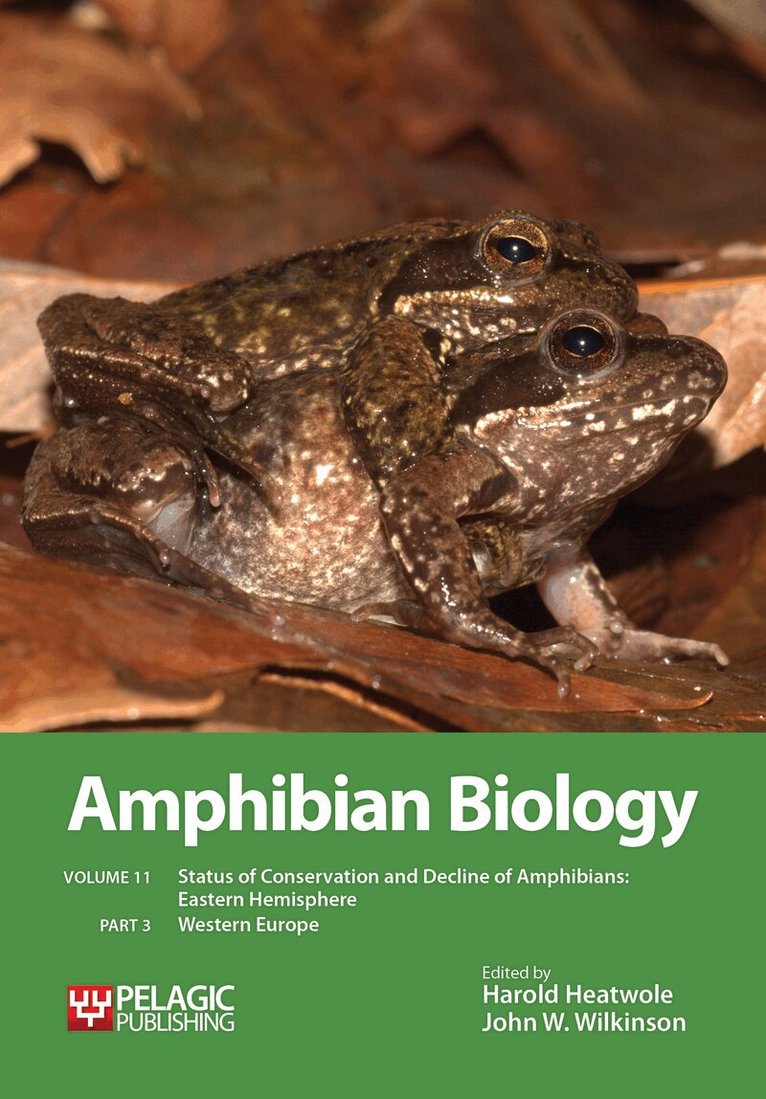
    Amphibian Biology, Volume 11, Part 3

    Status of Conservation and Decline of Amphibians: Eastern Hemisphere: Western Europe

    AvHarold Heatwole,John W. Wilkinson

    Häftad, Engelska, 2013

    Del 11 i serien Amphibian Biology

    1 430 kr

    Beställningsvara. Skickas inom 3-6 vardagar. Fri frakt över 249 kr.

    Beskrivning

    Amphibian species around the world are unusually vulnerable to a variety of threats, by no means all of which are properly understood. Volume 11 in this major series will be published in parts devoted to the causes of amphibian decline and to conservation measures in regions of the world; this Part 3 is concerned with Western Europe (Britain, Ireland, The Netherlands, Belgium, France, Spain and Portugal).Experts from each country contribute a chapter describing the ecological background and the conservation status of affected species, with an emphasis on native species. As well as infectious diseases and parasites (also covered in a general chapter), threats take the form of introduced and invasive species, pollution, destruction and alteration of habitat, and climate change. These are discussed as they affect each species. All these countries have monitoring schemes and conservation programmes, whose origins and activities are described. Recommendations for action are also made.Edited by leading scholars in the field, Volume 11, when complete, will therefore provide a definitive survey of the amphibian predicament and a stimulus to further research with the objective of arresting the global decline of an entire class of animal.

    Produktinformation

    • Utgivningsdatum:2013-07-01
    • Mått:170 x 244 x 11 mm
    • Vikt:225 g
    • Format:Häftad
    • Språk:Engelska
    • Serie:Amphibian Biology
    • Antal sidor:110
    • Förlag:Pelagic Publishing
    • ISBN:9781907807527

    Utforska kategorier

    • Groddjur och reptiler inom Naturvetenskap och teknik
    • Miljövetenskap och miljöpolitik inom Naturvetenskap och teknik
    • Reptiler och groddjur inom Djur och Natur

    Mer om författaren

    Harold Heatwole is an ecologist and herpetologist. His first PhD (University of Michigan) dealt with habitat use by amphibians, but then he branched out and studied other taxa, mostly reptiles and amphibians, but also ants, tardigrades, and seabirds. He earned a second PhD in Botany with a dissertation on the dynamics of vegetation on coral cays on the Great Barrier Reef of Australia (University of Queensland). He completed his education with a PhD in Geography (James Cook University) and a DsC (University of New England, Australia). He had faculty appointments at the University of Puerto Rico, University of New England, and currently is Professor of Biology at North Carolina State University and Adjunct Professor of Zoology at the University of New England. He is editor in Chief of the journal Integrative and Comparative Biology. He is a Fellow of the Explorers Club.John W. Wilkinson is a conservation biologist specializing in studying and monitoring amphibians and reptiles. He started working with herpetofauna whilst an undergraduate and now nobody will give him a proper job. For eight years he was International Coordinator of the Declining Amphibian Populations Task Force and is currently Science Program Manager for the charity Amphibian and Reptile Conservation. John's PhD thesis was on toad conservation - it just made him realize how much more there is to find out...

    Innehållsförteckning

    • 31 Infectious Diseases that May Threaten Europe’s Amphibians Trenton W. J. Garner, An Martel, Jon Bielby, Jaime Bosch, Lucy G. Anderson, Anna Meredith, Andrew A. Cunningham, Matthew C. Fisher, Daniel A. Henk, and Frank Pasmans 32 Conservation and Declines of Amphibians in Ireland Ferdia Marnell 33 Amphibian Declines and Conservation in Britain John W. Wilkinson and Richard A. Griffiths 34 Conservation and Declines of Amphibians in The NetherlandsAnton H. P. Stumpel 35 Amphibian Declines and Conservation in Belgium Gerald Louette and Dirk Bauwens 36 Amphibian Declines and Conservation in France Jean-Pierre Vacher and Claude Miaud 37 Conservation and Declines of Amphibians in Spain Cesar Ayres, Enrique Ayllon, Jaime Bosch, Alberto Montori, Manuel Ortiz-Santaliestra and Vicente Sancho 38 Conservation and Declines of Amphibians in Portugal Rui Rebelo, Maria José Domingues Castro, Maria João Cruz, José Miguel Oliveira, José Teixeira, and Eduardo Crespo