• Fri frakt över 249 kr
  • •
  • Snabba leveranser
  • •
  • Billiga böcker
Kundservice

Du är på sajten för privatpersoner.

Företag, bibliotek eller offentlig verksamhet?

Du handlar på classic.bokus.com, där alla dina funktioner finns intakta.
Till classic.bokus.com
Bokus logotyp. Gå till startsidan.
  • Erbjudanden
  • Nyheter
  • Student
  • Topplistor
  • Barn & ungdom
  • Bokus Play
  • E-böcker
  • Pocketböcker
  • Spel & pussel

10% rabatt på allt med kod: NYSTART10 →

Sidfot

Mina sidor

    Hjälp

    • Kundservice
    • Vanliga frågor och svar
    • Frakt och leverans
    • Retur vid ångerrätt
    • Reklamera vara
    • Betalning
    • Köpvillkor
    • Allmänna villkor
    • Information om webbplatsens tillgänglighet

    Om Bokus

    • Om oss
    • Pressrum
    • För studenter
    • För företag
    • För bibliotek och offentlig verksamhet
    • För leverantörer
    • Hållbarhet

    Populärt

    • Aktuella erbjudanden
    • Presentkort
    • Studentlitteratur
    • Nya böcker
    • Topplistor
    • Signerade böcker
    • Engelska böcker

    Inspiration

    • Boktips
    • BookTok
    • Populära bokserier
    • Barnbokskaraktärer
    • Populära författare
    Logotyp för Bokus
    Följ oss på Facebook (extern länk)Följ oss på Instagram (extern länk)Följ oss på YouTube (extern länk)Följ oss på TikTok (extern länk)
    bokus @ CookiesAnpassa cookiesIntegritetspolicyKöpvillkor
    Till Citymail hemsida (extern länk)Till Budbee hemsida (extern länk)Till Postnord hemsida (extern länk)Till Schenker hemsida (extern länk)Till Early Bird hemsida (extern länk)Till Walleys hemsida (extern länk)
    1. Samhälle och politik
    2. Samhälle och kultur
    3. Kultur och medier
    4. Referensverk och tvärvetenskap

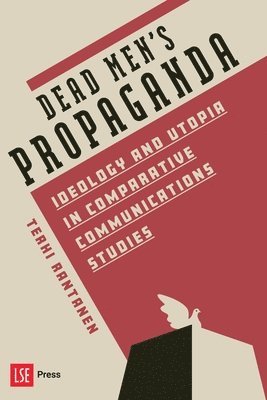
    Dead Men's Propaganda: Ideology and Utopia in Comparative Communications Studies

    AvTerhi Rantanen

    Häftad, Engelska, 2024

    330 kr

    Beställningsvara. Skickas inom 5-8 vardagar. Fri frakt över 249 kr.

    Beskrivning

    In Dead Men’s Propaganda: Ideology and Utopia in Comparative Communications Studies, Terhi Rantanen investigates the shaping of early comparative communications research between the 1920s and 1950s, notably the work of academics and men of practice in the United States. Often neglected, this intellectual thread is highly relevant to understanding the 21st-century’s challenges of war and rival streams of propaganda.Borrowing her conceptual lenses from Karl Mannheim and Robert Merton, Rantanen draws on detailed archival research and case studies to analyse the extent and importance of work outside and inside the academy, illuminating the work of pioneers in the field. Some of these were well-known academics such as Harold Lasswell and the authors of the seminal book Four Theories of the Press. Others operated in the world of news agencies, such as Associated Press's Kent Cooper, or were marginalised as émigré scholars, notably Paul Kecskemeti and Nathan Leites. Her study shows how comparative communications, from its very beginning, can be understood as governed by the Mannheimian concepts of ideology and utopia and the power play between them. The close relationship between these two concepts resulted in a bias in knowledge production, contributed to dominant narratives of generational conflicts, and to the demarcation of Insiders and Outsiders.By focusing on a generation at the forefront of comparative communications at this pivotal time in the 20th century, this book challenges orthodoxies in the intellectual histories of communication studies.

    Produktinformation

    • Utgivningsdatum:2024-01-31
    • Mått:152 x 229 x 20 mm
    • Vikt:524 g
    • Format:Häftad
    • Språk:Engelska
    • Antal sidor:362
    • Förlag:LSE Press
    • ISBN:9781911712183

    Utforska kategorier

    • Referensverk och tvärvetenskap inom Samhälle och politik
    • Sociologi inom Samhälle och politik

    Mer om författaren

    Terhi Rantanen (MSc; LicSc; DocSc; Docent, Helsinki University) is Professor in Global Media and Communications at the London School of Economics and Political Science (LSE). She is the founder of two double MSc programmes, with the University of Southern California (USC), which she has directed from 2000 to date, and with Fudan University, Shanghai, which she directed for its first three years. Since the beginning of her career, she has conducted research on globalisation and the media, and especially on news organisations but also on the history of knowledge production.

    Innehållsförteckning

    • List of figuresPreface1 Why study ideology and utopia in early comparative communications1.1 Previous research and its value1.2 Karl Mannheim a brief biography1.3 Robert K. Merton and his critique of Mannheim’s Wissenssoziologie1.4 Ideology and Utopia1.5 The concept of a generation1.6 Insiders and Outsiders1.7 Why does this matter now1.8 Plan of the book and details of sources2 Harold D. Lasswell propaganda research from the 1920s to the 1950s2.1 The academic period of progressive internationalism2.2 The policy science period of pragmatism to promote mainly US interests2.3 Conclusion3 Kent Cooper Barriers Down and The Right to Know3.1 The AP as a national and international news agency3.2 Cooper and his key concepts3.3 Cooper and his contemporaries3.4 Cooper as a liberal internationalist 1914–19253.5 Cooper as a pragmatic policymaker 1925–19343.6 Cooper as an ideologist 1942–19563.7 Conclusion4 World War II comparative communications the institutionalisation of ideology by policy scientists émigré scholars and the military 1940–19434.1 The nature of research4.2 The organisation and funding of the Wartime Communications Project4.3 Nazi terror European intellectuals run for their lives4.4 Quantitative and qualitative content analysis4.5 Conclusion5 From togetherness to separation comparative communications in the 1950s5.1 Post World Wars I and II communications compared5.2 The continuation of World War II studies5.3 Attempts to define international communication5.4 RAND Corporation and the work of émigré scholars after the war5.5 What were the main features of new international communication studies in the 1950s5.6 Conclusion6 Ideological utopias Fred S. Siebert Theodore Peterson and Wilbur Schramm and their Four Theories of the Press6.1 The key characters authors and colleagues at the University of Illinois6.2 New intellectual ideas the inspirations for Four Theories6.3 Generational conflicts over Four Theories6.4 Conclusion7 Conclusion can the circle be broken7.1 Ideology and utopia7.2 The concept of a generation7.3 Insiders and Outsiders7.4 Merton’s four criteria for evaluating comparative communications plus one new one7.5 Why does this all matterAcknowledgementsAbout the authorArchival sources and bibliographyIndex