• Fri frakt över 249 kr
  • •
  • Snabba leveranser
  • •
  • Billiga böcker
Kundservice

Du är på sajten för privatpersoner.

Företag, bibliotek eller offentlig verksamhet?

Du handlar på classic.bokus.com, där alla dina funktioner finns intakta.
Till classic.bokus.com
Bokus logotyp. Gå till startsidan.
  • Erbjudanden
  • Nyheter
  • Student
  • Topplistor
  • Barn & ungdom
  • Bokus Play
  • E-böcker
  • Pocketböcker
  • Spel & pussel

10% rabatt på allt med kod NYSTART10 →

Sidfot

Mina sidor

    Hjälp

    • Kundservice
    • Vanliga frågor och svar
    • Frakt och leverans
    • Retur vid ångerrätt
    • Reklamera vara
    • Betalning
    • Köpvillkor
    • Allmänna villkor
    • Information om webbplatsens tillgänglighet

    Om Bokus

    • Om oss
    • Pressrum
    • För studenter
    • För företag
    • För bibliotek och offentlig verksamhet
    • För leverantörer
    • Hållbarhet

    Populärt

    • Aktuella erbjudanden
    • Presentkort
    • Studentlitteratur
    • Nya böcker
    • Topplistor
    • Signerade böcker
    • Engelska böcker

    Inspiration

    • Boktips
    • BookTok
    • Populära bokserier
    • Barnbokskaraktärer
    • Populära författare
    Logotyp för Bokus
    Följ oss på Facebook (extern länk)Följ oss på Instagram (extern länk)Följ oss på YouTube (extern länk)Följ oss på TikTok (extern länk)
    bokus @ CookiesAnpassa cookiesIntegritetspolicyKöpvillkor
    Till Citymail hemsida (extern länk)Till Budbee hemsida (extern länk)Till Postnord hemsida (extern länk)Till Schenker hemsida (extern länk)Till Early Bird hemsida (extern länk)Till Walleys hemsida (extern länk)
    1. Ekonomi och Ledarskap
    2. Nationalekonomi
    3. Mikroekonomi

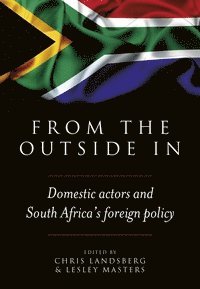
    From the outside in

    Domestic actors and South Africa’s foreign policy

    AvChris Landsberg,Lesley Masters

    Häftad, Engelska, 2017

    244 kr

    Beställningsvara. Skickas inom 11-20 vardagar. Fri frakt över 249 kr.

    Beskrivning

    What is South Africa’s foreign policy, who makes it and why does it matter? These are the varied questions that scholarship has grappled with following South Africa’s triumphant return to the global stage in 1994. In this edited volume, the authors assess the position and input of actors beyond the traditional structures of the Presidency and the department of international relations and cooperation, most notably civil society actors in foreign policy decision-making. In an environment where domestic actors are argued to be found increasingly on the outside of policy decision-making circles, this book brings back into the fold the discussion of the value of participation.In looking at foreign policy through the different standpoints of other government departments, parliament, labour, business, the African National Congress (ANC), civil society and the role of gender, the chapters offer insights into how South Africa’s foreign policy is understood and how these actors seek an input in its direction. It is this engagement that ultimately makes foreign policy matter to all South Africans as the country moves forward in a turbid international environment.

    Produktinformation

    • Utgivningsdatum:2017-11-17
    • Mått:146 x 210 x 15 mm
    • Vikt:500 g
    • Format:Häftad
    • Språk:Engelska
    • Antal sidor:224
    • Förlag:Jacana Media (Pty) Ltd
    • ISBN:9781928232421

    Utforska kategorier

    • Mikroekonomi inom Ekonomi och Ledarskap
    • Internationell ekonomi inom Ekonomi och Ledarskap
    • Internationella relationer inom Samhälle och politik

    Mer om författaren

    Professor Chris Landsberg holds the SARChI Chair of African Diplomacy and Foreign Policy at the University of Johannesburg (UJ), and is a senior associate at the UJ School of Leadership. He is the former head of the department of politics and international relations at UJ. Prof Landsberg was educated at the Rand Afrikaans University (now University of Johannesburg); Rhodes; and Oxford, and holds an MPhil and DPhil international relations degrees (Oxon). He was as a Rhodes Scholar at Oxford, and is a former Hamburg Fellow at Stanford University, United States (US). Previously he was director of the Centre for Policy Studies (CPS) in Johannesburg, and co-founder and former co-director of the Centre for Africa’s International Relations at the University of the Witwatersrand in South Africa. Dr Lesley Masters is a senior researcher and lecturer at the NRF Chair of African Diplomacy and Foreign Policy at UJ. Prior to this she was a senior researcher at the Institute for Global Dialogue (IGD), responsible for managing projects on foreign policy and diplomacy. She holds a PhD in international relations from the University of Leicester. She has edited books on South African foreign policy and natural resource governance, and served as joint guest editor of a special issue of the Journal for Contemporary History on African Diplomacy, and a special issue of the South African Journal of International Affairs.

    Innehållsförteckning

    • Contents; Introduction; Bringing plurality back in from the cold: Domestic actors and South Africa’s foreign policy; Chapter 1. Government departments and the challenges of integrated foreign policy-making; Chapter 2. Subnational governments and the localisation of foreign policy in South Africa; Chapter 3. Between Plein Street and Soutpansberg Road: Parliament and foreign policy during the Zuma presidency; Chapter 4. The ANC worldview and implications for South African foreign policy: Review of the 2015 foreign policy discussion document; Chapter 5. Labour Unions and South Africa’s foreign policy: The case of COSATU; Chapter 6. Big business and foreign policy: Cog or driver of South Africa’s international relations machinery?; Chapter 7. Women, gender and South Africa’s foreign policy: The need for an inclusive approach to foreign policy decision-making; Chapter 8. The elitist love-hate affair: Civil society and South African foreign policy (dis)engagement Voice from the periphery: Grassroots social movements and South Africa’s foreign policy Insights and perspectives on South Africa’s foreign policy from the Unemployed People’s Movement, Grahamstown; Conclusion; Bringing civil society back in