• Fri frakt över 249 kr
  • •
  • Snabba leveranser
  • •
  • Billiga böcker
Kundservice

Du är på sajten för privatpersoner.

Företag, bibliotek eller offentlig verksamhet?

Du handlar på classic.bokus.com, där alla dina funktioner finns intakta.
Till classic.bokus.com
Bokus logotyp. Gå till startsidan.
  • Erbjudanden
  • Nyheter
  • Student
  • Topplistor
  • Barn & ungdom
  • Bokus Play
  • E-böcker
  • Pocketböcker
  • Spel & pussel

10% rabatt på allt med kod: NYSTART10 →

Sidfot

Mina sidor

    Hjälp

    • Kundservice
    • Vanliga frågor och svar
    • Frakt och leverans
    • Retur vid ångerrätt
    • Reklamera vara
    • Betalning
    • Köpvillkor
    • Allmänna villkor
    • Information om webbplatsens tillgänglighet

    Om Bokus

    • Om oss
    • Pressrum
    • För studenter
    • För företag
    • För bibliotek och offentlig verksamhet
    • För leverantörer
    • Hållbarhet

    Populärt

    • Aktuella erbjudanden
    • Presentkort
    • Studentlitteratur
    • Nya böcker
    • Topplistor
    • Signerade böcker
    • Engelska böcker

    Inspiration

    • Boktips
    • BookTok
    • Populära bokserier
    • Barnbokskaraktärer
    • Populära författare
    Logotyp för Bokus
    Följ oss på Facebook (extern länk)Följ oss på Instagram (extern länk)Följ oss på YouTube (extern länk)Följ oss på TikTok (extern länk)
    bokus @ CookiesAnpassa cookiesIntegritetspolicyKöpvillkor
    Till Citymail hemsida (extern länk)Till Budbee hemsida (extern länk)Till Postnord hemsida (extern länk)Till Schenker hemsida (extern länk)Till Early Bird hemsida (extern länk)Till Walleys hemsida (extern länk)
    1. Psykologi och pedagogik
    2. Pedagogik
    3. Pedagogisk psykologi

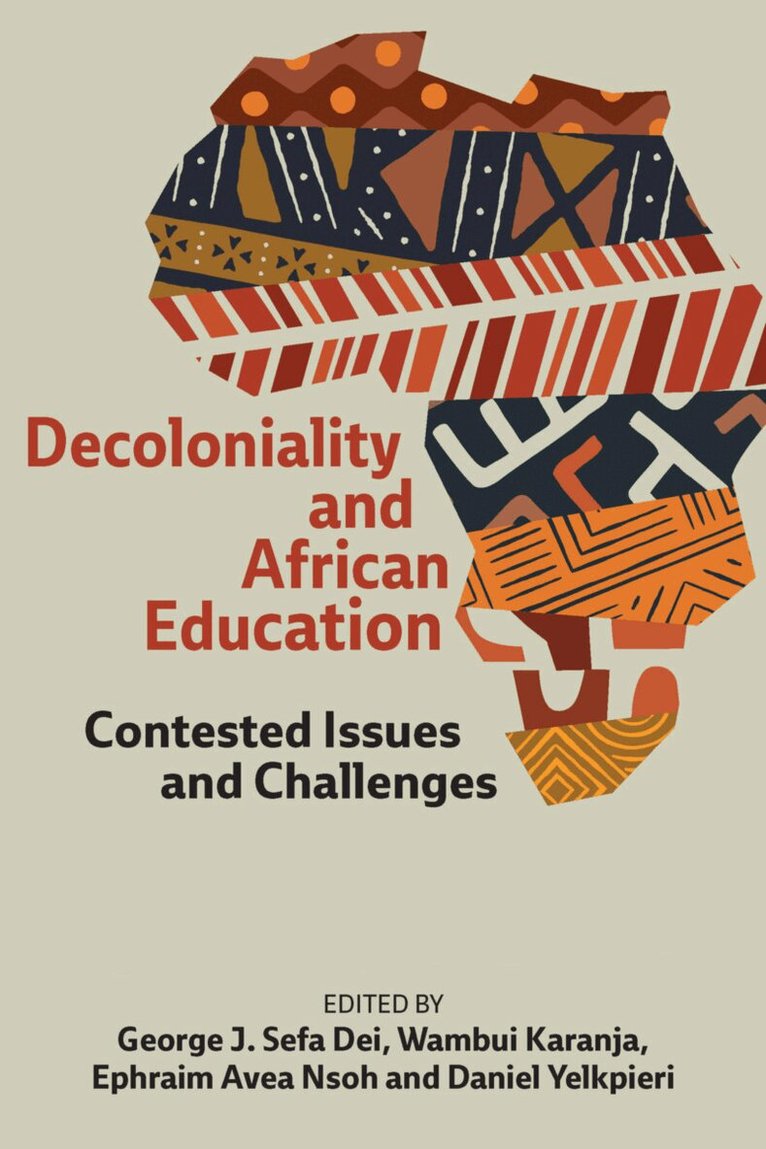
    Decoloniality and African Education

    Contested Issues and Challenges

    AvGeorge J. Sefa Dei,Wambui Karanja

    Häftad, Engelska, 2026

    526 kr

    Beställningsvara. Skickas inom 5-8 vardagar. Fri frakt över 249 kr.

    Beskrivning

    Decoloniality and African Education: Contested Issues and Challenges is a vibrant and vital collection of essays that addresses the challenges, possibilities, and responsibilities for the future of de- and anti-colonial African education. Decolonization has become a buzz word of late, so the term is used in this context with a certain trepidation. But the themes of this book go beyond mere rhetoric by creating specific approaches to dismantling colonial educational systems in African and to create a new environment for African education duly informed by local cultural resource knowing, known from grounded everyday practices of authentic African educators. In other words, a revision of educational practices informed by what educators know and are doing for the lessons in envisioning schooling and education in Africa. In this endeavor, while we seek lessons and partnerships with others, African educators are urged to think through solutions specific to the problems and challenges in schools today, and meet the call of our times to provide education to young learners that not only empowers them, but also provides them with background knowledge, cultural grounding, and specific lessons that will enable them to craft their own futures. So how do we “do” decolonial education from the standpoint of African educators and learners everyday schooling practice and knowledge? Decoloniality and African Education argues that a careful embrace of African Indigenous and cultural knowings determine the successful response to this question. It engages both the “decolonial” and the “anti-colonial,” with a reading that the “decolonial” (as many have pointed out, see Parry, 1994) is a process and a path toward an end, which is the goal of the “anti-colonial” (see Dei, 2022).Decoloniality and African Education is essential reading for students and scholars committed to the improvement of educational outcomes for African American students. It’s a book that empowers educators and raises awareness about African-based teaching environments. It can be used in a variety of courses, including African Studies, African Development, Anti-Colonial Thought and Indigenous Knowledge, and the Pedagogical Implications of Decolonization.

    Produktinformation

    • Utgivningsdatum:2026-05-05
    • Mått:178 x 254 x 11 mm
    • Vikt:349 g
    • Format:Häftad
    • Språk:Engelska
    • Antal sidor:240
    • Förlag:Myers Education Press
    • ISBN:9781975508807

    Utforska kategorier

    • Pedagogisk psykologi inom Psykologi och pedagogik
    • Skolväsen och utbildningssystem inom Psykologi och pedagogik
    • Referensverk och tvärvetenskap inom Samhälle och politik

    Mer om författaren

    Ghanaian-born George Sefa Dei is a renowned educator, researcher and writer who is considered by many as one of Canada's foremost scholars on race, anti-racism studies, Black and minority education, African Indigeneity and anti-colonial thought. Professor Dei has forty-seven (47) books, over eighty (80) refereed journal articles, as well as 78 chapters in books to his credit. Finally, in June of 2007, Professor Dei was installed as a traditional chief in Ghana, specifically, as the Gyaasehene of the town of Asokore, Koforidua in the New Juaben Traditional Area of Ghana. His stool name is Nana Adusei Sefa Tweneboah.Wambui Karanja is a PhD ABD Candidate in the Depart of Social Justice Education at the Ontario Institute for Studies in Education, University of Toronto (OISE/UT). Her research interests lie in the fields of de/anti-colonial theorizing, Indigenous philosophies, research methodologies, gender, law and development theories.Ephraim Avea Nsoh is a Ghanaian politician and was the Upper East Regional Minister of Ghana. Prior to heading the Upper East Region, Ephraim Avea Nsoh was Upper West Regional Minister. He was appointed as principal of the College of Languages Education, University of Education. The appointment was a four-year contract which took effect from October 1, 2016.Daniel Yelkpieri is a Senior Fellow at the Centre for Educational Policy Studies at the Institute for Educational Research and Innovative Studies (IERIS) in the University of Education, Winneba. He holds a Doctorate in Social Sciences (DSocSci) from the University of Leicester in the UK. He also has an M.Phil in Educational Administration, B.Ed (Psychology) and a Diploma in History from the University of Cape Coast and a Post-graduate Diploma in Teaching and Learning in Higher Education (PGDTLHE) from the University of Education, Winneba. He was the Head of the Department of the Centre for School and Community Science and Technology Studies (SACOST). He was also the acting Director for IERIS for a period of ten months. Currently, he is the Deputy Director of the IERIS.

    Recensioner i media

    "Decoloniality and African Education is a timely work that contextually recasts contemporary debates on African education and decolonization. While there have been few somewhat scattered foci on the area, this volume illuminates new epistemically and instructionally elevated possibilities that connectively highlight the critical location, inter alia, of futuristic and localized African education reformulations. It thus, selectively achieves redemptive pedagogical and cultural reconstructions that are African in origin and objectives. It will surely benefit students, specialized scholars and policy makers in Africa and beyond." - Professor Ali Abdi, University of British Columbia"Unapologetically African centred scholarly work. I have said elsewhere that the time has come for those who want to carry the badge 'an African/Black Scholar' must demonstrate through words and actions how their scholarships show indebtedness to the Land, African Ancestors, Elders and the community. This is exactly the book has done. The book addresses critical questions about African education in the 21st century. Though the authors approach these questions with empathetic lens, they do not shy away debilitating problems facing African education. The book leaves readers with hope that the continent and its people can resuscitate itself from any terminal collapse. The book cautions that addressing African educational problems cannot be business as usual. Things should be done differently. As a proud son of the Continent, I am most grateful to the authors for giving readers something different and unique about African education. This is a must-have and a must-read book. Personally, I can't wait to have my copy." - Professor Paul Banahene Adjei, Memorial University of Newfoundland

    Innehållsförteckning

    • Acknowledgements 1. Introduction — George J. Sefa Dei, Wambui Karanja, Ephraim Avea Nsoh, and Daniel Yelkpieri 2. Localizing Educational Administration and Management in Ghana—The Way Forward — Peter Kwegyir-Aggrey 3. Shaping African Educational Futurities through African Girl-Child and Women Education: The Case Study of Eddah Gachukia's Work at The Forum for African Women Educationalists — Peter Otiato Ojiambo 4. Towards Decolonizing Language Education in Ghana: The Ecological Turn — David Dankwa-Apawu and Victoria Ofori 5. Towards a Decolonial Future: Ghanaian Teachers' Collective Visions for STEM Education — Kenneth Gyamerah 6. Anti-Black Gender-Based Violence (aBGBV) as a Decolonial Framework and Black Feminist Intervention — Temitope Adefarakan 7. Training Teachers Differently: Decolonizing Ghana's Teacher Education Program — Isaac Nortey Darko and Chloe Weir 8. To Decolonize or Not to Decolonize? Locking in Lessons From the COVID-19 Pandemic for Enhanced Education Systems in Africa — Felix Kwabena Donkor 9. A Brief Conclusion: Towards a New Beginning — George J. Sefa Dei, Wambui Karanja, Ephraim Avea Nsoh, and Daniel Yelkpieri Editors and Contributors Index