• Fri frakt över 249 kr
  • •
  • Snabba leveranser
  • •
  • Billiga böcker
Kundservice

Du är på sajten för privatpersoner.

Företag, bibliotek eller offentlig verksamhet?

Du handlar på classic.bokus.com, där alla dina funktioner finns intakta.
Till classic.bokus.com
Bokus logotyp. Gå till startsidan.
  • Erbjudanden
  • Nyheter
  • Student
  • Topplistor
  • Barn & ungdom
  • Bokus Play
  • E-böcker
  • Pocketböcker
  • Spel & pussel

10% rabatt på allt med kod NYSTART10 →

Sidfot

Mina sidor

    Hjälp

    • Kundservice
    • Vanliga frågor och svar
    • Frakt och leverans
    • Retur vid ångerrätt
    • Reklamera vara
    • Betalning
    • Köpvillkor
    • Allmänna villkor
    • Information om webbplatsens tillgänglighet

    Om Bokus

    • Om oss
    • Pressrum
    • För studenter
    • För företag
    • För bibliotek och offentlig verksamhet
    • För leverantörer
    • Hållbarhet

    Populärt

    • Aktuella erbjudanden
    • Presentkort
    • Studentlitteratur
    • Nya böcker
    • Topplistor
    • Signerade böcker
    • Engelska böcker

    Inspiration

    • Boktips
    • BookTok
    • Populära bokserier
    • Barnbokskaraktärer
    • Populära författare
    Logotyp för Bokus
    Följ oss på Facebook (extern länk)Följ oss på Instagram (extern länk)Följ oss på YouTube (extern länk)Följ oss på TikTok (extern länk)
    bokus @ CookiesAnpassa cookiesIntegritetspolicyKöpvillkor
    Till Citymail hemsida (extern länk)Till Budbee hemsida (extern länk)Till Postnord hemsida (extern länk)Till Schenker hemsida (extern länk)Till Early Bird hemsida (extern länk)Till Walleys hemsida (extern länk)
    1. Samhälle och politik
    2. Samhälle och kultur
    3. Kultur och medier
    4. Referensverk och tvärvetenskap

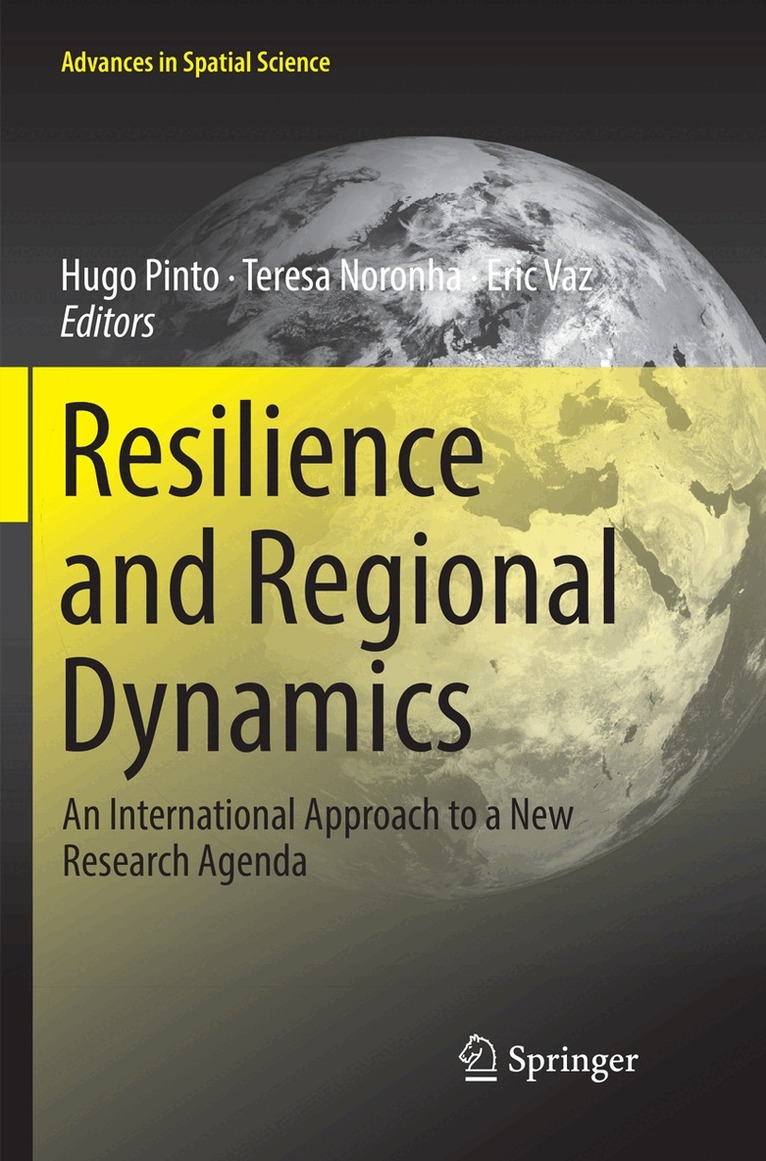
    Resilience and Regional Dynamics

    An International Approach to a New Research Agenda

    AvHugo Pinto,Teresa Noronha

    Häftad, Engelska, 2019

    Del i serien Advances in Spatial Science

    1 625 kr

    Beställningsvara. Skickas inom 10-15 vardagar. Fri frakt över 249 kr.

    Beskrivning

    Economic and financial crises have brought the rise of unemployment, reduction of economic growth and emergence of global imbalances and tensions as countries and regions have suffered the effects of a variety of internal and external shocks. In this context of constant disruption, the scientific community has struggled to provide satisfactory answers to current economic challenges within standard frameworks. Focusing on the interconnections between innovation and resilience, this edited book contributes to a better understanding of how the crisis affects innovation and the capacity of territories to adapt and evolve. It offers both theoretical and empirical contributions that debate the notions of resilience in regional and urban contexts and serve as case studies related to innovation strategies and territorial clusters.

    Produktinformation

    • Utgivningsdatum:2019-01-03
    • Mått:155 x 235 x 15 mm
    • Vikt:406 g
    • Format:Häftad
    • Språk:Engelska
    • Serie:Advances in Spatial Science
    • Antal sidor:255
    • Förlag:Springer Nature Switzerland AG
    • ISBN:9783030069810

    Utforska kategorier

    • Referensverk och tvärvetenskap inom Samhälle och politik
    • Ekonomisk politik inom Ekonomi och Ledarskap
    • Geografi inom Naturvetenskap och teknik

    Mer om författaren

    Hugo Pinto is a Permanent Researcher at the Centre for Social Studies, University of Coimbra (Portugal).  He is invited Professor at the Faculty of Economics - University of Algarve and an associate member of the Research Centre for Spatial and Organizational Dynamics. His research interests regard regional innovation, S&T policy, knowledge production and transfer, and blue growth. He is also interested in the discussion of Economics as a science. He has participated in the development and evaluation of several RIS3 - smart specialization strategies in peripheral territories. Recent research was published in Regional Studies, European Planning Studies, Industry & Innovation, Technological Forecasting & Social Change or Marine Policy.Teresa Noronha is Full Professor of Economics of Innovation and Regional Development at the University of Algarve (Portugal) and director of the Ph.D. program in Innovation and Land Use Management. Also, she is Presidentof the Consulting Commission of the Research Centre for Spatial and Organizational Dynamics, after having been President for the past years of that same organization. In the last two decades, she was invited professor at the University of Paris I - Sorbonne, University of Gent, University of Bologna and the University of Toronto. She is an expert in regional economics and related public policies, in particular, the use of instruments to implement innovation in lagging areas. Among her most significant works, there is the three-book series: “The New European Rurality”, “Traditional Food Production and Rural Sustainable Development”, and “Towns in a Rural World”, published by Ashgate.Eric Vaz is tenured Associate Professor for Geographical Analysis at Ryerson University, Department of Geography and Environmental Studies and Director for the Laboratory for Geocomputation, Toronto, Canada. He has published over seventy scientific contributions in the field of regional science, Geographic Information Systems and Science, and spatial analysis. In 2015, he was distinguished with the Dean's SRC Award. Between 2015 and 2018, Professor Vaz held the position of Vice-President of the Research Centre for Spatial and Organizational Dynamics (CIEO). He was in that time frame also Associate Editor of Elsevier’s Habitat International, where he presently serves as a member of the editorial board. Professor Vaz focuses on using spatial analysis methods, and complex system modeling approaches as well as Geographic Information Systems and Science to understand regional dynamics and integrate a better understanding of policy within the Anthropocene.

    Innehållsförteckning

    • Introduction.- Part I: Theoretical Foundations.- Part II: the Multilevel Aspects of Resilience.- Part III: Towards Strategies for Resilience.- Part IV: Resilience and Innovation.- Conclusion