• Fri frakt över 249 kr
  • •
  • Snabba leveranser
  • •
  • Billiga böcker
Kundservice

Du är på sajten för privatpersoner.

Företag, bibliotek eller offentlig verksamhet?

Du handlar på classic.bokus.com, där alla dina funktioner finns intakta.
Till classic.bokus.com
Bokus logotyp. Gå till startsidan.
  • Erbjudanden
  • Nyheter
  • Student
  • Topplistor
  • Barn & ungdom
  • Bokus Play
  • E-böcker
  • Pocketböcker
  • Spel & pussel

10% rabatt på allt med kod: NYSTART10 →

Sidfot

Mina sidor

    Hjälp

    • Kundservice
    • Vanliga frågor och svar
    • Frakt och leverans
    • Retur vid ångerrätt
    • Reklamera vara
    • Betalning
    • Köpvillkor
    • Allmänna villkor
    • Information om webbplatsens tillgänglighet

    Om Bokus

    • Om oss
    • Pressrum
    • För studenter
    • För företag
    • För bibliotek och offentlig verksamhet
    • För leverantörer
    • Hållbarhet

    Populärt

    • Aktuella erbjudanden
    • Presentkort
    • Studentlitteratur
    • Nya böcker
    • Topplistor
    • Signerade böcker
    • Engelska böcker

    Inspiration

    • Boktips
    • BookTok
    • Populära bokserier
    • Barnbokskaraktärer
    • Populära författare
    Logotyp för Bokus
    Följ oss på Facebook (extern länk)Följ oss på Instagram (extern länk)Följ oss på YouTube (extern länk)Följ oss på TikTok (extern länk)
    bokus @ CookiesAnpassa cookiesIntegritetspolicyKöpvillkor
    Till Citymail hemsida (extern länk)Till Budbee hemsida (extern länk)Till Postnord hemsida (extern länk)Till Schenker hemsida (extern länk)Till Early Bird hemsida (extern länk)Till Walleys hemsida (extern länk)
    1. Naturvetenskap och teknik
    2. Matematik och naturvetenskap
    3. Matematik
    4. Matematikens grunder

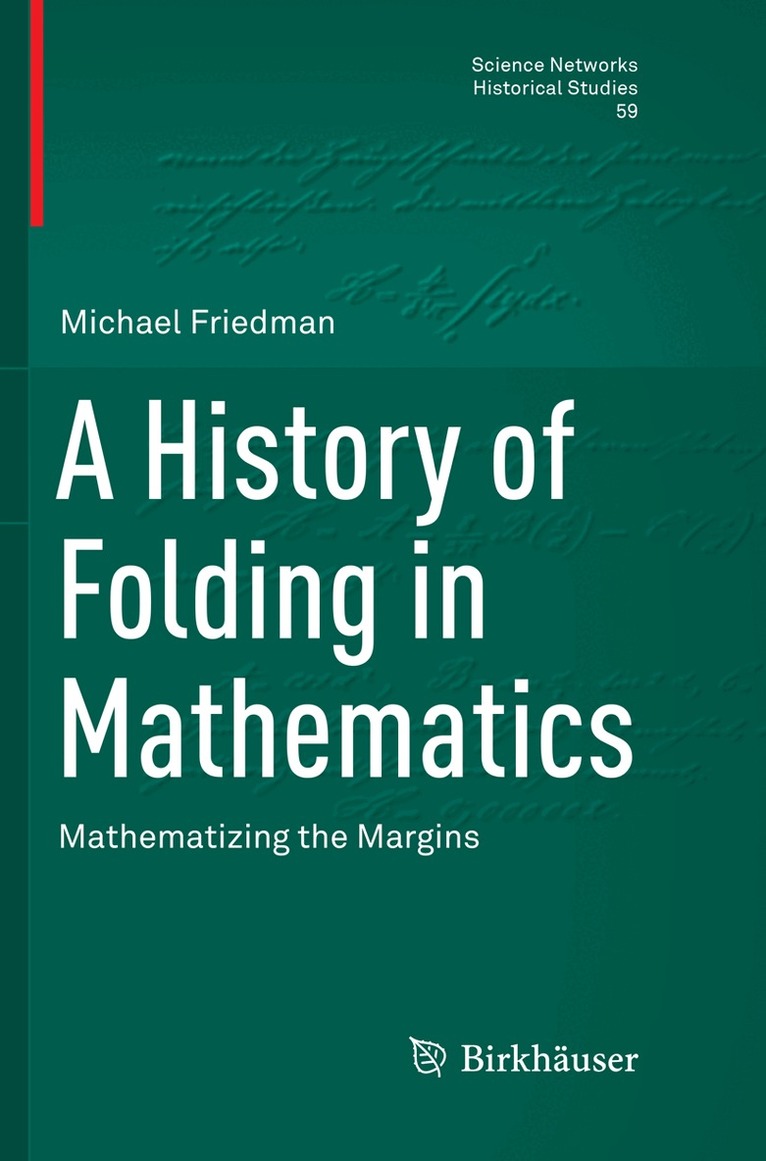
    History of Folding in Mathematics

    Mathematizing the Margins

    AvMichael Friedman

    Häftad, Engelska, 2019

    Del 59 i serien Science Networks. Historical Studies

    2 381 kr

    Beställningsvara. Skickas inom 10-15 vardagar. Fri frakt över 249 kr.

    Fler format och utgåvor

    Inbunden

    2 381 kr

    E-bok

    3 148 kr

    Beskrivning

    While it is well known that the Delian problems are impossible to solve with a straightedge and compass – for example, it is impossible to construct a segment whose length is cube root of 2 with these instruments – the discovery of the Italian mathematician Margherita Beloch Piazzolla in 1934 that one can in fact construct a segment of length cube root of 2 with a single paper fold was completely ignored (till the end of the 1980s). This comes as no surprise, since with few exceptions paper folding was seldom considered as a mathematical practice, let alone as a mathematical procedure of inference or proof that could prompt novel mathematical discoveries. A few questions immediately arise: Why did paper folding become a non-instrument? What caused the marginalisation of this technique? And how was the mathematical knowledge, which was nevertheless transmitted and prompted by paper folding, later treated and conceptualised?Aiming to answer these questions, this volume provides, for the first time, an extensive historical study on the history of folding in mathematics, spanning from the 16th century to the 20th century, and offers a general study on the ways mathematical knowledge is marginalised, disappears, is ignored or becomes obsolete.In doing so, it makes a valuable contribution to the field of history and philosophy of science, particularly the history and philosophy of mathematics and is highly recommended for anyone interested in these topics.

    Produktinformation

    • Utgivningsdatum:2019-01-15
    • Mått:155 x 235 x 24 mm
    • Vikt:657 g
    • Format:Häftad
    • Språk:Engelska
    • Serie:Science Networks. Historical Studies
    • Antal sidor:419
    • Förlag:Springer Nature Switzerland AG
    • ISBN:9783030102098

    Utforska kategorier

    • Matematikens grunder inom Naturvetenskap och teknik
    • Matematik inom Naturvetenskap och teknik
    • Matematikens historia inom Naturvetenskap och teknik

    Recensioner i media

    “Friedman’s new book is the first modern scholarly account of the history of mathematical paper folding. … His insights and detailed scholarship make this an invaluable source book for anyone interested in the history of mathematics. … Summing Up: Recommended. Upper-division undergraduates and above.” (R. L. Pour, Choice, Vol. 56 (05), January, 2019)“The work offers a wealth of mathematical and historical information on a wide selection of topics that involve folding. … the author provides general readers, as well as historians and mathematicians, with a fascinating, well-researched, richly illustrated, well-referenced, and valuable resource on the history of paper folding and its mathematical aspects.” (James J. Tattersall, Mathematical Reviews, January, 2019)

    Innehållsförteckning

    • Introduction.- From the 16th Century Onwards: Folding Polyhedra. New Epistemological Horizons?.- Prolog to the 19th Century: Accepting Folding as a Method of Inference.- The 19th Century – What Can and Cannot be (Re)presented: On Models and Kindergartens.- Towards the Axiomatization, Operationalization and Algebraization of the Fold.- The Axiomatization(s) of the Fold.- Appendix I: Margherita Beloch Piazzolla: “Alcune applicazioni del metodo del ripiegamento della carta di Sundara Row”.- Appendix II: Deleuze, Leibniz and the Unmathematical Fold.- Bibliography.- List of Figures.